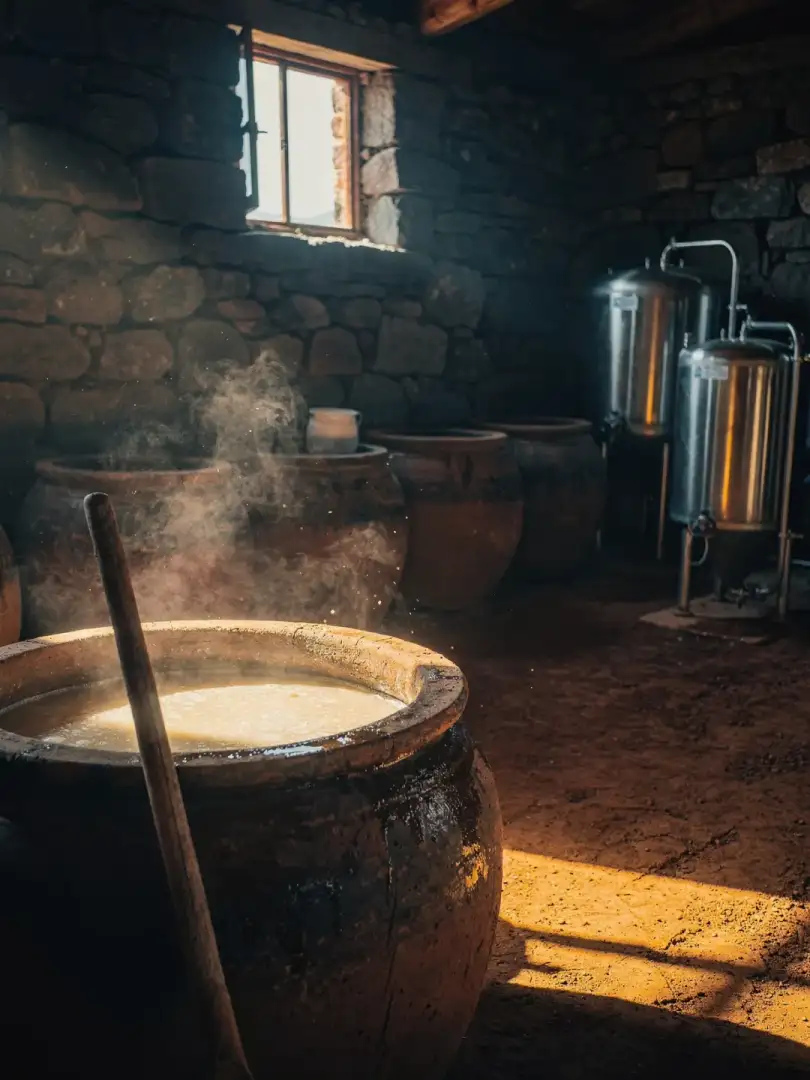
Jug and Tank
Yeast & Fermentation
How does chicha de jora ferment? Usually without any added cultured yeast, since fermentation begins on its own. Wild yeasts and lactic acid bacteria live in the kitchen and the jug, converting the sugar of the cooked jora into alcohol and acid. This is called spontaneous fermentation, as with Belgian lambic. Chicha is thus a relative of sour beers, even though its grain is entirely different.
Traditionally it ferments in large clay vessels, often belonging to individual families. The liquid sits for a few days, working slowly. What emerges during fermentation depends on the room temperature, the vessel, and the microbes already living in it. As a result, alcohol content varies widely from jug to jug and can't be read off any standard.
The brewery works quite differently. A Cusqueña ferments like any lager, bottom-fermenting, with a yeast that works calmly at cool temperatures around ten degrees Celsius. The beer then lagers cold for several weeks so it turns clear and mild. This method comes from Bavaria and Bohemia and arrived in Cusco with Günther & Tidow.
The craft brewers in the Sacred Valley take different paths. The Cervecería del Valle Sagrado says it brews, among others, IPA, pale ale, and a beer they call "Chicha Pilsen." Here two worlds mix: yeast and hops from Europe, ingredients and names from the Andes. One rule applies to all: fermentation at altitude demands patience and precise measurement.