Stange and Seidel
Tasting
What does Eastern Swiss beer taste like? Mostly pale, fresh, and soft. Pour a Quöllfrisch from Locher, and you'll see a slightly hazy golden yellow. The aroma shows bread crust and hay; on the palate it's rather mild, turning briefly bitter toward the finish. Foam and carbonation are moderate, keeping it from feeling heavy.
For comparison, there's the Schützengarten Lager, which is clear and golden in color. Here too the bitterness is restrained, with a fine, clean malt note up front. Locher's Naturperle, the organic Helles, is similarly light but is described as a bit more floral and softer. This is subjective and varies slightly from batch to batch.
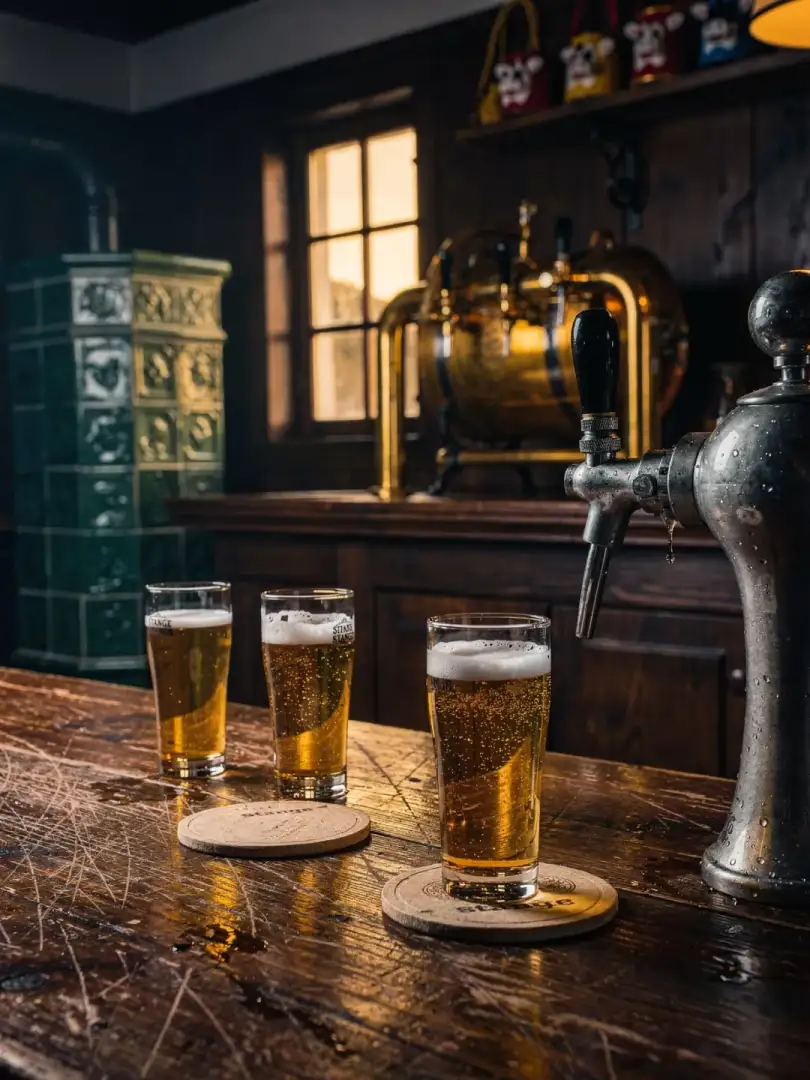
The typical glass is the Stange, a slim, cylindrical glass that in Switzerland is the name for a small beer. The size isn't legally fixed: a Stange can hold 0.25, 0.3, or 0.33 liters, as long as the server states the amount. There's also the large beer, the half-liter, often served as a mug or stein.
It's served chilled, at around 6 to 8 degrees Celsius. Too cold, and you barely taste anything; too warm, and the beer feels flat and heavy. When pouring, you tilt the glass, let the beer run down the side, then straighten it so the foam sets firmly. The glass should be clean and free of detergent residue, otherwise the head will collapse. When pouring a naturally cloudy beer from the bottle, you can either carefully swirl in the yeast settled at the bottom or deliberately leave it behind, depending on whether you prefer it rounder or clearer.