What's Actually Proven
Is Non-Alcoholic Beer Isotonic? Non-Alcoholic Beer and Sport
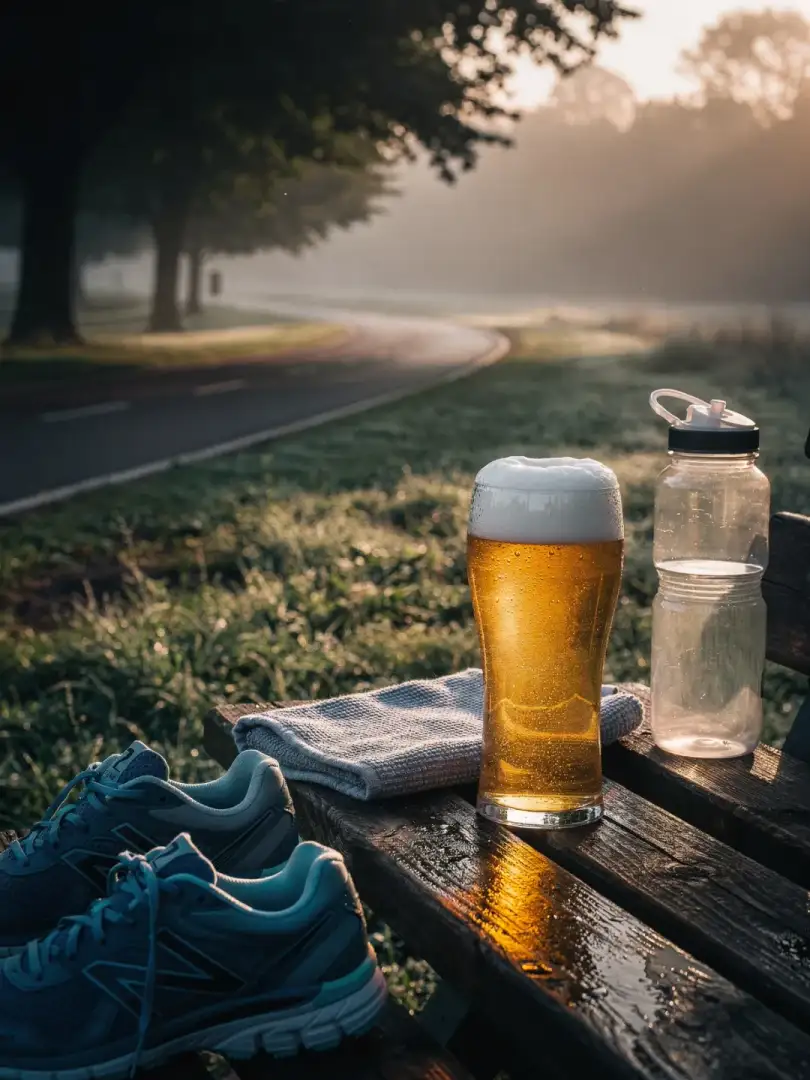
According to some manufacturers, certain non-alcoholic beers are isotonic, meaning they contain roughly the same amount of dissolved particles as blood. That's a manufacturer's claim, not a feature of every non-alcoholic beer. What isotonic actually means, what a Munich marathon study found, and where its limits lie.
Isotonic: What Does It Mean for Drinks?
Our blood contains dissolved particles such as salts, sugar and protein. Experts call their concentration osmolality. A drink is called isotonic if it has roughly the same particle density as blood, hypotonic if it has less, and hypertonic if it has more. Isotonic and slightly hypotonic drinks pass quickly from the gut into the bloodstream, which is why they're popular with endurance athletes. The commonly used range for isotonic is roughly 270 to 330 milliosmoles per kilogram.
Non-alcoholic beer brings water, carbohydrates from the malt, and some potassium and magnesium. Depending on the recipe, it can fall within the isotonic range. Sodium, the salt lost most through sweating, is only present in beer in small amounts. When a manufacturer markets its beer as isotonic, that's a claim about that one specific product. Another non-alcoholic beer can be composed quite differently.
The Be-MaGIC Study: Non-Alcoholic Wheat Beer at the Marathon
The best-known study comes from sports physicians at the Technical University of Munich, led by Johannes Scherr. They followed 277 healthy runners around the 2009 Munich Marathon. Randomly assigned, the men drank 1 to 1.5 liters of non-alcoholic wheat beer or a placebo drink daily for three weeks before and two weeks after the race. Neither the runners nor the researchers knew who received which drink. The results were published in 2012 in the journal Medicine & Science in Sports & Exercise.
In the beer group, inflammation markers rose less sharply after the run, and white blood cell counts were about 20 percent lower. Upper respiratory tract infections occurred 3.25 times less often in the two weeks after the race than in the placebo group. The researchers suspected plant compounds from malt and hops, so-called polyphenols, as the cause. An important point for context: the study was supported by the Erdinger brewery, whose non-alcoholic wheat beer was tested. Only men were studied, and it is a single study.
What Non-Alcoholic Beer Can and Can't Do After Sport
Soberly considered, non-alcoholic beer after training is a drink that provides fluid and carbohydrates, along with calories you should factor in. It's not a cure-all or a performance enhancer. Health claims are strictly regulated in the EU: under the Health Claims Regulation, every health-related claim needs recognized scientific evidence. A court accordingly banned a private brewery from advertising its non-alcoholic beer as "revitalizing."
In practice: anyone who enjoys a non-alcoholic beer after exercise can include it as one of several drinks. A lot of carbonation at once can upset some stomachs, and water remains the foundation. During very long efforts with heavy sweating, beer is particularly lacking in sodium.
Calories are also worth a glance. Alcohol provides around 7 kilocalories per gram, carbohydrates around 4. A non-alcoholic beer therefore usually has noticeably fewer calories than a regular one. With beers made via arrested fermentation, however, the residual sugar narrows that gap. The exact figures are on the nutrition label. It also remains open whether other non-alcoholic beers, or other drinks rich in polyphenols, have effects similar to those found in the Munich study. That wasn't examined.
And Regular Beer After Sport?
Here, the professional bodies are clear. The German Nutrition Society (DGE) revised its position on alcohol in 2024: there is no amount considered health-safe, and even small amounts can increase the risk of various illnesses. For recovery after sport, alcohol brings no benefit. This also explains why non-alcoholic beer is a topic in sport at all.