Storing Beer Properly
Storing Beer: Light, Heat, and Shelf Life
Beer should be stored in the dark, kept cool, and kept upright. Light produces an unpleasant odor within a short time, while heat causes hop aroma to fade and makes the beer age faster. Most beers taste best young, and only a few strong styles improve with years of aging.
Why Is Light Harmful to Beer?
Light is beer's fastest enemy. Certain bitter compounds from hops, known as isoalpha acids, break down under UV and blue light. The process is triggered by riboflavin, a vitamin from malt that passes along the light energy. This produces a sulfur compound called 3-methylbut-2-ene-1-thiol, which can be detected in the tiniest amounts, down to a few billionths of a gram per liter. Brewers call this lightstruck flavor, or "skunky" in English, after the smell of a skunk.
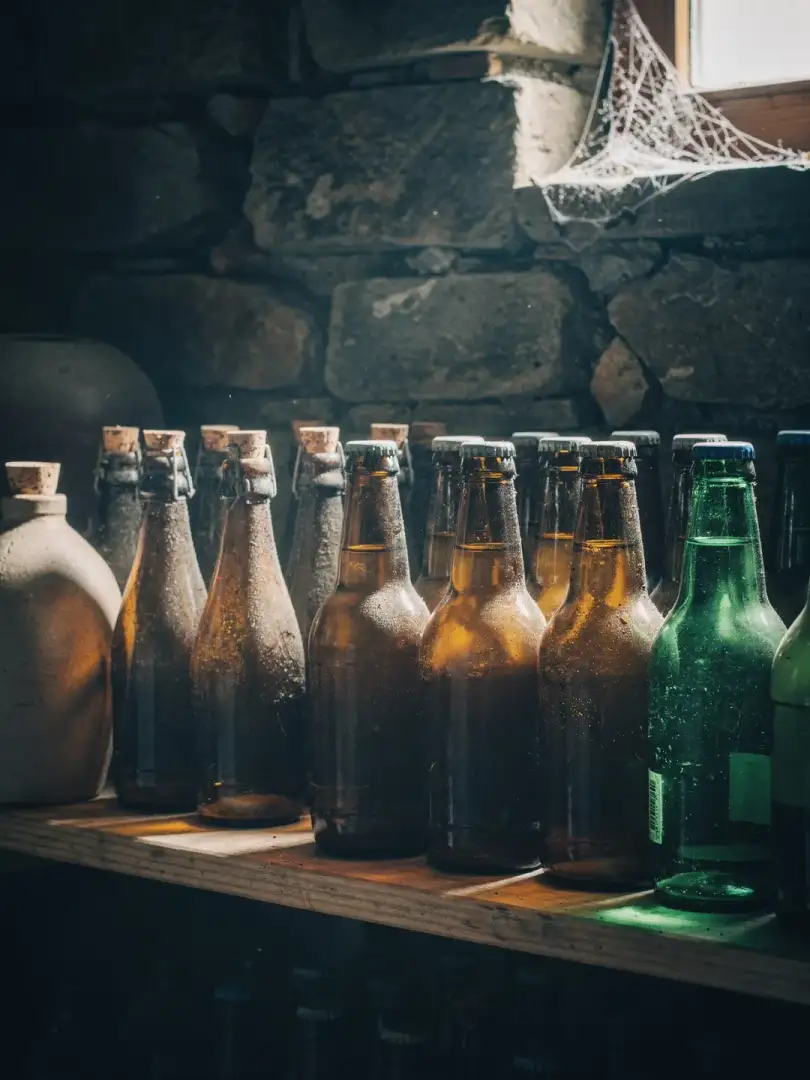
Blue light around 440 to 450 nanometers is the most damaging. Brown glass blocks light below roughly 500 nanometers quite effectively and therefore offers good protection. Green and clear glass let exactly these wavelengths through. Beer in such bottles can turn quickly in sunlight or under store lighting. Cans and kegs are completely light-proof. A six-pack of green bottles has no business sitting by the window, not even for an afternoon.
How Long Does Beer Keep?
Every bottle carries a best-before date. This isn't an expiration date: the brewery is simply assuring that the beer will retain its typical characteristics until then, provided it's stored properly. The beer doesn't automatically become undrinkable afterward. Alcohol, carbonation, hops, and a low pH make beer a hostile environment for germs. However, it does lose freshness. Filtered and pasteurized lagers often carry a date many months into the future.
Over time, small amounts of oxygen seep through the closure, and the beer oxidizes. Hop aroma is the first thing to fade, followed later by notes of paper, honey, or sherry. Heat significantly speeds up this aging process. Storing beer in a hot car or next to a heater will age it considerably faster than keeping it in a cool cellar. For more on the aging notes you might detect in the glass and how to describe them, see the Tasting section.
Should Beer Be Stored Upright or on Its Side?
Beer should be stored upright. Unlike wine sealed with a natural cork, a bottle with a crown cap doesn't need moisture at the closure. Lying down, the beer touches a larger surface of the air pocket in the neck, and with unfiltered or bottle-conditioned beers, the yeast sediment forms a streak along the bottle wall instead of settling at the bottom. This then leads to unwanted cloudiness when pouring.
A quiet, dark spot with a steady temperature is ideal, such as a cellar shelf or a cabinet against a cool interior wall. The refrigerator works well for anything you plan to drink within the next few weeks. It's best to avoid major swings between cold and warm. Opened bottles only last a few hours: carbonation escapes, and oxygen has free access. A cap from the drawer slows this down but doesn't stop it entirely.
Which beers can handle aging, and which can't?
Most beers taste best young. IPA tops that list: its citrus, tropical fruit, or pine aromas come from heavy hopping, and those are exactly the aromas that fade first. Many craft breweries print the canning date right on the can and recommend drinking it within a few weeks. Wheat beer, pilsner, and helles also lose their freshness and shine after a few months, even when the best-by date is still far off.
Strong, malt-forward, or mixed-fermentation beers are a different story. Barley wine, imperial stout, doppelbock, and robust Belgian ales at 8 percent ABV and above can age for years, developing notes of dried fruit, sherry, or leather. A Gueuze, a blend of young and old spontaneously fermented lambic, keeps evolving in the bottle thanks to the living yeasts and bacteria still at work inside. Anyone looking to cellar beers like these needs patience, darkness, and a consistently cool space.