The British Family
Ale, IPA, Porter, Stout
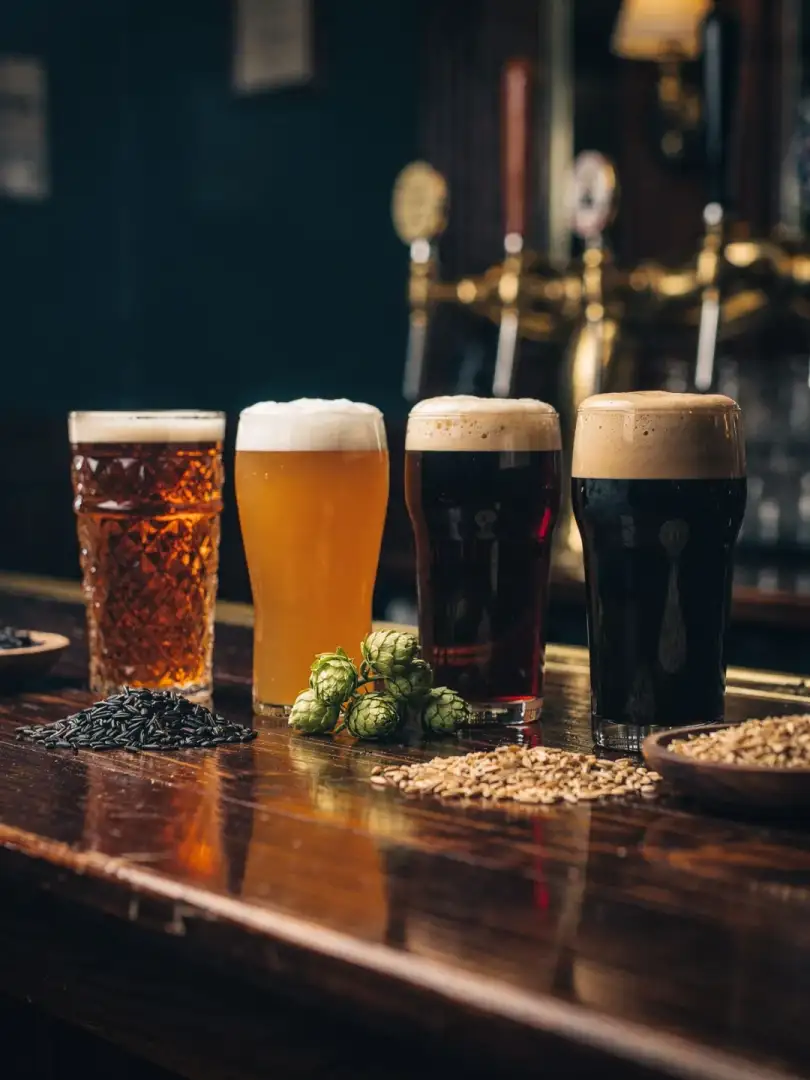
Ale is the umbrella term for top-fermented beers of British tradition; IPA is a heavily hopped pale ale, Porter and Stout are dark ales made with roasted malt. Stout was originally simply a strong porter. Today what mainly separates the two is how intense the roast is.
What Is an Ale? Bitter, Pub, and Burton
Order a beer in an English pub and you'll usually get an ale. It often arrives as a cask ale: unfiltered, conditioned in the cask, and served without added carbonation via a hand pump. The yeast works warm and produces esters, fruity aromas of apple, pear, or marmalade. That's why English ales taste rounder and less fizzy than German lagers.
The everyday beer there is called Bitter. An Ordinary Bitter has just 3.2 to 3.8% ABV, a Best Bitter 3.8 to 4.6%, and a Strong Bitter up to 6.2%. Bitterness ranges from 25 to 50 IBU, with color usually copper. The water of Burton upon Trent was formative: very hard and gypsum-rich, which makes hop character appear angular and dry. Brewers still add gypsum today, a process known as Burtonizing.
There's also the Mild, a dark, soft ale with only 3 to 3.8% ABV and 10 to 25 IBU. For a long time it was the beer of working-class neighborhoods, and it shows that British ales are often lighter than their reputation suggests.
What Is an IPA? Hops, Not a Seafaring Legend
India Pale Ale is often told as an adventure story: a London brewer supposedly invented the style so beer could survive the sea voyage to India. That's not documented. Beer had already been shipped to India as early as 1711. Hodgson of the Bow Brewery supplied the East India Company with a pale October beer, but he didn't invent a new style. The term India Pale Ale only appears in the early 19th century, and troops in India were still drinking porter until the late 19th century.
What defines an IPA today is the hops. An English IPA has 40 to 60 IBU, while an American IPA ranges from 40 to 70 IBU at 5.5 to 7.5% ABV, with citrus, pine, and tropical fruit aromas from American hop varieties. The Hazy IPA is cloudy, softer, and fruitier, with 25 to 60 IBU. A Double IPA reaches 7.5 to 10% ABV and up to 100 IBU.
Porter: The Dark Beer from London
Porter emerged in London in the 1720s. The name is associated with the city's porters, the load carriers. The story that a brewer named Ralph Harwood invented the beer in 1722 as a substitute for a blend called Three Threads comes from a city record dated 1802, roughly 80 years later and without earlier sources. Who actually invented porter remains unknown.
An English Porter is dark brown to black, 39 to 59 EBC, with 4 to 5.4% ABV. It tastes of chocolate, caramel, and bread, with gentle roast character. The Baltic Porter from the Baltic Sea region is a stronger, usually bottom-fermented relative with 6.5 to 9.5% ABV. Porter was among the first beers produced in large quantities at big breweries; London houses would age it in massive wooden vats.
The Difference Between Porter and Stout
Stout originally just meant strong. A Stout Porter was a robust porter, and later the name shrank to just Stout. Ireland, above all Guinness in Dublin, made the style world-famous, though it didn't invent it. Today Stout usually stands for more roast character, often made with roasted unmalted barley, which brings coffee and bitter chocolate notes to the glass.
Surprising to many: an Irish Stout is light. The BJCP lists 3.8 to 5% ABV and only 9 to 11% original gravity, less than a Pilsner. It feels heavy because its color, at 49 to 79 EBC, is deep black, and the roasted bitterness lingers dry. Its counterpart is the Imperial Stout, with 8 to 12% ABV and 50 to 90 IBU. There's no sharp line between Porter and Stout; the brewery decides what to call its beer. Then there are variations like the Oatmeal Stout, made with oats for a silky mouthfeel, or the Milk Stout, brewed with milk sugar that stays unfermented and makes the beer sweeter.