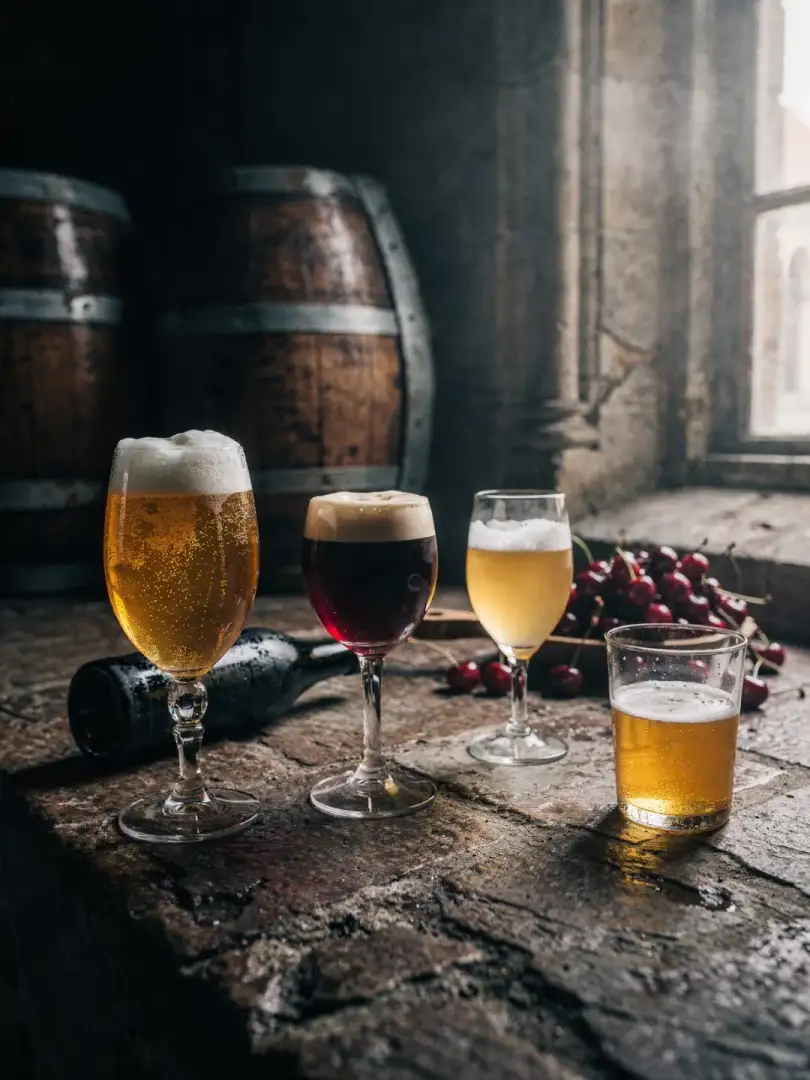
Belgian Beer Styles
Tripel, Dubbel, Saison, Lambic
Tripel, Dubbel, Saison, and Lambic are Belgian beer styles with very different roots: Dubbel and Tripel from monastery breweries, Saison from farmhouses in Wallonia, Lambic from spontaneous fermentation near Brussels. What they share is that yeast contributes more to the flavor than hops do.
Is Trappist Beer a Beer Style?
Belgian beer menus list Trappist beer and Abbey beer as if they were styles. They're not. Trappist is a mark of origin: the Authentic Trappist Product logo from the International Trappist Association is granted only to beers brewed in or directly beside a Trappist monastery under the supervision of the monks or nuns, with proceeds going to the community or charitable purposes. As of mid-2025, beers from eight breweries carried this logo, including Westmalle, Chimay, Rochefort, and Orval.
Abbey beers like Leffe, Grimbergen, or Affligem, by contrast, come from secular breweries that use a monastery name. Both groups feature the same styles: Blond, Dubbel, Tripel, and dark strong ales.
The Difference Between Dubbel and Tripel
The names sound mathematical, but they don't describe an exact doubling or tripling. Dubbel is the dark monastery beer: reddish-brown, 20 to 33 EBC, 6 to 7.6% ABV, with aromas of raisin, plum, and caramel. Westmalle is considered the benchmark for both styles. The Tripel is the color opposite, golden yellow at 9 to 14 EBC, but stronger, at 7.5 to 9.5% ABV.
Despite its alcohol content, a Tripel feels surprisingly light. Belgian brewers often add pale sugar, which ferments almost completely and makes the beer dry. The yeast contributes pepper, clove, and pear. Going even further up leads to the dark strong ale, often called Quadrupel, at 8 to 12% ABV. At the other end sits the light Patersbier at 4.8 to 6%, originally the monks' everyday beer.
Belgian Blond and Golden Strong Ale: The Pale Strong Beers
Beyond the monastery styles, Belgium has produced two pale beers often confused with Tripel. Belgian Blond is the milder form: golden yellow, 8 to 12 EBC, 6 to 7.5% ABV and 15 to 30 IBU, with slightly sweet malt and gentle yeast fruitiness. It feels rounder and less spicy than a Tripel.
Belgian Golden Strong Ale, by contrast, is very pale, 6 to 12 EBC, and at 7.5 to 10.5% ABV is at least as strong as a Tripel. It's even drier, more effervescent, and fruitier, with pear and apple instead of spice. Its best-known example is Duvel from Breendonk. The strength hides behind the lightness, which makes these beers deceptively dangerous.
What Is a Saison? The Farmhouse Beer
Its roots lie in Wallonia, the French-speaking south of Belgium. Farms there brewed beer during the cool months, meant to refresh harvest workers in summer. Today, Saison is a dry, sparkling, often slightly hazy ale with 5 to 7% ABV and 20 to 35 IBU. Saison yeast ferments very thoroughly and tolerates high temperatures; it leaves behind pepper, citrus, and an earthy note.
A relative across the border is Bière de Garde from northern France. The name means beer for keeping. It's maltier and rounder than a Saison, at 6 to 8.5% ABV with 18 to 28 IBU, and is fermented either top or bottom, usually with extended cool aging. Where Saison is peppery and dry, Bière de Garde tastes of toast and caramel.
What Is Lambic? Spontaneous Fermentation near Brussels
In the Pajottenland and the Senne Valley southwest of Brussels, Belgium's wildest beer is born. The hot wort cools overnight in a shallow vessel called a coolship. Yeasts and bacteria from the air begin the fermentation. The beer then often ages for years in wooden barrels. Brewers use aged hops, mainly for preservation, which is why bitterness sits at just 0 to 10 IBU.
Brewers and blenders mix young and old Lambic to create Gueuze, which undergoes secondary fermentation in the bottle, building its own carbonation there. Kriek is made when sour cherries ferment along with the Lambic. The legal situation is complicated. The plain names Lambic, Gueuze, and Kriek have no longer been EU-protected since January 4, 2023. Only Oude Geuze and Oude Kriek, along with their variants, are protected as Traditional Speciality Guaranteed, meaning protected by method rather than origin. That Lambic comes from the Senne Valley is tradition, not an EU rule of origin.