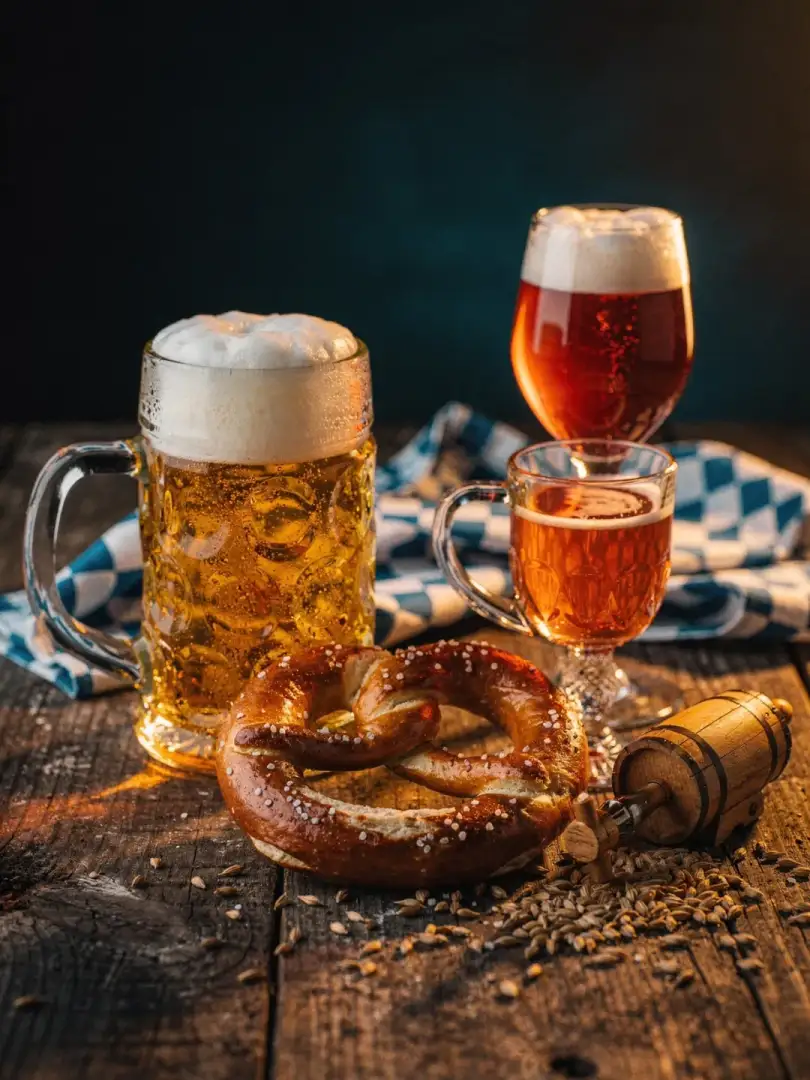
Amber and gold
Märzen, Festbier, Vienna Lager
Märzen is a full-bodied, amber-colored lager; Festbier its paler successor served at Oktoberfest; Vienna Lager a reddish-gold beer with a toasted bread note. All three are bottom-fermented and malt-forward. What sets them apart is color, strength, and history.
What is a Märzen? Brewing against the summer
Before refrigeration existed, summer was a hazard for brewers. In warm cellars, beer turned sour easily. The 1553 Bavarian brewing ordinance therefore permitted brewing only between Michaelmas, September 29, and St. George's Day, April 23. The last beer brewed before the break was brewed in March, a bit stronger than usual so it would survive the summer in a cool cellar. That's how Märzen got its name.
Today the word describes a style, not a brewing date. According to BJCP 2021, a Märzen has 13.3 to 14.7 percent original gravity, 5.6 to 6.3 percent ABV, and just 18 to 24 IBU. Color ranges from deep gold to amber, 16 to 33 EBC. Malt dominates the flavor: bread crust, a touch of toast, barely any roastiness, and a dry finish. This comes from Munich and Vienna malt. Both are kilned at higher temperatures, meaning dried at higher heat, which gives them more color and aroma.
Vienna Lager: the reddish original
In 19th-century Vienna, a bottom-fermented beer emerged from moderately kilned malt. It was paler than the dark beers common at the time, but not as pale as the later Pils. Vienna Lager is reddish to amber, 18 to 30 EBC, with 4.7 to 5.5 percent ABV—a touch lighter than a Märzen—and similarly restrained hopping at 18 to 30 IBU. A note of toasted bread is typical, without the beer turning sweet. The finish stays dry, inviting another bite of food rather than lingering on the palate.
The connection to Munich is close. In 1872, Spaten under Josef Sedlmayr brought an original Märzen in the Viennese style to the Wiesn (Oktoberfest). Märzen and Vienna Lager have been siblings ever since: same malt character, with the Märzen usually stronger and fuller. In Vienna itself, the style later became rare, while in Mexico, amber lagers that draw on the Viennese tradition are still brewed today.
Difference between Märzen and Festbier: what flows at the Wiesn
No amber Märzen is served at Oktoberfest today. What's in the stein is Festbier: golden, 8 to 12 EBC, with 13.3 to 14 percent original gravity and 5.8 to 6.3 percent ABV per BJCP. So it's similarly strong to a Märzen, but much paler and softer—more like a robust Helles than an amber beer. Bitterness stays restrained at 18 to 25 IBU.
Both are still found in stores, though. Many breweries sell an amber Märzen alongside a golden Festbier in autumn. To taste the difference, set them side by side. The Märzen brings bread crust and toast; the Festbier, fresh grain and a soft sweetness. With Festbier, it's also striking how little its strength shows—that's by design, and also a reason to drink it mindfully.
Oktoberfestbier: a protected name, not a style
The term Oktoberfestbier works differently. It doesn't describe a flavor, but an origin. Protection was applied for in 2012, and the name has been registered as a Protected Geographical Indication since 2022. Only breweries within Munich's city limits may brew Oktoberfestbier. In practice, that means the six members of the Verein Münchener Brauereien (Association of Munich Breweries): Augustiner, Hacker-Pschorr, Hofbräu, Löwenbräu, Paulaner, and Spaten. The term Oktoberfest-Bier is additionally a collective trademark of this association.
A Festbier from Franconia or a Märzen from Austria therefore can't be called Oktoberfestbier, even if it tastes similar. Conversely, the name doesn't guarantee a uniform flavor, since each of the six breweries brews to its own recipe.
For choosing in autumn, a simple rule helps. If you're after malt and color, reach for a Märzen. If you want a pale, soft beer with plenty of strength, go for Festbier. If you prefer something a bit lighter with toasted bread notes, Vienna Lager is your glass. Original gravity, incidentally, won't tell Märzen and Festbier apart, since both start at 13.3 percent. The deciding factors are color and malt selection. All three pair well with hearty fare, from roast chicken to pork roast, since their malt echoes the roasted notes of the meat.