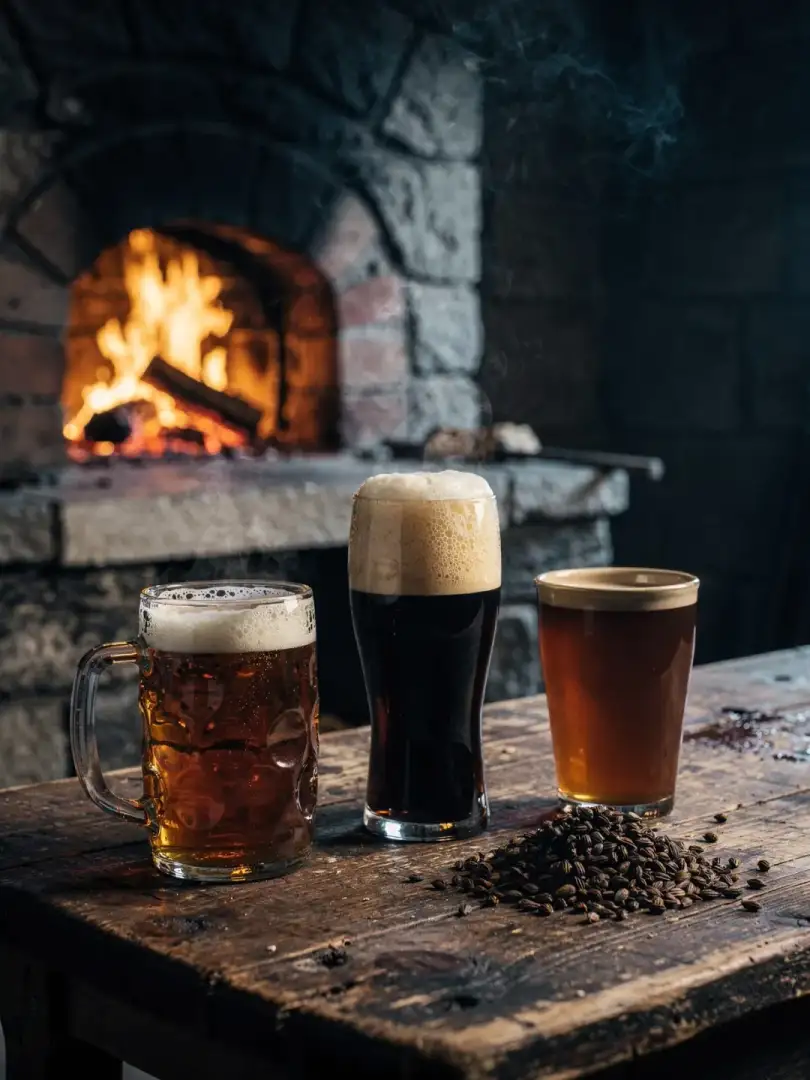
The dark lagers
Dunkel, Schwarzbier, Rauchbier
Dunkel, Schwarzbier, and Rauchbier are all dark, bottom-fermented lagers, yet they taste quite different: Dunkel malty with bread crust, Schwarzbier dry with light roastiness, Rauchbier smoky with beechwood character. The difference lies in the malt, not the yeast.
Dark beer isn't automatically heavy beer
Many people assume dark beer carries more alcohol than pale beer. The numbers say otherwise. According to BJCP 2021, a Munich Dunkel runs 4.5 to 5.6 percent ABV, a Schwarzbier 4.4 to 5.4—barely more than a Pils. The color comes from the malt. The hotter the germinated barley is kilned or roasted, the darker and more aromatic it becomes. Even small amounts of roasted malt can color an entire batch deep brown.
What matters is how this malt is used. Plenty of dark base malt yields bread and nut notes; a little heavily roasted malt yields coffee and cocoa. This balance determines whether a beer leans toward Dunkel or toward Schwarzbier. Calories, too, depend not on color but on alcohol and residual sugar. A Schwarzbier and a Pils of equal strength therefore land close together.
What is a Munich Dunkel?
Until the 19th century, the typical Munich beer was dark. This had to do with the water: Munich's carbonate-rich brewing water pairs well with dark malts. Today, almost all breweries treat their water, but the style has stuck around.
A Dunkel is brewed mainly from Munich malt, a robustly kilned base malt with bread crust and nutty aromas. Traditionally, decoction is often part of the process, a mashing method where a portion of the mash is removed, boiled, and returned, deepening the malt flavors. The numbers: 11.9 to 13.8 percent original gravity, 18 to 28 IBU, color 33 to 55 EBC, so chestnut to dark brown. A Dunkel shouldn't have roasty bitterness; on the palate it feels soft, slightly sweet, and surprisingly fresh for its color. Its Czech cousin, the Czech Dark Lager, reaches even darker at 33 to 69 EBC and often tastes sweeter.
Difference between Dunkel and Schwarzbier
Schwarzbier is at home in Thuringia and Saxony. In the glass it looks almost black, 37 to 59 EBC, yet lighter than a Dunkel. The reason lies in the recipe. The base is pale malt, with a small portion of roasted malt added for color and a dry, slightly chocolatey note. At 20 to 35 IBU, Schwarzbier is also somewhat more bitter, and the finish stays short and clean. Many brewers use dehusked roasted malt, meaning malt roasted without the hard grain husks. It colors strongly but gives off hardly any harsh bitterness.
Schwarzbier is often called a German stout. The comparison only holds visually. Stout is top-fermented and usually has significantly more roasty bitterness; Schwarzbier is bottom-fermented, cold-conditioned, and finishes clean like a lager. If you want a dark beer without coffee-like bitterness, Dunkel is the right choice. If you like roasted aroma without heaviness, reach for a Schwarzbier.
What is a Rauchbier? Bamberg and beechwood
In Bamberg, some beers taste of ham and campfire. Behind this is malt kilned over an open beechwood fire. The smoke permeates the moist, germinated grain and lodges within it. In the past, wood was the usual heat source for kilning in many places, so smoky beers were common. In Bamberg, this tradition never died out. The best-known houses are Schlenkerla and Brauerei Spezial.
At its core, Rauchbier is a bottom-fermented Märzen made with smoked malt. BJCP specifies 12.4 to 14 percent original gravity, 4.8 to 6 percent ABV, 20 to 30 IBU, and 24 to 43 EBC. How strong the smoke comes through depends on the proportion of smoked malt used. Incidentally, Bamberger Rauchbier is not protected as an EU designation of origin, even though you sometimes hear otherwise. It shouldn't be confused with the Polish Grodziskie: that's a light, top-fermented beer made from wheat malt smoked over oak.
Rauchbier pairs especially well with food. Smoked dishes, grilled meats, and robust cheeses pick up the smoky aroma rather than clashing with it. There are also gentler versions, such as a Rauchweizen or a pale lager with a touch of smoked malt, where the smoke only whispers in the background. For beginners, these are often the better choice.