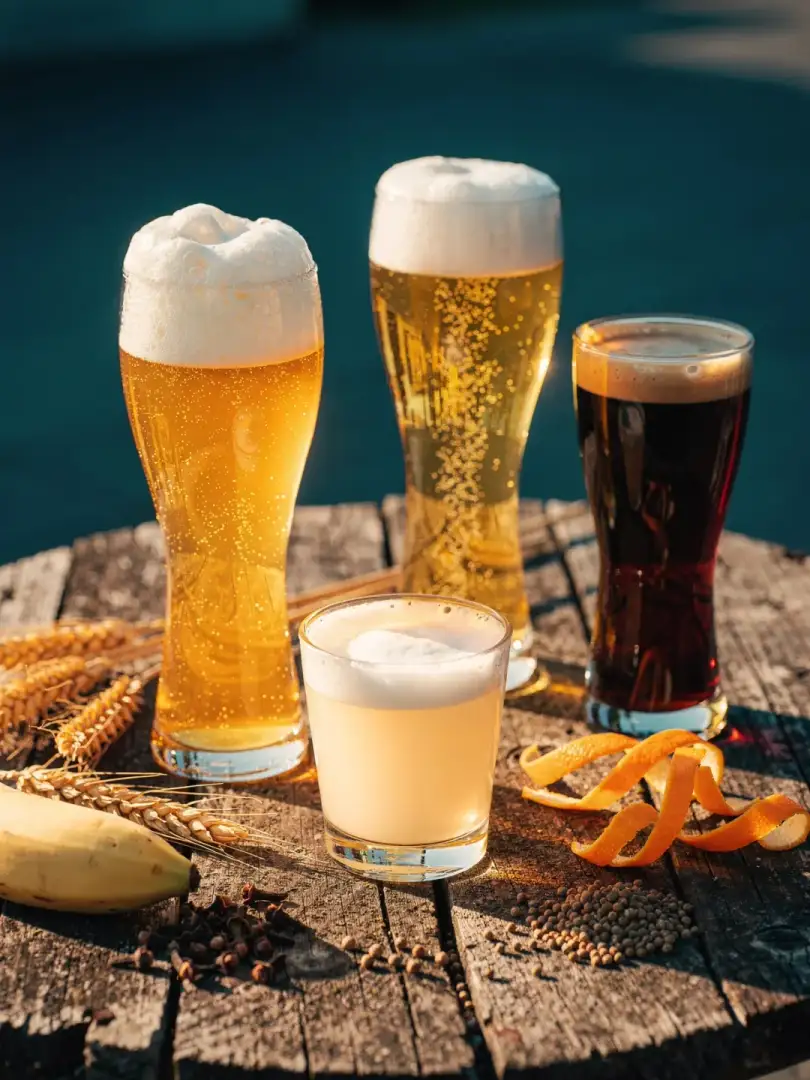
The wheat beers
Weißbier, Hefeweizen, Kristallweizen, Witbier
Weißbier and Weizenbier are the same thing: a top-fermented beer with a high proportion of wheat malt, called Weißbier in Bavaria. Hefeweizen is the cloudy version, Kristallweizen the filtered one. Belgian Witbier is something different, spiced with coriander, orange peel, and fresh acidity.
Difference between Weißbier and Weizenbier: just the name
In Bavaria, you order a Weißbier; elsewhere in the country, often a Weizen. The same beer is meant either way. The "Weiss" (white) in the name refers to its pale color, which once set it apart from dark barley beers, not to some distinct ingredient.
A high proportion of wheat malt is typical. As an industry rule of thumb, at least half of the grist, meaning the total malt bill, should be wheat; there's no documented legal basis for this figure. Wheat malt is permitted because German beer law allows malts other than barley for top-fermented beers. Historically, this was a delicate matter, since the Bavarian rule of 1516 mentioned only barley. Weißbier long remained a privilege, granted in 1548 to the House of Degenberg. After that line died out in 1602, Duke Maximilian I claimed the monopoly for himself.
Where do banana and clove in Hefeweizen come from?
No other German style owes so much to its yeast. Bavarian wheat beer yeast produces plenty of isoamyl acetate during warm fermentation, an ester, meaning a fruity aroma compound, that smells of banana. Alongside this comes 4-vinyl guaiacol, a phenol, meaning a spicy aroma compound, responsible for the clove note. How the two balance against each other is controlled by the brewer through temperature and fermentation management. Warmer tends to emphasize banana, cooler the clove.
Hops stay in the background: 8 to 15 IBU according to BJCP, less than almost any other German style. The wheat's protein creates the haze, the tall, creamy head, and the full mouthfeel. A pale Hefeweizen has 4.3 to 5.6 percent ABV and 11 to 13.1 percent original gravity.
Hefeweizen, Kristallweizen, Dunkles Weizen
Hefeweizen and Hefeweißbier are unfiltered. The yeast stays in the beer, settles in the bottle, and is often swirled back in when pouring. Many Weißbiers continue to mature in the bottle, gaining their carbonation there through a small secondary fermentation.
Kristallweizen is the filtered version of Weißbier: clear, more sparkling, and with less yeast character, since the yeast is absent. BJCP doesn't list separate measurements for it, mentioning it only as a variant of Weißbier. Dunkles Weizen uses darker malt, sitting at 28 to 45 EBC, combining banana with bread crust and caramel. The strong version is Weizenbock, which belongs to the Bock family.
Difference between Weißbier and Witbier
Translated, Witbier also means "white beer," but it comes from Brabant in Belgium and follows a different logic. It's brewed with unmalted wheat, often with a bit of oats, and spiced with coriander seed and bitter orange peel. The yeast lends a light, fresh acidity and subtle spice, but hardly any banana. In the glass, Witbier is very pale and milkily hazy, 4 to 8 EBC, with 4.5 to 5.5 percent ABV and 8 to 20 IBU.
For German breweries, Witbier is a special case. Coriander and orange peel aren't among the permitted ingredients under German beer law. A German brewery needs a special exemption from the state authority to brew it as a specialty beer, which, according to the Brewers' Association, is possible in every state except Bavaria. Imported Witbier, however, has been allowed to be sold as beer since the 1987 European Court of Justice ruling, as long as it's recognized as beer in its country of origin.
How to pour Weißbier properly
The tall, slender Weißbier glass is no accident. It gives the robust head room to form and shows off the beer's color. Before pouring, it's rinsed with cold water so the foam doesn't shoot up unevenly on dry spots. Then the glass is tilted and the beer poured slowly down the side. Only at the end is the glass straightened upright.
With Hefeweizen, a small amount remains in the bottle. This is swirled briefly to loosen the settled yeast, then poured in on top. That's how the beer gets its characteristic haze. If you prefer a clearer, fresher beer, you can leave the yeast sediment in the bottle; with Kristallweizen, the question doesn't even arise. Many brewers advise against the once-common lemon slice on the glass rim, since its acidity collapses the foam and masks the yeast aromas.