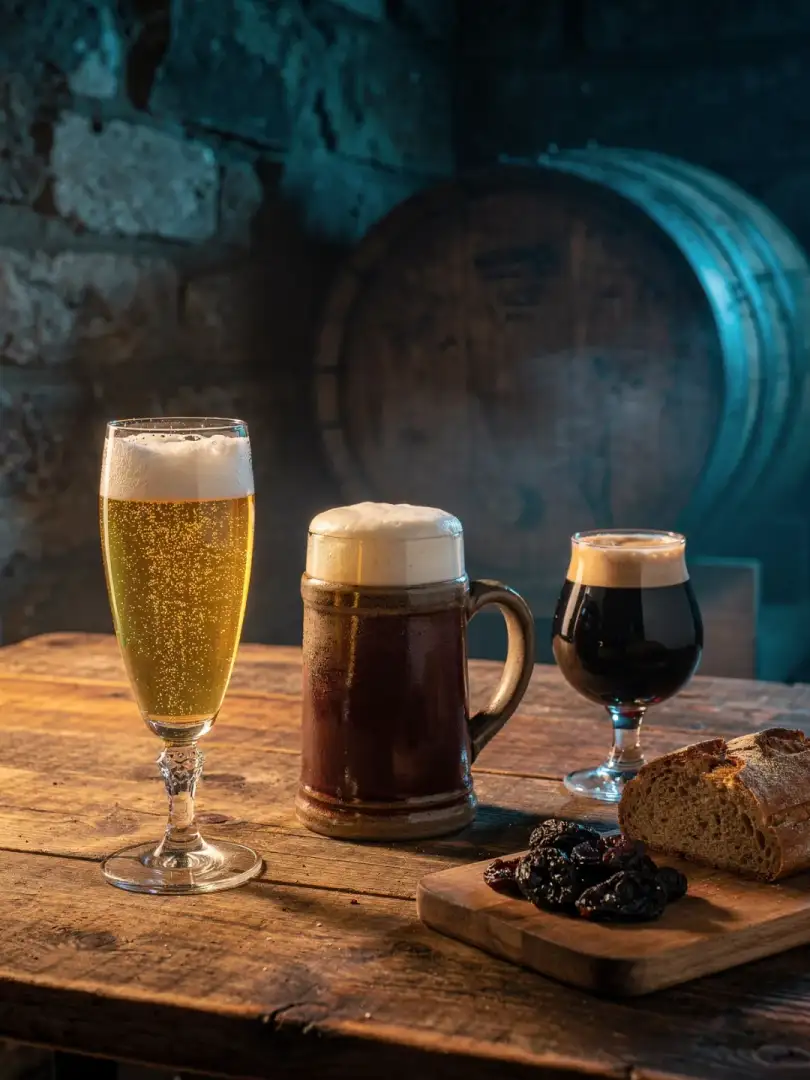
The strong beers
What is a Bockbier? Bock, Doppelbock, Eisbock
In Germany, a Bockbier is a strong beer with at least 16 percent original gravity, as stipulated by the German Beer Ordinance. Doppelbock goes beyond that, while Eisbock is concentrated through freeze-distillation. The name doesn't come from the billy goat, but from Einbeck.
Bockbier and the rule of the Beer Ordinance
Bock is one of the few style names that German law ties to a specific number. Under Section 3 of the Beer Ordinance, only beers with at least 16 percent original gravity may be called strong beer or Bockbier. Original gravity refers to the proportion of dissolved substances, mainly malt sugar, in the wort before fermentation. More original gravity means more sugar for the yeast, which usually means more alcohol and more body.
The American BJCP guidelines let Helles Bock and Dunkles Bock begin mathematically as low as 15.7 percent. But for a beer sold as Bock in Germany, the German threshold applies. The Ordinance does not regulate alcohol content. Typical figures are 6.3 to 7.4 percent ABV for the pale version and 6.3 to 7.2 percent for the dark one.
Why is Bockbier called Bock? From Einbeck to Munich
Einbeck in Lower Saxony was a Hanseatic town famous for its widely traded beer. The Munich court began sourcing it in 1555. In 1614, the Einbeck brewmaster Elias Pichler was brought to the Hofbräuhaus so that the strong beer could henceforth be made in Munich. In the Munich dialect, "Ainpöckisch Bier" became "Bock." The billy goat on many labels is a later play on words. Incidentally, Einbecker Bier is not registered today as an EU designation of origin.
Helles Bock, Maibock, and Dunkles Bock
Within the family, color is the main dividing line. Helles Bock, often served in spring as Maibock, is golden yellow to light amber, 12 to 18 EBC, and relatively hoppy for a Bock at 23 to 35 IBU. It tastes of pale malt, honey, and a touch of herbal hops. Dunkles Bock, traditionally served in autumn and winter, sits at 28 to 43 EBC and 20 to 27 IBU. Here, toffee, bread crust, and dark fruit lead the way, with no roasty bitterness.
Both are bottom-fermented and lagered cold for a long time. This smooths out the alcohol, so a good Bock feels rounded rather than hot. A top-fermented relative is Weizenbock, at 6.5 to 9 percent ABV, with the banana and clove notes of wheat beer yeast.
Doppelbock: what does the "-ator" ending mean?
Doppelbock doesn't mean twice as strong. The BJCP standard ranges from 17.5 to 26.4 percent original gravity and 7 to 10 percent ABV. In Germany, 18 percent original gravity is considered the usual lower threshold, though this is a matter of tradition rather than a formal category under the Beer Ordinance. In flavor, a Doppelbock is deeply malty, almost bread-like sweet, with notes of caramel, dried fruit, and sometimes chocolate. It's barely bitter, at 16 to 26 IBU.
Many Doppelbocks carry names ending in "-ator." The model is Salvator, a Munich strong beer brewed for Lent; other breweries attached the ending to their own names to signal the style. On the label, this ending is therefore a useful clue, though not a legal term.
The link between Lent and strong beer is often explained this way: anything liquid was, by the thinking of the time, considered not to break the fast, and a nourishing malt beer helped people through the lean weeks. How strictly this was ever observed is hard to verify in detail. Still, Munich's springtime Starkbierzeit, or strong beer season, keeps the memory alive.
Eisbock: concentrated by cold
To make Eisbock, a finished Bock is chilled until part of the water freezes. The ice is removed, leaving alcohol, sugar, and flavor concentrated behind. This results in 9 to 14 percent ABV from an original gravity of 18.9 to 28.1 percent. The result is dense, sweet, and warming, a beer for small glasses and slow sipping. Kulmbach and Franconia are considered its home. Comparing Bock, Doppelbock, and Eisbock, you'll quickly notice: as strength increases, it's mainly the sweetness that grows, not the bitterness.
Tasting Bockbier: small glass, slightly warmer
Strong beers call for a different approach than a Helles. A small glass with a slightly narrowed rim keeps the aromas concentrated. Served a bit warmer, around eight to ten degrees Celsius, the malt and dark fruit show more depth; ice cold, a Bock tastes flat and merely sweet. Because Bockbiers contain significantly more alcohol than a standard beer, it's worth keeping an eye on quantity. A half-liter of Doppelbock at 8 percent ABV contains as much alcohol as roughly 0.8 liters of a 5 percent beer.