Into the Containers
Cask, Bottle, Can: How Is Beer Packaged?
Packaging is the final step and one of the trickiest: the beer must take on almost no oxygen and lose no carbon dioxide. It's filled under counter-pressure into cask, bottle, or can. Each container protects differently against light and air, and you can taste the difference.
Why Is Oxygen So Dangerous During Packaging?
A beer can be carefully brewed and lagered for weeks, only to be ruined in a single minute at the filler. If oxygen gets in, it oxidizes. Experts mean by this chemical reactions that, after a few weeks, produce notes of wet cardboard, sherry, or stale bread. Hop-forward beers in particular quickly lose their fresh aroma as a result.
Modern fillers therefore first draw the air out of the empty bottle, flush it with carbon dioxide, and then fill under counter-pressure. This way, the pressure inside the bottle matches that in the tank, so the beer flows in calmly without foaming up. Just before sealing, it's often given a slight jolt so foam pushes the remaining air out of the bottle neck.
Cask: Keg, Wooden Barrel, and Cask Ale
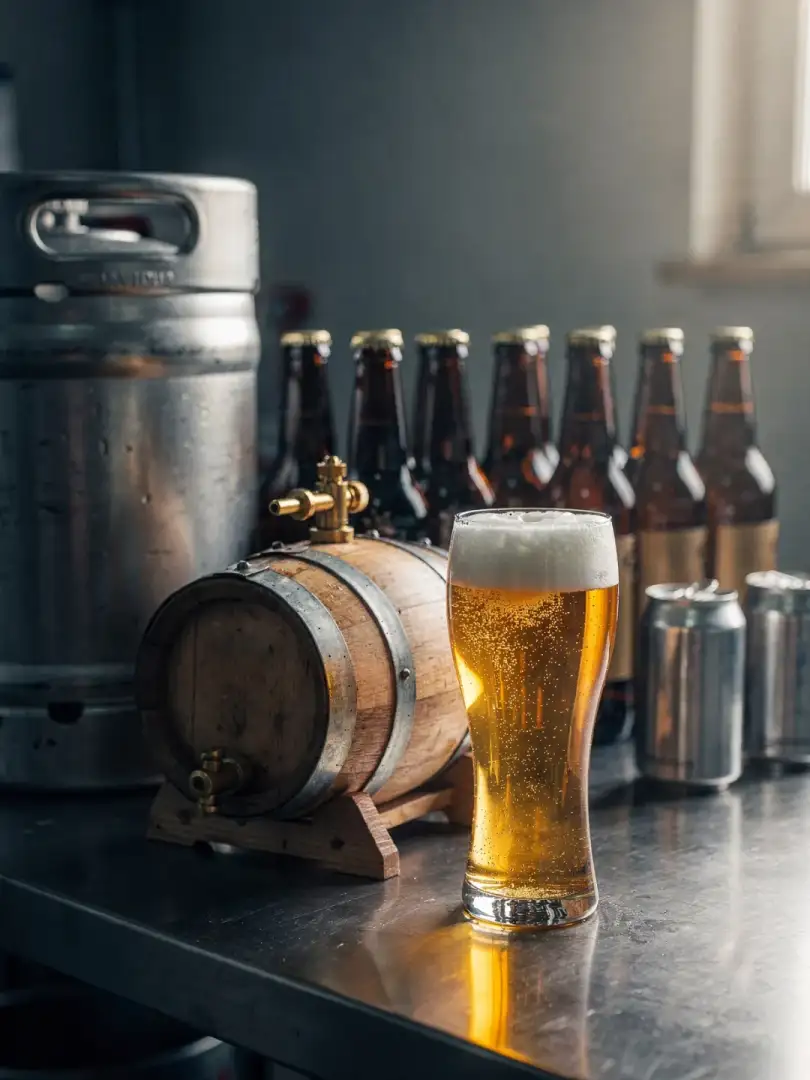
For pubs and restaurants, beer usually arrives in a keg, a stainless steel cask with a fixed dip tube built in. It's cleaned and filled at the brewery, connected at the pub, and dispensed using carbon dioxide or a gas blend. No light gets in, and no air either. For freshness, the keg is therefore an excellent package, as long as it's emptied promptly.
The wooden barrel is mostly experienced at festivals and in traditional inns. Today it's often lined on the inside or fitted with a plastic liner, so the wood doesn't impart flavor into the beer. Its appeal lies in the tapping ceremony and in serving without additional gas pressure.
In Britain, cask ale has its own tradition. The beer goes into the cask unfiltered, undergoes secondary fermentation there, and finishes maturing in the pub's cellar. It's served using a hand pump with no added gas. As a result, it has little carbonation and must be drunk within just a few days.
Brown, Green, or Clear Bottle: What's the Difference?
In Germany, the bottle is the most important container, often as a reusable bottle that gets rinsed and refilled many times over. Its color is more than just looks. Light in the blue and ultraviolet range breaks down bitter compounds from the hops. With the help of the vitamin riboflavin, this produces a sulfury compound reminiscent of skunk or cat urine. Brewers call this lightstruck flavor, or "skunking."
Brown glass blocks most of this light. Green and clear glass offer far less protection. Some breweries using clear bottles therefore use specially treated hop extracts that don't react to light. Even the green glass of certain imported beers is more about brand tradition than actual protection.
The crown cap in common use today was patented by the American William Painter in 1892. The swing-top closure with a rubber seal is older and is still used by some breweries as a signature feature, partly because it's resealable.
Beer in a Can: Better Than Its Reputation Suggests?
The first canned beer went on sale on January 24, 1935, in Richmond, Virginia, filled by the Gottfried Krueger Brewing Company. The problem with earlier attempts was the pressure of the carbon dioxide and the contact with metal. An interior coating solved it. Today, a thin lacquer layer separates beer from aluminum, so no metallic off-flavor develops.
Canned beer has long had a reputation for being cheap, but technically the can has real advantages: it's completely light-proof, lightweight, and picks up very little oxygen when sealed. That's why many craft breweries specifically can their hop-forward IPAs. In the end, what matters most for the environment is whether a container is part of a reusable or single-use system, and how far it has to travel.