Maturing and Clarifying
Lagering, Filtering, Pasteurizing: How Beer Stays Fresh
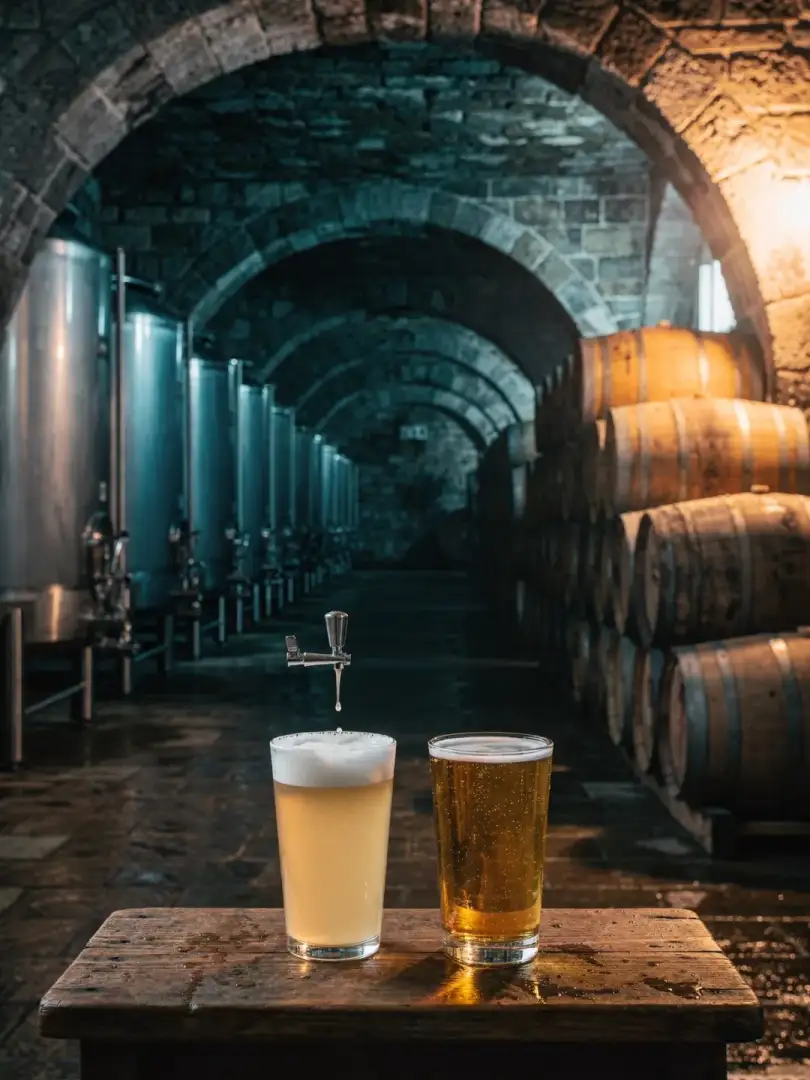
Lagering means letting the young beer mature cold after primary fermentation. During this time, residual sugar ferments out, carbon dioxide binds into the beer, and unripe flavors disappear. Afterward, depending on the style, the beer is either filtered or left hazy. Pasteurizing extends its shelf life even further.
What Happens When Beer Is Lagered?
After primary fermentation, the beer is called young beer. It still tastes unfinished, often somewhat sulfury, green, and rough around the edges. The brewer transfers it to a lagering tank and cools it to near 0 °C. A small amount of residual sugar continues to ferment slowly there. This secondary fermentation produces the carbon dioxide that later provides freshness and foam.
To keep the carbon dioxide in the beer, the tank is kept under slight pressure. Brewers call this spunding, after the spunding valve that regulates the pressure. At the same time, yeast and haze particles slowly settle out. The yeast continues to break down unripe compounds like diacetyl and sulfury notes, or they simply dissipate. The beer becomes rounder.
The German word Lagerbier comes from this practice. Under the Bavarian brewing ordinance of 1553, brewing was only allowed between Michaelmas on September 29 and St. George's Day on April 23. Beer meant for summer therefore had to age in cool cellars for months, often chilled with ice from ponds.
How Long Is Beer Lagered?
For bottom-fermented beers, three to six weeks of lagering is common; strong beers like Doppelbock often mature for considerably longer. Top-fermented wheat beers usually need a shorter maturation period, since many of them undergo secondary fermentation in the bottle or cask. There's no fixed required duration. Some breweries add krausen, young, vigorously fermenting beer, to give the secondary fermentation a fresh kickstart.
Long lagering time isn't a quality marker in itself. It mainly helps where the style calls for a clean, soft character. A hop-forward IPA, by contrast, loses its fresh aroma if lagered too long. That's why it's typically matured only briefly and bottled quickly.
Kölsch and Altbier offer an interesting case. Both ferment with top-fermenting yeast, essentially like an ale. Afterward, though, they mature cold in a lagering tank for several weeks, just like a bottom-fermented beer. This cold maturation smooths out the fruity notes from the yeast. That's why a good Kölsch tastes so clear and fresh, even though its yeast is related to that of a British Pale Ale.
Filtered or Unfiltered: What's the Difference?
After lagering, the beer is still slightly hazy from yeast and fine protein particles. For a bright, clear Pils, it gets filtered. Diatomaceous earth was long the standard, a fine powder made from fossilized diatoms that serves as a filter medium. More and more breweries today use membrane filters. For stabilization, auxiliary agents like silica gel or PVPP bind proteins and tannins that would otherwise cause haze later. Under Section 9(6) of the still-applicable German Beer Law, such clarifying agents must be completely removed again.
A Kellerbier or Zwickelbier, on the other hand, remains unfiltered, keeping its natural haze and more yeast and malt aroma. Hefeweizen is also unfiltered. With Kristallweizen, the same wheat beer base is filtered, making it appear crisper and clearer. Same style, different final step.
Why Is Beer Pasteurized?
Louis Pasteur published his studies on beer in 1876, showing that microorganisms spoil beer. Heating to moderate temperatures kills them off. Breweries today use two methods. In flash pasteurization, the beer passes through a heat exchanger for a few seconds before bottling. With tunnel pasteurization, filled bottles or cans travel through warm water sprays.
Pasteurized beer keeps longer, especially over long export routes. Critics point to a slightly cooked, duller taste when the beer is heated too aggressively. Many smaller breweries therefore skip pasteurization and rely instead on very clean working practices, refrigeration, and short supply chains. If you buy a beer with live yeast in the bottle, you're generally holding an unpasteurized product.
An alternative is cold sterile filtration. In this process, yeast and bacteria pass through membranes so fine that they get caught, without the beer ever being heated. The label usually doesn't state which method a brewery uses. To find out whether a beer was pasteurized, sterile-filtered, or simply bottled very fresh, your best bet is to ask the brewery directly. In the end, how cool and dark the beer is stored afterward matters for flavor too.