The Whole Journey
How is Beer Brewed? The Journey in Ten Steps
Beer is brewed in ten steps: milling the malt, mashing, lautering, boiling the wort with hops, clarifying, cooling, fermenting with yeast, conditioning, filtering, and packaging. The ingredients are almost always the same. It's the decisions along the way that create the style.
How is Beer Brewed? The Ten Steps at a Glance
Anyone stepping into a brewhouse for the first time sees gleaming kettles, pipes, and valves. Behind this machinery lies a surprisingly simple idea: grain contains starch, but yeast can only ferment sugar. Brewing is therefore mainly about converting starch into sugar, washing that sugar out, seasoning it with hops, and then handing it over to the yeast.
The journey begins with milling: the malt is coarsely crushed. During mashing, the grist is stirred into warm water, and enzymes from the malt break down the starch. During lautering, the brewer separates the sweet liquid, the wort, from the spent grain, known as draff or spent grains. Then comes the wort boil with hops, usually lasting one to one and a half hours.
After boiling, the wort is clarified, often in a whirlpool, a vessel in which the coagulated protein collects in the center. A plate heat exchanger brings it down to pitching temperature. During pitching, the yeast is added and fermentation begins. The young beer then matures in a conditioning tank, is filtered depending on the style or left hazy, and finally ends up in keg, bottle, or can.
What Happens Before the Brewhouse? Malting as Step Zero
One step is missing from the count, because most breweries don't handle it themselves. Malting takes place at maltings. There, barley or wheat is left to germinate in water until enzymes form, and the grains are then dried on a kiln, a heated platform. The hotter the kilning, the darker and more roasted the malt becomes.
For the brewer, malt is therefore an ingredient with a ready-made character. A Pilsner malt brings pale colour and grainy sweetness, a Munich malt brings bread crust, a roasted malt brings coffee and cocoa. The malt blend, known as the grist bill, determines even before the first step in the brewhouse whether the end result will be a Helles or a Stout.
Why Do Beers Differ Despite Using the Same Ingredients?
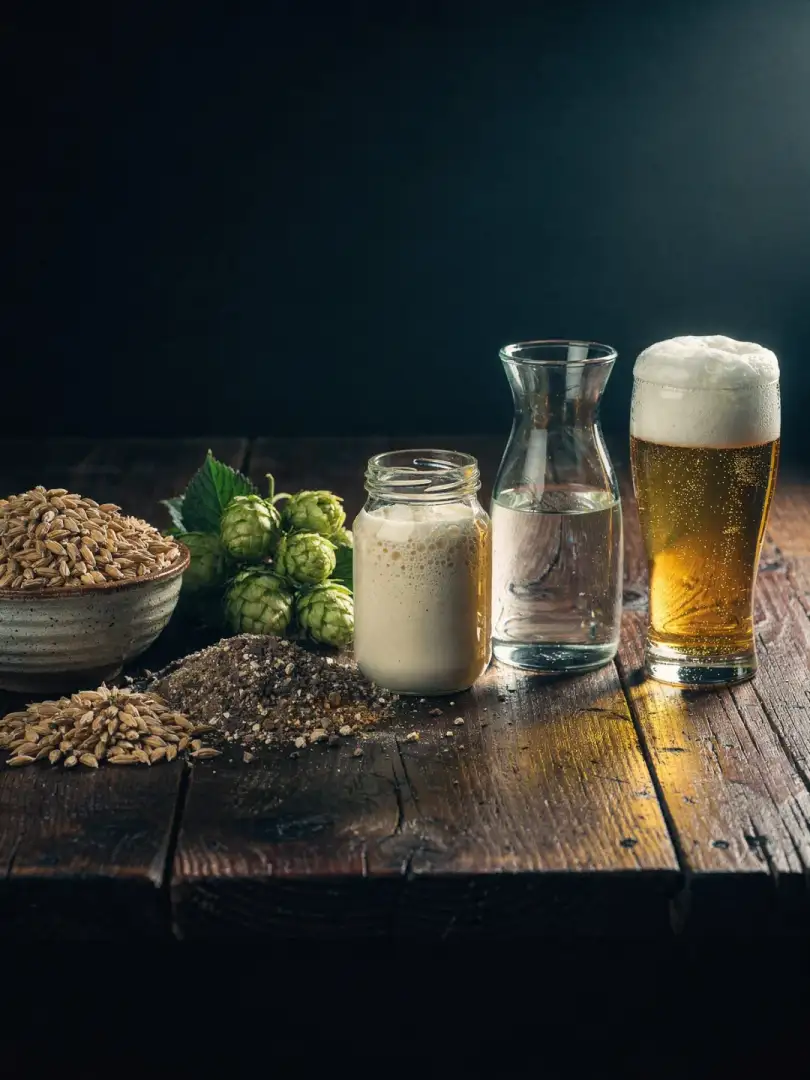
In Germany, bottom-fermented beer may, under Section 9 of the Provisional Beer Law, consist only of barley malt, hops, yeast, and water. The law itself was repealed in 2005, but this section still applies under a transitional rule. Yet a Pils tastes completely different from a Bock. The reason lies in the process.
The temperature during mashing determines how much fermentable sugar is produced. This in turn decides whether a beer ends up lean and dry or full-bodied. The timing of hop additions determines bitterness or aroma. The yeast and its fermentation temperature bring fruit, spice, or a clean, neutral flavour. Conditioning time and filtration finally shape clarity and mouthfeel.
One example makes this tangible. Kölsch and Pils are both pale, lean, and hop-forward. Kölsch, however, ferments with top-fermenting yeast at warmer temperatures and is then cold-conditioned, while Pils ferments with bottom-fermenting yeast at cooler temperatures. Taste the two side by side, and you'll notice a subtle fruity note in the Kölsch that the Pils lacks.
How Long Does it Take to Brew Beer?
The actual brew day in a brewery usually takes six to ten hours, from mashing-in to cooled wort in the fermentation tank. After that, time takes over. A top-fermented wheat beer can be ready after two to three weeks. A classically lagered bottom-fermented beer often needs four to six weeks or longer, while a strong doppelbock can take several months.
Large breweries shorten some phases using technology and precise control. Small breweries, by contrast, often advertise long maturation times. Both are, at first, simply statements about process, not a guarantee of flavour. Whether a beer tastes rounded and clean only becomes clear in the glass.
Brewing Worldwide: Same Basic Steps, Different Traditions
Whether in Bamberg, Brussels, or Portland, the basic steps are the same everywhere. The differences lie in the details. In Britain, mashing is classically done at a single temperature, while in Franconia and the Czech Republic, decoction is often used, in which part of the mash is boiled. Lambic brewers around Brussels leave the wort to cool in the open air, so that wild yeasts and bacteria can settle in.
The following sections go through each step individually. Knowing them also means understanding the language found on labels and brewery tours: original gravity, lautering, hop additions, secondary fermentation. And you'll see why two beers made with almost the same ingredients can taste so different.