Starch Becomes Sugar
Milling and Mashing: Rests, Enzymes, Infusion, Decoction
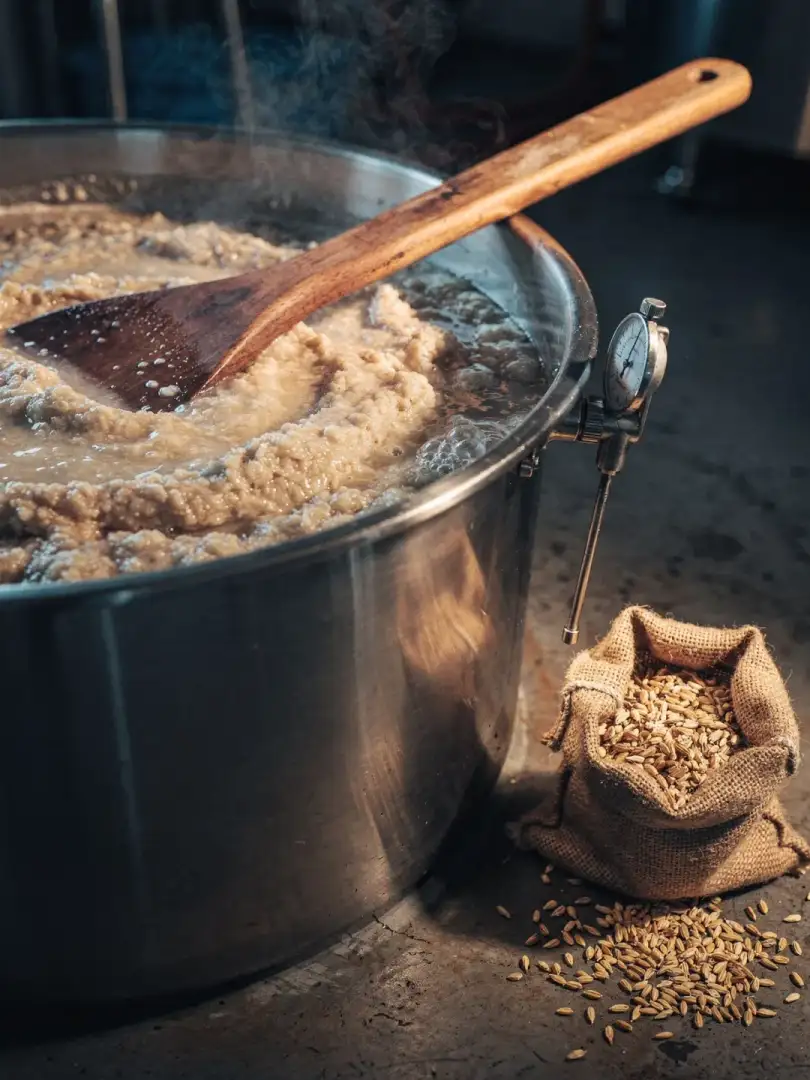
Mashing means that milled malt is stirred into warm water, and the malt's enzymes break down starch into sugar at specific temperatures, known as rests. Whether the mash is simply heated (infusion) or part of it boiled (decoction) shapes the beer's body and malt aroma.
Milling: Why the Malt Mustn't Become Flour
Before mashing, the malt passes through a mill. Its rollers crack open the grain's starchy interior so water and enzymes can reach the starch. The husks, the outer shells of the barley kernel, should ideally remain as intact as possible. Later, in the lauter tun, they form the filter bed through which the wort drains.
Grist that's too fine clogs this bed; grist that's too coarse wastes yield. Many breweries therefore briefly moisten the malt before milling so the husks stay pliable, a process known as conditioning. Breweries using a mash filter instead of a lauter tun can mill more finely, since filter cloths there take over the job the husks normally do.
What Happens to the Enzymes During Mashing?
During malting, the grain develops enzymes, tiny protein tools that break substances down. In the warm mash water, they become active. Each works best at a different temperature, and this is where the brewer's craft comes in. The brewer holds the mash at specific temperatures in sequence, known as rests.
Around 62 to 65 °C (144 to 149 °F), beta-amylase mainly does the work. It nibbles maltose off the starch, a sugar yeast ferments readily. At 70 to 72 °C (158 to 162 °F), alpha-amylase takes over, cutting starch into larger fragments. Some of these remain unfermented in the beer, giving it body. Finally, the mash is heated to around 76 to 78 °C (169 to 172 °F), known as mashing out, to make it thinner and easier to lauter.
How long the brewer holds each rest determines the finished beer. Spending a lot of time at the maltose rest produces a high degree of fermentation and a lean, dry beer like a Pils or Kölsch. Emphasising the higher rest leaves more residual sweetness, as expected in a Märzen or Bock. Whether the starch has fully converted is classically checked with the iodine test: iodine turns starch blue-black, but not fully converted mash.
Infusion or Decoction: What's the Difference?
In the infusion method, the entire mash stays in one vessel and is simply heated, either step by step or with a single rest. British ale tradition relies mainly on this simple approach. Well-modified malt, where the maltings have already done much of the groundwork, doesn't need more than this.
In decoction, the brewer draws off part of the mash, boils it in a separate kettle, and returns it. This raises the temperature of the whole mash to the next rest. Depending on how many portions are boiled, this is called a single, double, or triple decoction. Boiling promotes Maillard reactions, browning reactions between sugar and protein, similar to what happens with bread crust.
Historically, decoction was a response to poorly modified malt and the lack of thermometers, since boiling water always has the same temperature. Today it's a matter of flavour choice. Many Czech lagers, some Franconian farmhouse beers, and doppelbocks still rely on it because it deepens malt aroma and colour. But it costs time and energy.
Mashing for Wheat Beer, Pils, and Bock: What Sets the Styles Apart
For wheat beer, some brewers hold a rest around 45 °C (113 °F). This releases ferulic acid, which the wheat beer yeast later converts into its characteristic clove-like aroma. Skip this rest, and you get a wheat beer with more banana and less clove. Here, the mashing itself already decides an aroma often credited to the yeast.
A Pils, by contrast, needs a high proportion of fermentable sugar to come across dry and crisply hop-forward. A Bock thrives on malt fullness and, according to German beer regulations, must have an original gravity of at least 16 percent, meaning the dissolved extract in the wort before fermentation. For this, the brewer chooses more malt, often a higher conversion rest, and frequently decoction. Same kettles, same ingredient list, completely different beers.