New Variations
Craft Beer Trends: Dry Hopping, Pastry Stout, Sour, Low-Alc
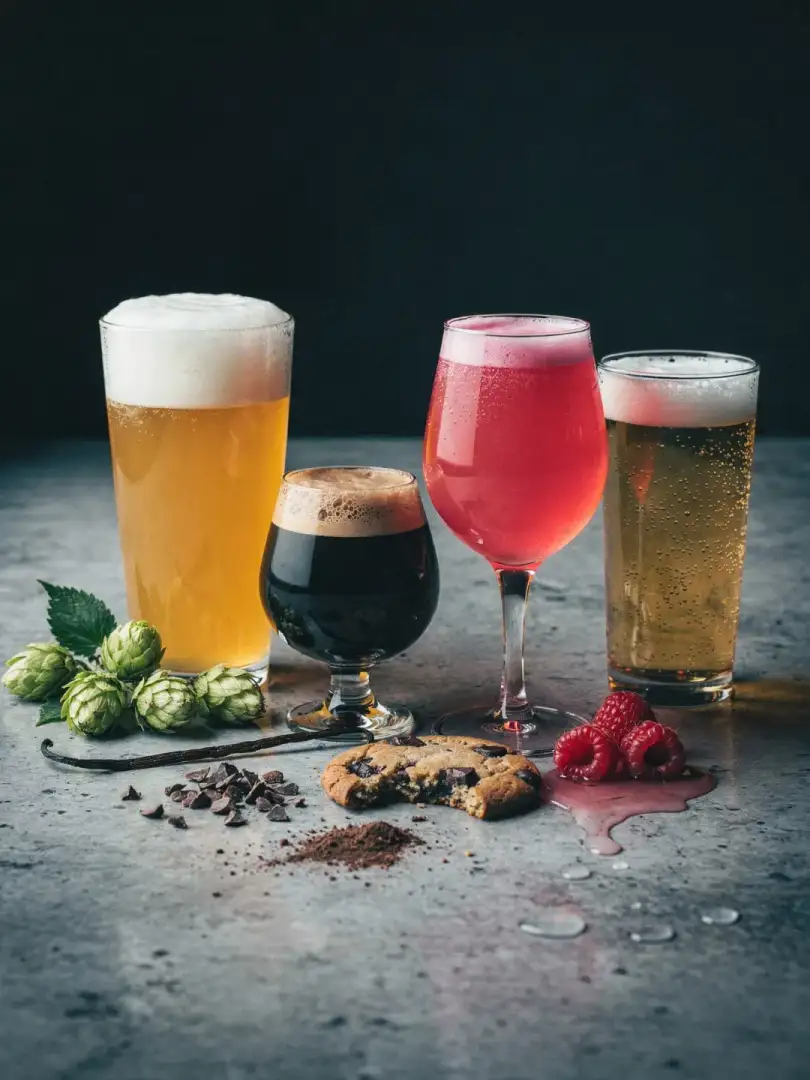
Dry hopping, pastry stouts, kettle sours, and low-alcohol craft beer are among the scene's most striking new directions. Dry hopping delivers hop aroma without much bitterness, pastry stouts taste like dessert, sours bring fresh lactic tang, and low-alc beers deliver flavor with little to no alcohol.
What is dry hopping?
Hops contain two groups of compounds that matter in beer. The alpha acids only convert into soluble bittering compounds once they're boiled. The essential oils carry the aroma, but most of them evaporate during boiling. Brewers who want aroma therefore add hops after boiling, into the fermenting or finished young beer. This is called cold hopping, known in English as dry hopping, or in German also Hopfenstopfen.
The technique itself isn't new. English brewers knew it for a long time, and Anchor brought it back to the US in 1975 with Liberty Ale. What's new are the quantities and the varieties. Modern IPAs often get several hop additions during fermentation. This can trigger secondary fermentation, since enzymes from the hops break down leftover malt sugars that the yeast then goes on to ferment after all. In Germany, dry hopping is permitted, including with hop pellets, since the law explicitly refers to them as hop powder.
What is a Pastry Stout?
Pastry is the English word for baked goods, and that's exactly the flavor profile this kind of beer aims for. The base is usually an Imperial Stout at 8 to 12 percent alcohol. On top of that come milk sugar, vanilla, cocoa, coconut, maple syrup, or even cookies. Milk sugar, also called lactose, can't be fermented by brewer's yeast. It therefore stays in the beer, contributing sweetness and body. This is important to know for people with lactose intolerance and for vegans.
In Germany, these ingredients fall outside the permitted list of malt, hops, yeast, and water. A domestically brewed Pastry Stout therefore needs approval as a special beer, something Bavaria doesn't grant. Imports have been allowed to be sold as beer since 1987, provided they qualify as beer in their country of origin. Experts argue over whether such beers are still a stout or have crossed over into dessert territory. One thing is clear: anyone expecting a dry Irish Stout will get exactly the opposite here.
What is a Kettle Sour and how does it differ from Lambic?
Sour beers have a long history, from Berliner Weisse to Belgian Lambic. Lambic ferments spontaneously, meaning with wild yeasts and bacteria from the air and the wood, and ages for months or even years. Craft brewers looked for a faster route and found it in the Kettle Sour. Here, lactic acid bacteria sour the unboiled wort, the sweet malt liquid, right in the kettle. Afterward it's boiled, which kills the bacteria, and a standard yeast ferments the beer.
This produces a cleanly sour beer in just a few days, fresh like yogurt rather than layered and complex like Gueuze. The models for this style are Berliner Weisse at 2.8 to 3.8 percent alcohol and Gose, brewed with salt and coriander, which counts as a special beer in Germany. From Brazil comes the Catharina Sour, a light sour beer with fresh fruit, which the BJCP guidelines currently list as its own style. Many breweries now add large amounts of fruit purée to the mix.
How much alcohol is in non-alcoholic and low-alcohol craft beer?
According to industry practice in Germany, non-alcoholic means no more than 0.5 percent alcohol. There's no legal definition for beer, and other countries draw the line differently. The claim "0.0" is an additional label the brewery adds voluntarily. Low-alcohol beer, per the BJCP, falls between 2.4 and 3.6 percent. Craft brewers today make non-alcoholic IPAs, stouts, and sours, either using special yeasts that produce barely any alcohol or by removing the alcohol afterward.
The market for these beers has grown. In German retail, non-alcoholic beers and beer mixed drinks surpassed 10 percent of sales for the first time in 2025, according to the Brauer-Bund. The larger breweries produced around 616 million liters of non-alcoholic beer, 6.5 percent more than the previous year. No one can say today which of these new variations will stick around. Dry hopping has long since become a standard tool, while Pastry Stouts are still a matter of debate. That will ultimately be decided in the glass.