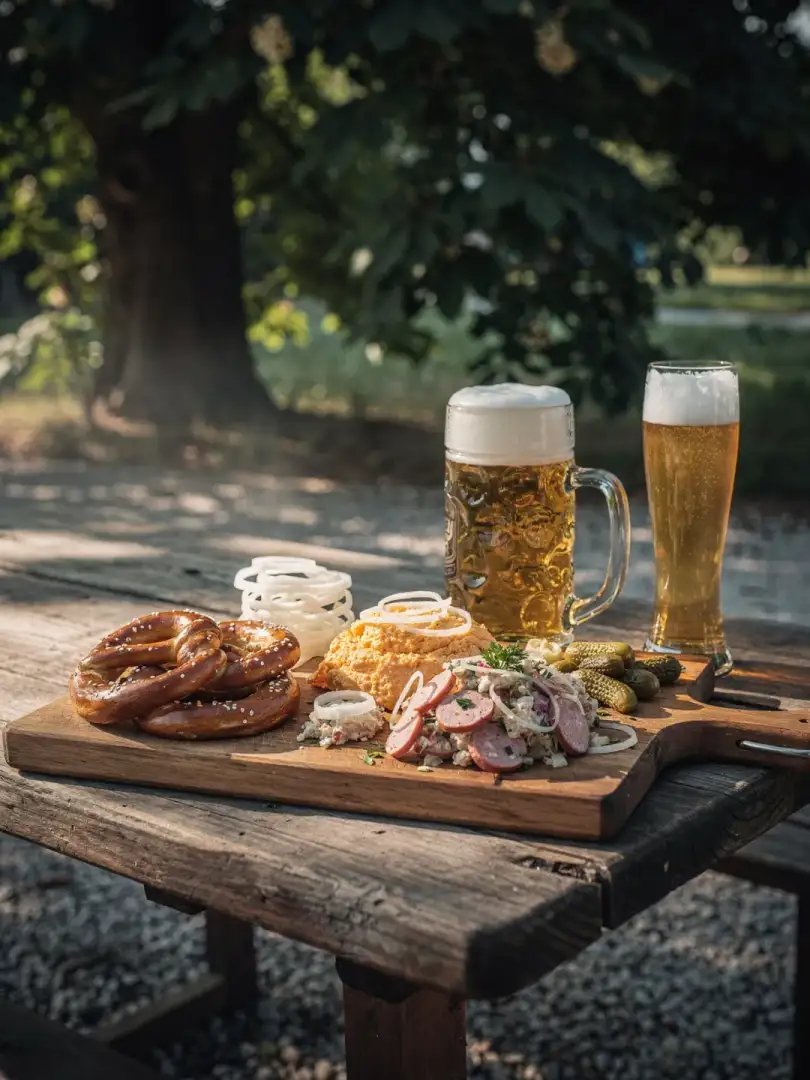
Brotzeit in the Beer Garden
Beer Garden and Brotzeit: What Belongs on the Table
In Bavarian beer gardens, you're allowed to bring your own Brotzeit, a cold snack spread. This right dates back to a decree issued by King Maximilian I Joseph on January 4, 1812. On the table you'll typically find pretzels, Radi (thinly sliced, salted radish), Obatzda, Wurstsalat, and cheese, usually alongside a helles, a wheat beer, or a radler.
Why Can You Bring Your Own Food to a Beer Garden?
The answer lies in the cellar. Under the Bavarian brewing regulations of 1553, beer could only be brewed between Michaelmas (September 29) and St. George's Day (April 23), since the brew spoiled easily in warm weather. The märzen beer meant to last through summer was therefore stored in deep cellars. Above these cellars, brewers planted chestnut trees, whose dense leaves provided shade, and spread gravel on the ground. Soon they began serving beer directly there.
Tavern owners feared the competition. King Maximilian I Joseph settled the dispute by decree on January 4, 1812: Munich brewers were allowed to sell their own beer and bread above their märzen cellars from June through September, but not to sell prepared food. So guests simply brought their own meals. The Bavarian Beer Garden Ordinance of April 20, 1999 preserves this custom: a beer garden, as defined by the ordinance, is a place where guests may eat their own packed meal free of charge.
What Belongs in a Traditional Bavarian Brotzeit?
Cold, simple, and easy to pack: that's the essence of a Bavarian Brotzeit. Classics include pretzels, Radi (paper-thin, salted radish slices), Obatzda, Wurstsalat, Leberkäse, Emmentaler, pickles, and farmhouse bread. Obatzda is a spread made from ripe Camembert, butter, onions, paprika, and often a splash of beer. It's salty, rich, and full of flavor — and calls for a beer that can cut right through it.
The radish shows how salt and beer work together. The radish is salted until it releases water, giving it a sharp, fresh taste. A Helles with soft malt tempers the sharpness, while the salt makes the beer seem rounder. A Pils or Kellerbier pairs well with Wurstsalat dressed in vinegar and onions, while a Weißbier, with its yeasty fruitiness, complements the paprika and caraway in Obatzda.
Helles, Weißbier, or Radler: What's Served in the Beer Garden
In the beer garden, it's the length of the afternoon that matters, which is why beers with moderate alcohol content dominate. Munich Helles, at 4.7 to 5.4% ABV with mild hops, is the standard, while Weißbier, at 4.3 to 5.6%, is the second classic. Those wanting less alcohol go for a Radler—beer mixed with lemon soda, usually in roughly equal parts—or a Russ, the blend of Weißbier and lemon soda.
Helles and Pils are often lumped together, but alongside a hearty Brotzeit they taste noticeably different. Helles is malt-forward and mild (16 to 22 IBU), while German Pils is distinctly more bitter (22 to 40 IBU) and drier. With a rich, fatty Brotzeit, the Pils comes across as fresher, while the Helles stays softer and more unobtrusive. Non-alcoholic Weißbier and Helles have by now earned a firm place on the menu in many beer gardens.
Brotzeit Elsewhere: Bierkeller, Zoigl, and the Board at Home
In Franconia, many beer gardens are called Keller, because—just as in Munich—they sit atop old storage cellars. For Brotzeit, you'll find Kellerbier there: unfiltered and cloudy with yeast, served alongside Presssack, Stadtwurst, and bread. In the Upper Palatinate, the Zoigl villages keep their own tradition alive: communal brewers brew in a shared brewhouse, and the Zoiglstuben take turns opening, recognizable by the Zoigl star hanging above the door. Hearty, cold fare rounds out the meal.
A Brotzeit at home follows the same rules as one enjoyed beneath the chestnut trees. A board of bread, cheese, sausage, and vegetables can be arranged by weight: fresh cheese and radishes with a Helles, Wurstsalat and Bergkäse with a Märzen or Kellerbier, smoked ham with a Rauchbier. If you're opening several beers, start with the lightest and finish with the strongest, so none overpowers the next.