North of the Alps
Beer Among Germanic Tribes, Celts and Romans
Germanic tribes and Celts drank beer, while the Romans preferred wine. In Hochdorf near Stuttgart, archaeologists found malting trenches from the 5th or 4th century BC, and around 98 AD Tacitus described a drink the Germanic peoples made from barley or wheat.
Celtic Beer: The Malting Trenches of Hochdorf
There's no single date marking beer's arrival in Central Europe. Grain cultivation came with the Neolithic period, and fermented grain beverages may well have arrived alongside it. Solid evidence, however, is more recent. The best-known find comes from Eberdingen-Hochdorf near Stuttgart, a Celtic settlement from the 5th to 4th century BC.
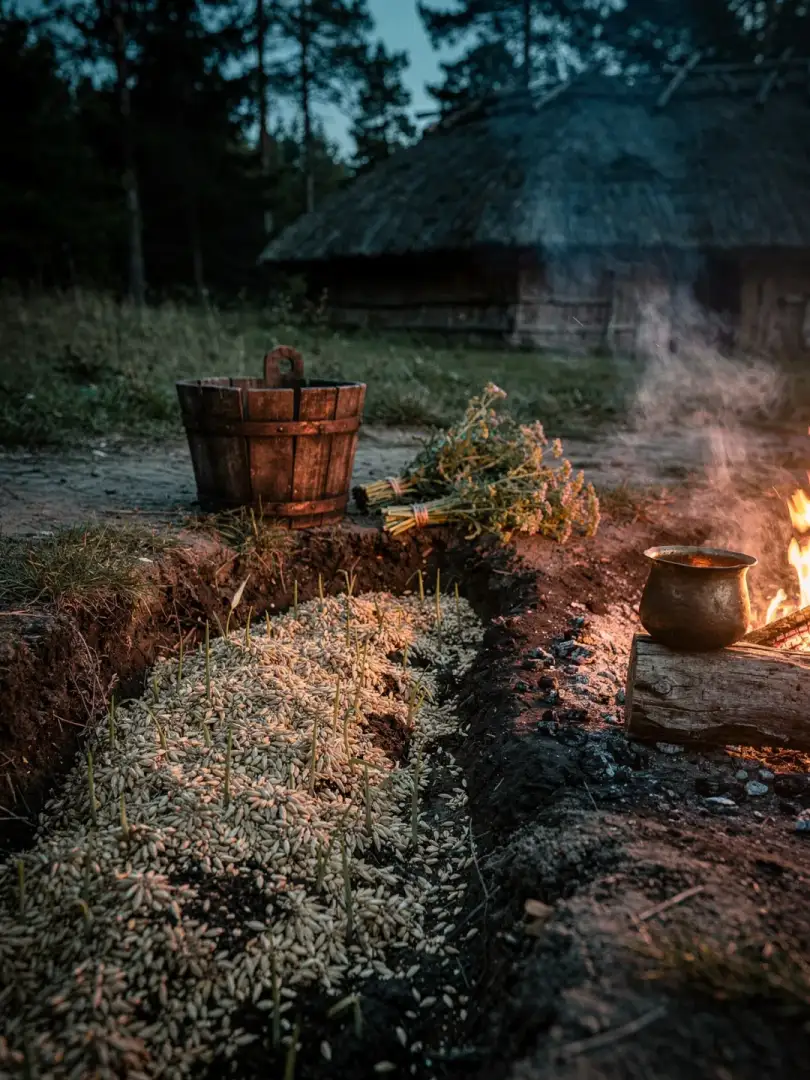
There, archaeobotanist Hans-Peter Stika of the University of Hohenheim found six purpose-built trenches containing thousands of charred barley grains. Many had germinated, meaning they'd been malted. Stika's interpretation: barley was soaked in these trenches until it sprouted, then dried over fire from both ends. This is essentially the same principle as a kiln, the drying facility maltsters use today to dry green malt.
According to this reconstruction, the beer from Hochdorf was dark, smoky and slightly sour, since lactic acid bacteria were active during the slow drying process. Seeds of henbane, a poisonous plant with intoxicating effects, were also found. Whether it ended up in the beer is speculation; mugwort and carrot seeds are also candidates as flavoring agents.
Cervesia: Where the Word Comes From
Roman authors called Celtic beer cervesia or cerevisia. The word survives in Spanish cerveza and Portuguese cerveja, and lives on in the scientific name of brewer's yeast, Saccharomyces cerevisiae. The German word Bier, by contrast, has a different and not fully settled origin; one theory under discussion links it to the Latin biber, meaning "drink."
What Tacitus Wrote About Germanic Beer
The Roman historian Tacitus wrote his Germania around 98 AD, a description of the peoples beyond the Rhine and Danube. In chapter 23, he states, roughly, that the Germanic peoples drank a liquid made from barley or wheat, corrupted into something resembling wine. The word "corrupted" reveals the Roman perspective: to Tacitus, beer was a poor substitute for wine.
The Germania should be read with caution. Tacitus likely never set foot in Germania himself, and he also wrote partly to hold up a mirror to his Roman readers. Still, it's plausible that Germanic peoples drank grain-based beverages, a claim supported by drinking vessels found in graves.
Romans and Beer: Wine in the South, Beer at the Limes
In the Mediterranean world, wine was considered the drink of civilization. But wherever Rome expanded northward, into Gaul, Britain, and along the Rhine and Danube, it encountered beer drinkers. Soldiers stationed at the frontiers drank whatever was available. Among the writing tablets from Vindolanda fort on Hadrian's Wall, dating to around 100 AD, are mentions of beer and of a brewer.
This created a divide still visible on the map today. South of the Alps, wine and viticulture remained the dominant culture; north of it, grain and beer. The line is rough, since Franconia and the Palatinate drink both, but it explains why Belgium, Germany, the Czech Republic and the British Isles are among the great old beer nations.
Beer Without Hops: Herbs Instead of Bitterness
All the beers of this era lacked something we take for granted today: hops. Flavor and a measure of shelf life came from herbs like bog myrtle, mugwort or yarrow. Hops grew wild in Europe, but didn't become a standard beer ingredient until the Middle Ages. Without it, beer spoiled quickly and was mostly brewed at home for personal use, chiefly by women.
In terms of flavor, this meant beers of this era tended to be sweetish, herbal and often slightly sour, since lactic acid bacteria fermented alongside the yeast. None of it was clear and sparkling like a modern lager. Anyone who tries a gruit beer or herb beer today gets a sense of this, though not an exact copy: malt, yeast and hygiene are all modern, only the seasoning recalls the past.