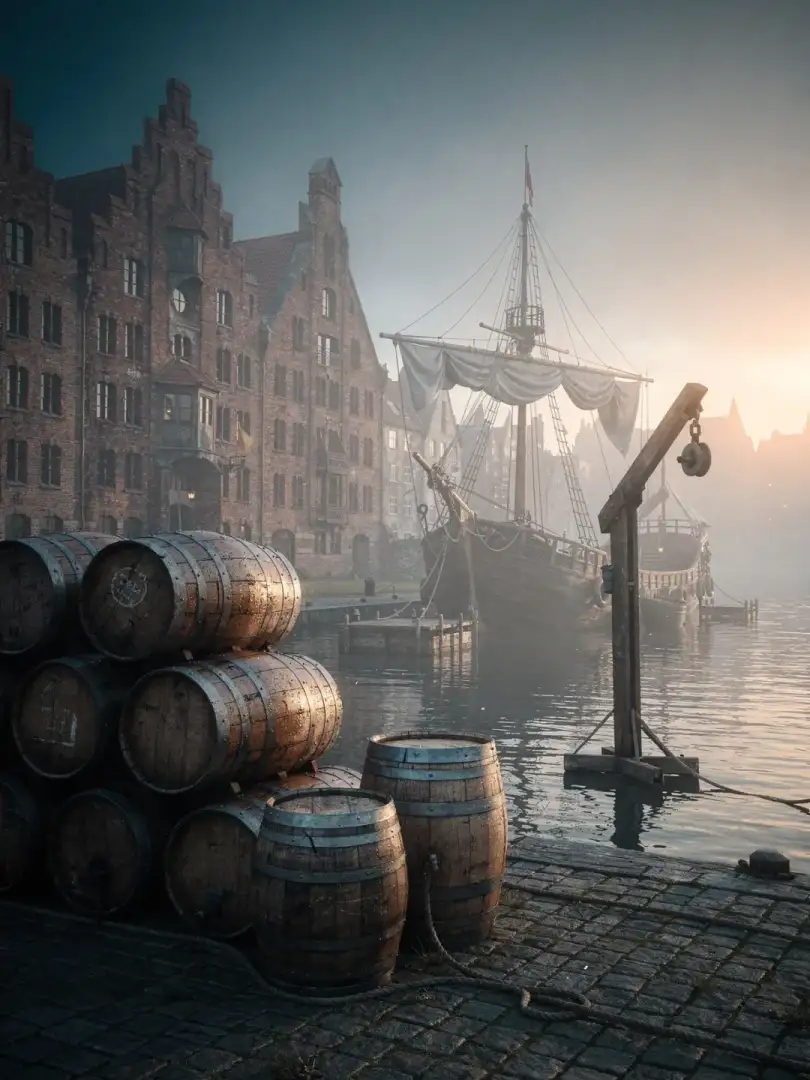
Cogs Full of Barrels
Hanseatic Beer: Beer as an Export Hit
Hops made beer durable, and the Hanseatic League turned it into a trade good. From the 13th century onward, Bremen, Hamburg, Wismar, and Einbeck shipped hopped beer as far as Flanders, Holland, and Scandinavia. Hamburg was known as the brewhouse of the Hanseatic League, and Einbeck gave bock beer its name.
Why Hops Were the Key to Beer Exports
Unhopped beer kept for only a few days. Anyone trying to send it beyond the next market risked it arriving as vinegar. Hopped beer, brewed strong and well fermented, could on the other hand survive weeks on ship and wagon. Only then did beer become a trade good that could be shipped in barrels across the North and Baltic Seas.
The Hanseatic League, an alliance of northern German merchants and towns, provided the network for this: ships, trading posts in Bruges, London, Bergen, and Novgorod, and established trade routes. Beer fit well into this system, since it served well as return cargo and bulk goods, and was in demand in the destination countries.
There was also a locational advantage that's easily forgotten today. In Flanders and Holland, hops had long been held back by gruit rights, while northern German towns brewed with hops early on. Anyone in Bruges or Amsterdam who wanted a beer that kept well and tasted distinctly bitter therefore bought beer from Hamburg or Bremen—until local brewers there switched to hops themselves and built up their own large breweries.
Bremen, Hamburg, Wismar: the great brewing cities
In the 13th century, Bremen beer was in demand in Flanders. Over the course of the 14th century, Hamburg took over this role. An old saying called the city the brewhouse of the Hanseatic League. Historians have calculated that in the 15th century, around 270 Hamburg export brewers supplied mainly the Dutch-Flemish region. Beer was one of the city's most important exports there.
Wismar, Lübeck, Rostock, and Danzig also brewed for export. Anyone drinking a Bremen beer today stands in this tradition, though in a legally quite different way: Bremer Bier has been registered as a Protected Geographical Indication in the EU since 1998. A fine example of how a trade name became a mark of origin.
Einbecker Bier: how the Bock got its name
Einbeck in Lower Saxony was not a port city, but it was a beer city. Citizens with brewing rights there brewed a strong, long-lasting beer that was sold far and wide by land and river. It traveled all the way to Bavaria: the Munich court began sourcing Einbecker beer from 1555.
Because this was expensive, in 1614 the Einbeck brewmaster Elias Pichler was brought to the Munich Hofbräuhaus. In Munich dialect, Ainpöckisch Bier became Bock. The billy goat on many labels is a later play on words. Today in Germany, only beers with at least 16 percent original gravity—meaning at least 16 percent dissolved substances, mainly malt sugar, in the wort before fermentation—may be called Bockbier or Starkbier.
Ale and Beer: How Hopped Beer Conquered England
Hopped beer came to England mainly in the 14th and 15th centuries with merchants and immigrants from Flanders and Holland. For a long time, two drinks were distinguished there: Ale, the traditional unhopped beer, and Beer, the new hopped beer from the continent. Resistance was fierce; Ale brewers saw the foreign beer as competition.
In the end, hops prevailed in England too, and Ale became the term for top-fermented beers from Britain. Today, Ale and Lager refer to the yeast and fermentation temperature, not to hops or the absence of hops. Anyone reading old English texts needs to know: Ale once meant something different.
The End of the Hanseatic Era
With the decline of the Hanseatic League in the 16th and 17th centuries, new sea routes, and the Thirty Years' War, beer exports shrank. The Netherlands and England began brewing their own, and territorial rulers protected their own brewers with tariffs. What survived were names like Bock and an idea: that beer is a good that can travel, if brewed the right way.