Cold, Steam, Yeast
Beer and Industrialization
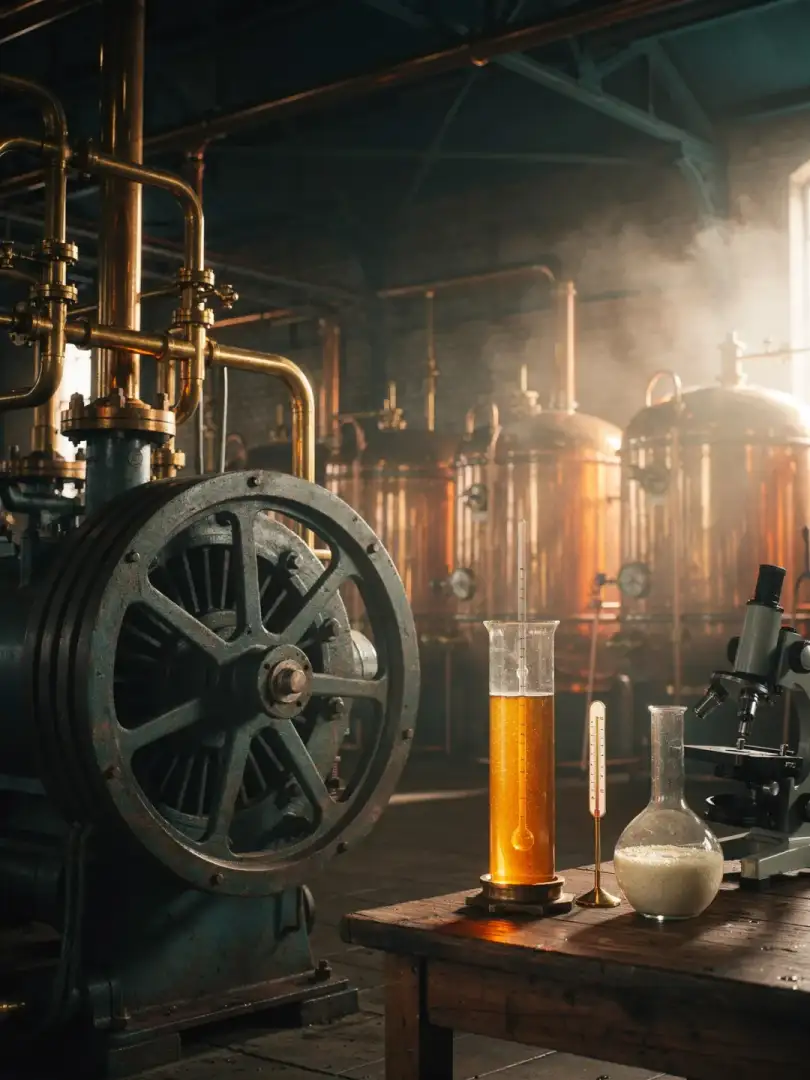
In the 19th century, craft became industry. Steam engines, thermometers and saccharometers, Linde's refrigeration machine, Pasteur's research, and Hansen's pure-culture yeast made beer predictable. Only then could bottom-fermented lager be brewed in large quantities all year round.
Porter, Steam, and Measuring Instruments: London First
The industrialization of brewing began in London. In the 18th century, porter breweries there grew into enormous operations with storage vats holding hundreds of thousands of liters. Toward the end of the century, major London brewers began using steam engines to grind malt and pump water.
Measuring instruments were at least as important. The thermometer made it possible for the first time to precisely control mashing and fermentation. The saccharometer, a float that measures the density of the wort, let brewers calculate how much extract a malt actually yielded. This revealed that pale malt was significantly more efficient than the dark brown malt previously used to brew porter.
The solution came in 1817 with Daniel Wheeler's drum roaster. It allowed small amounts of very dark roasted malt to be produced without burning it. From then on, London breweries brewed porter from mostly pale malt with a bit of roasted malt added for color. This technique still shapes porter and stout today.
The name stout shows just how closely the two are linked. Stout originally simply meant strong; a stout porter was an especially robust porter, and only later did the name shorten to stout. Guinness in Dublin made it famous, but Ireland didn't invent it. The popular story that a certain Ralph Harwood invented porter in 1722 also comes from a book published in 1802 and isn't backed by earlier sources. What's certain is only that porter emerged in 1720s London.
Linde's Refrigeration Machine: Lager in Summer
Bottom-fermented beer needs cold. The yeast works best between about 6 and 12 degrees Celsius, with the subsequent lagering even colder. Under Bavaria's 1553 brewing ordinance, brewing was only permitted between Michaelmas on September 29 and St. George's Day on April 23. For summer, a stronger beer was brewed in March—the Märzen—and stored in deep cellars, cooled with natural ice from lakes and ponds.
The engineer Carl von Linde, with support from Gabriel Sedlmayr, owner of the Spaten brewery in Munich, developed a compression refrigeration machine and was granted a Bavarian patent for it in 1873. By the mid-1870s, a machine was running continuously at Spaten. This freed breweries from dependence on ice and rock cellars. Lager could now be brewed anywhere, in any season, even in hot countries.
The effects still echo in today's styles. Because Märzen was brewed stronger for summer, it was heartier than the winter beer. In 1872, Spaten brought a Vienna-style Märzen to the Oktoberfest. At today's Wiesn, however, it's Festbier that flows—paler and golden-yellow, not amber-colored Märzen. The refrigeration machine made the seasonal workaround unnecessary, and the style survived as a specialty.
Pasteur and Hansen: Understanding Yeast
For millennia, brewers knew fermentation worked, but not why. Louis Pasteur showed that living microorganisms cause fermentation and that foreign microbes spoil beer. In 1876, he published his studies on beer. This led to new hygiene standards in the brewhouse and to pasteurization—brief heating to kill off microbes.
The next step was taken by Emil Christian Hansen in the laboratory of the Carlsberg brewery in Copenhagen. In 1883, he isolated a pure culture of bottom-fermenting yeast, grown from a single cell. It was the same yeast Carlsberg had received from Spaten in Munich back in 1845. With pure-culture yeast, a beer's flavor stayed consistent from batch to batch; Carlsberg shared the culture with other breweries.
Railway, Glass, and Bottle
The railway carried beer in refrigerated cars from the brewery to distant cities. Cheaper pressed glass turned the beer glass into an everyday object, and suddenly people could see what they were drinking: a clear, golden beer looked better in the glass than a cloudy, dark one. Crown caps and bottle filling followed toward the end of the century. All of this paved the way for a beer that began its triumphant rise around this time: Pils.