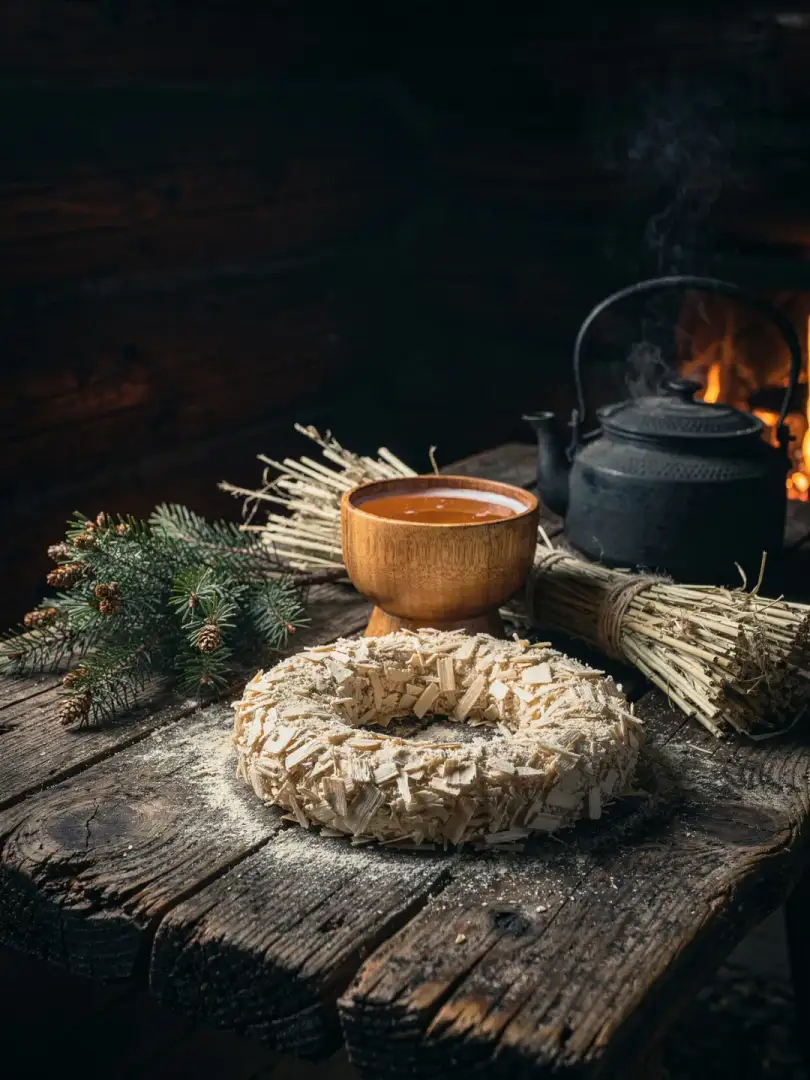
Yeast from the farm
Kveik and farmhouse yeasts: fermenting at up to 40°C
Kveik is Norwegian farmhouse yeast: families in western Norway passed it down through generations and traditionally added it to wort at 28 to 40°C (82 to 104°F). It often finishes fermenting in just one to two days and produces hardly any fusel notes despite the heat.
What is kveik? Yeast as a family heirloom
On farms in western Norway, families brewed their own beer, especially for celebrations like Christmas, weddings, and funerals. Nobody bought the yeast. It was collected after every brew, dried, and saved for next time. Kveik is an old dialect word for yeast, and it was treated with just that kind of everyday simplicity.
Drying was often done on wood, for instance on rings made of wood shavings called kveikringer, or on straw and cloth. In this state, the yeast can survive for months, sometimes longer. The tradition became known outside Norway largely through the Norwegian author Lars Marius Garshol. He visited farmhouse brewers, collected their cultures, and documented their methods.
Why can kveik handle such high temperatures?
The farmers added their yeast to warm wort, traditionally in the range of 28 to 40°C (82 to 104°F). An ordinary ale yeast at such warmth would produce many higher alcohols that taste like solvent, or simply tire out prematurely. Kveik, by contrast, often ferments the wort completely within one to two days. For brewers, that's unusually fast.
Anyone using kveik immediately notices the difference from familiar practice. Instead of laboriously cooling the wort, it can be pitched warm. Fermentation typically starts within a few hours. At the end, the yeast flocculates strongly, meaning it settles out well, as the 2018 study described for many of the strains examined.
In 2018, a research team led by Richard Preiss, which also included Garshol, examined kveik from nine Norwegian sources. The results were published in the journal Frontiers in Microbiology. The yeasts belong to Saccharomyces cerevisiae, but form a genetically distinct group within brewer's yeasts. The researchers found genetic changes that could be linked to heat tolerance, high alcohol tolerance, and rapid fermentation.
Flavor-wise, many kveik strains show fruitiness, often with notes of orange peel or tropical fruit. Clove is absent. The strains examined were POF-negative, meaning they don't produce 4-vinylguaiacol the way Bavarian wheat beer yeast does. Kveik is thus a counterexample to the rule of thumb that warm fermentation always tastes unclean.
Mixed culture instead of pure culture: what sets kveik apart
A kveik from a farm is typically not a single yeast, but a community of several strains. That's the opposite of what Emil Christian Hansen established in Copenhagen in 1883. Pure culture aimed to eliminate every uncertainty, while farmhouse culture lived alongside it, selecting over generations for whatever reliably produced good beer.
Today, yeast labs offer individual kveik strains as pure cultures, isolated from these mixtures. They're popular among homebrewers and craft breweries because they don't require elaborate cooling and finish quickly. For a classic lager, however, they're unsuitable. A Pils thrives on the cool fermentation of bottom-fermenting yeast and long cold storage, and that simply can't be shortcut.
Sahti, saison, and other farmhouse beers
Norway isn't alone in this tradition. Finland is home to sahti, a farmhouse beer that's often unboiled or only briefly heated, and filtered through juniper branches. It's traditionally fermented with baker's yeast. What would be considered a stopgap solution in a brewery is part of sahti's character, which can be spicy, sweetish, and slightly banana-like.
Belgian saison was, according to tradition, a beer for harvest workers in Wallonia, brewed in winter and drunk in summer. Today's saison yeasts are highly attenuative, making the beer dry, peppery, and spicy. Many of them carry a gene that also lets them break down residual starch. Experts call these diastaticus yeasts. In an ordinary brewery, such strains are feared, since they can keep fermenting in other people's bottles and build up excess pressure.
What these farmhouse yeasts have in common is that they come from an era when yeast was gathered rather than bought. Their legacy is now returning as a specialty, broadening what we understand top-fermenting yeast to be.