Wild fermentation
Spontaneous fermentation: lambic, koelschip, and Brettanomyces
Spontaneous fermentation means the brewer adds no yeast at all. The hot wort cools overnight in a shallow, open vessel called a koelschip, capturing wild yeasts and bacteria from the air. This is how lambic is made in Belgium, the foundation of gueuze and kriek.
What is spontaneous fermentation? Beer without added yeast
For an ordinary beer, the brewer selects a yeast strain and adds it to the cooled wort. With spontaneous fermentation, this step is skipped entirely. Fermentation is instead carried out by microorganisms living in the air, in the wood of the barrels, and in the walls of the brewery. It sounds like chance, but it follows centuries of accumulated experience.
The best-known example is lambic, from the area southwest of Brussels, the Pajottenland and the Senne valley. It's brewed from barley malt and a high proportion of unmalted wheat. The hops used are deliberately aged. They contribute almost no bitterness anymore, but retain their preservative effect against unwanted bacteria.
How does a koelschip work?
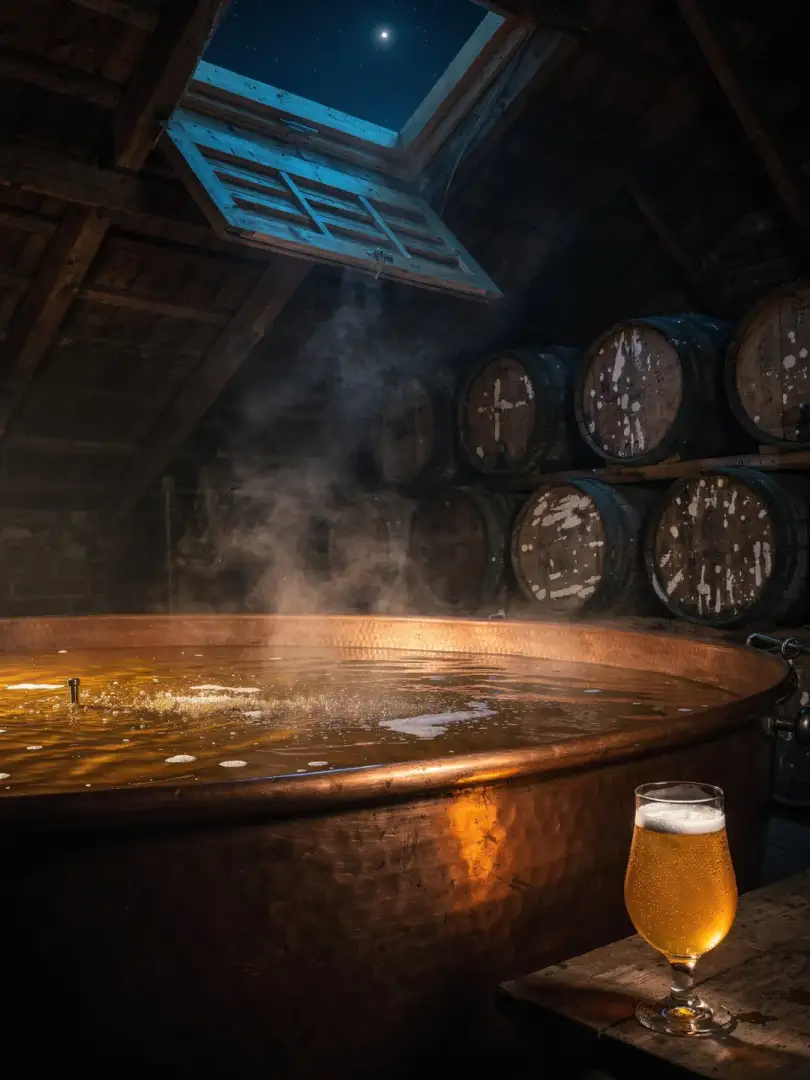
After boiling, lambic brewers pump the hot wort into the koelschip, a large, shallow vessel made of copper or stainless steel, usually positioned directly under the roof. Overnight, the wort cools. Night air streams in through ventilation openings, carrying with it a multitude of wild microbes. By morning, the wort is transferred to wooden barrels, where fermentation begins.
The vessel is shallow by design. A large surface area allows the wort to cool quickly and gives the air plenty of contact. Many of the microbes that later shape the fermentation, however, actually come from the wooden barrels and the building itself. Lambic brewers are therefore reluctant to alter their premises, since no one knows exactly which organisms reside in which beams.
Traditionally, lambic brewers only brew during the cold season, roughly from October to April. On warm nights, the wort cools too slowly, and unwanted microbes gain the upper hand. Belgian lambic brewers report that climate change is reducing the number of suitably cold nights. The brewing season, then, isn't mere tradition for its own sake, but a condition of the process itself.
Who ferments lambic? Yeasts, lactic acid bacteria, Brettanomyces
Fermentation unfolds in waves. First, bacteria from the Enterobacteriaceae family multiply, and the wort smells rather unpleasant during this phase. After a few days, Saccharomyces yeasts take over and ferment most of the sugar into alcohol. Over the following months, lactic acid bacteria such as Pediococcus follow, producing the characteristic, pronounced acidity.
The longest work is done by Brettanomyces, a wild yeast brewers simply call Brett. It works slowly, breaking down residual sugars that ordinary brewer's yeast leaves behind. In doing so, it produces aromas described as barnyard, leather, horse blanket, or tropical fruit. A lambic therefore ages for one to three years in the barrel before it's used.
Brettanomyces exists beyond spontaneous fermentation too. It was first described in the early 20th century at the Carlsberg laboratory, found in long-aged English ales, which is where the name, translating roughly to British fungus, comes from. The Trappist brewery Orval deliberately adds it at bottling today. In a Pils or Helles, by contrast, Brett is considered contamination.
Lambic, gueuze, kriek: what's what?
Young lambic is still, meaning without significant carbonation, and is served that way in Belgium as well. Gueuze is created when a blender combines young and old lambics, traditionally one-, two-, and three-year-old batches. The residual sugars of the young lambic ferment in the bottle, resulting in a drink that's lively, dry, and distinctly sour. Kriek is lambic aged on sour cherries.
Faro is a sweetened version of lambic, once an everyday beer in Brussels pubs. Related, but produced differently, are the Flemish sour beers such as the red ale of West Flanders. These also age for a long time in wood, but are fermented with a deliberately added mixed culture of yeasts and bacteria rather than through spontaneous fermentation.
The legal picture is worth a closer look. EU registrations for the simple names lambic, gueuze, kriek, and faro expired as of January 4, 2023. Only oude geuze and oude kriek are protected as a Traditional Speciality Guaranteed. This protection governs the process, not the place. That genuine lambic comes from the Pajottenland is living tradition and an agreement among producers, not an EU rule of origin.