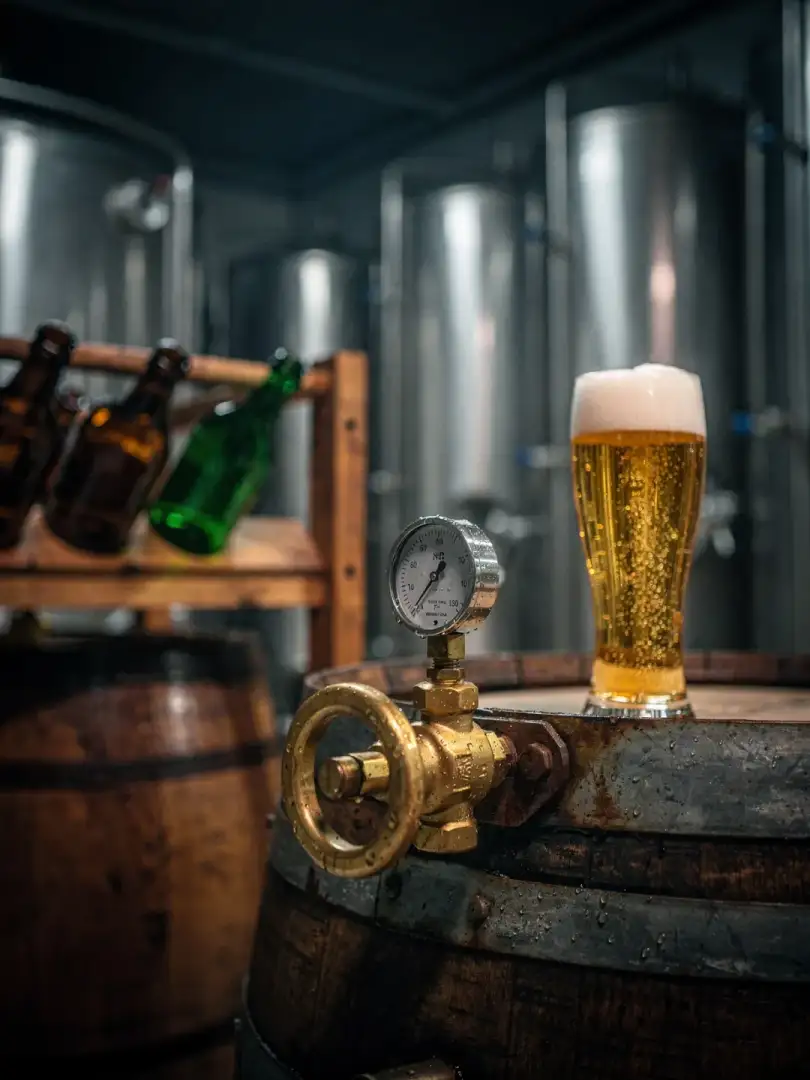
Maturity takes time
Secondary Fermentation, Lagering, Bottle Conditioning
Secondary fermentation and lagering turn young beer into finished beer: the yeast breaks down off-flavors like diacetyl, builds carbonation, and settles out. Lager beer matures for weeks at just above freezing for this purpose, while bottle-conditioned beers continue to mature right in the bottle.
What is young beer, and why does it need to mature?
Once most of the sugar has fermented, brewers call the result young beer, or green beer. It already contains alcohol but tastes rough around the edges. Typical traits include a green apple note from acetaldehyde, a buttery note from diacetyl, and sometimes a sulfury tinge. Carbonation is still weak, and haze particles float in the beer.
The yeast doesn't produce diacetyl directly. During fermentation, it excretes an odorless precursor, alpha-acetolactate, which slowly converts into diacetyl within the beer. Only afterward does the yeast reabsorb the compound and break it down into flavor-neutral substances. This takes time, active cells, and the right temperature. If the beer is packaged too early, the buttery note remains and can even intensify later on.
In the glass, insufficient maturation is often easy to spot. If a lager smells distinctly of butter or buttered popcorn, the yeast hasn't finished its job. In some Czech lagers and English ales, a touch of diacetyl is considered familiar and traditional, but in a German Pils or Helles it's regarded as a flaw.
How does secondary fermentation work in the lagering tank?
Classically, the young beer of a lager, still containing some residual fermentable sugar, goes into the lagering tank. There it ferments slowly onward. Because the tank is sealed, the carbon dioxide produced stays dissolved in the beer. Using a spunding valve, a kind of adjustable pressure-relief valve, the brewer controls the pressure and thus the beer's eventual carbonation level. This process is called spunding.
One variant is called kräusening. Here, the brewer adds a small amount of freshly fermenting wort, called kräusen, to the young beer. The fresh yeast it contains helps break down diacetyl, while the sugar provides carbonation. Many modern breweries instead rely on a diacetyl rest. At the end of primary fermentation, they let the beer warm up for a few days so the yeast can clean up more quickly.
Cold storage follows next, often near 0°C (32°F) for lager and lasting several weeks. In the cold, yeast and protein flocculate and sink to the bottom, the beer clarifies, and the flavor becomes rounder. How long it's stored is up to each brewery's house practice. Kölsch and Altbier go through this cold phase too, despite being top-fermented.
What is bottle conditioning? When the beer keeps living in the bottle
In bottle conditioning, the final fermentation takes place inside the sealed bottle. The brewer fills the beer with live yeast and adds a measured amount of sugar or unfermented wort. The yeast ferments this remainder and produces carbonation directly in the container. A fine yeast sediment settles at the bottom, which is considered part of the beer.
Belgian monastery beers, many saisons, and English bottle-conditioned ales are treated this way. Such beers evolve over months and years. A strong quadrupel can develop notes of dried fruit and sherry with age. A hop-forward beer, on the other hand, quickly loses its freshness, so long aging rarely benefits hoppy beers.
Some Belgian breweries even adopt the méthode champenoise, the bottle fermentation technique used for Champagne. The bottles are riddled until the yeast collects in the neck, then the yeast plug is disgorged. The beer is clear afterward and has very fine carbonation.
Cask and Wood Barrel: Maturing Right Up Until the Glass
In Britain, the maturation of cask ale isn't complete until it reaches the pub. The unfiltered beer goes into the cask with live yeast and continues to ferment there. The publican lets it rest in the cellar until it's clear and properly conditioned. The carbonation is kept deliberately low, giving the beer a soft, rounded character.
Beers matured in whisky or wine barrels pick up additional flavors from the wood. Wild yeasts such as Brettanomyces often live in the wood and continue working slowly. So the yeast remains active right to the end, even when hardly any sugar is left.