Fermentation Explained
What Does Yeast Do in Beer?
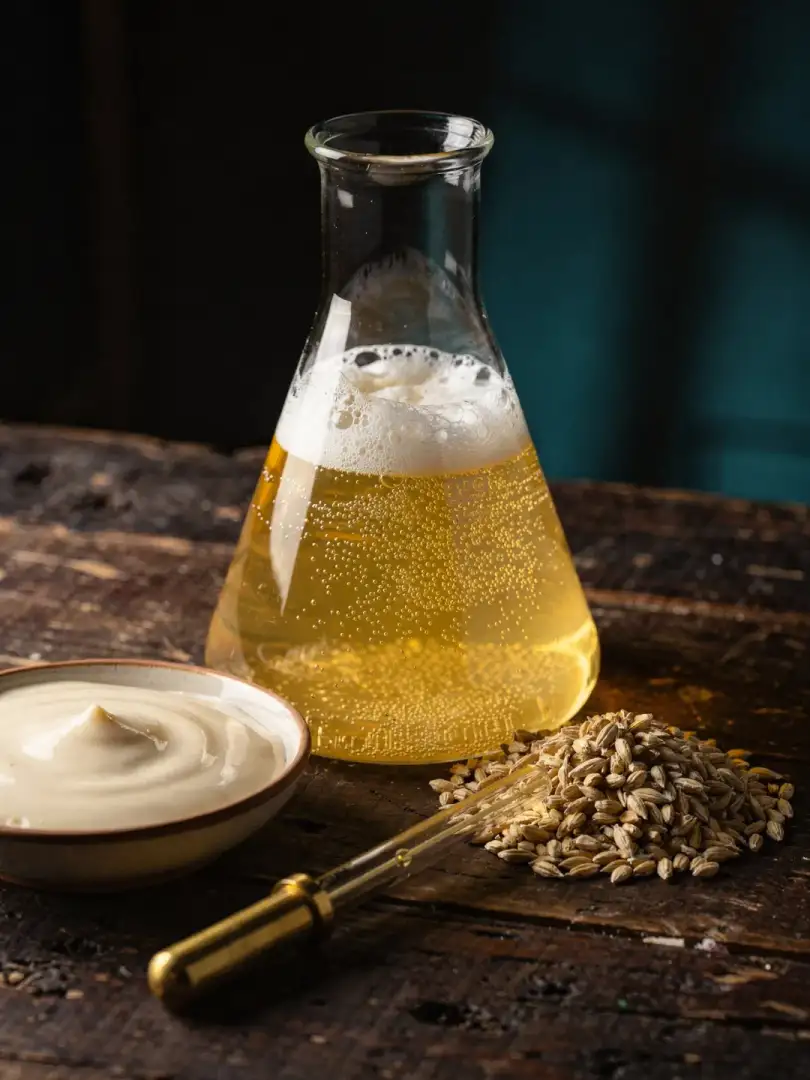
Yeast transforms sweet wort into beer: it consumes the malt sugar and turns it into alcohol and carbon dioxide. Along the way, hundreds of aroma compounds form that shape smell and taste. Without yeast, beer would remain a sweet, flat malt brew.
What Is Brewer's Yeast? A Single-Celled Fungus with a Big Appetite
Under the microscope, brewer's yeast looks unspectacular. You see roundish cells, each about five to ten thousandths of a millimeter in size. Biologically, it's a single-celled fungus of the genus Saccharomyces, which translates to "sugar fungus." Most brewing yeasts belong to the species Saccharomyces cerevisiae, which is also the source of baking and wine yeasts. For bottom-fermented beer, a related species is used, Saccharomyces pastorianus.
What makes yeast valuable is its metabolism. Lacking oxygen, it gains energy by breaking down sugar into ethanol, i.e. drinking alcohol, and carbon dioxide. For the cell, alcohol is a waste product. For the brewer, it's the reason wort becomes beer. Wort is the term for the sweet liquid produced when malt and water are mashed, which is then boiled with hops.
The math is simple: fermenting one gram of sugar yields roughly half a gram of alcohol and almost as much carbon dioxide. Some of the gas escapes during fermentation. The rest stays dissolved and later provides the sparkle in the glass.
How Does Fermentation Proceed? From Pitching Yeast to Green Beer
It begins with pitching, the term for adding yeast to the cooled wort. Breweries add many millions of cells per milliliter, often yeast harvested from an earlier brew. In the first hours, seemingly little happens. The yeast takes up oxygen, uses it to build components for its cell membrane, and multiplies. That's why brewers deliberately aerate the wort before pitching.
Once the oxygen is used up, the metabolism switches over. Now the yeast ferments the sugar, first simple types like glucose, then maltose, the main sugar in malt, and finally the larger maltotriose. A dense layer of foam forms on the surface, which brewers call kräusen. After a few days, activity subsides. The yeast sinks or rises to the top, depending on the strain.
How much sugar is ultimately fermented is described by the degree of attenuation. A high degree of attenuation produces a dry, lean beer. A low one leaves behind a full-bodied beer with noticeable residual sweetness. This depends on the recipe, the mashing process, and the yeast strain. Some strains barely ferment maltotriose, others nearly completely.
What Flavors Does Yeast Create? Esters, Phenols, and Off-Flavors
Besides alcohol, yeast produces a wealth of other substances. Esters are compounds of alcohol and acid that smell fruity, like pear, apple, or banana. Higher alcohols, also called fusel alcohols, have a warming effect in small amounts and a solvent-like character in large amounts. Phenols recall clove or smoke and occur in significant amounts only in certain strains.
There are also compounds that form during fermentation and are meant to disappear again later. Diacetyl smells of butter or caramel candy, acetaldehyde of green apple, hydrogen sulfide of rotten egg. Healthy yeast reabsorbs these substances during the maturation phase. If they remain in the finished beer, they're considered beer flaws.
How much of all this the yeast produces is controlled mainly by temperature. Fermented warm, more esters and higher alcohols form; fermented cool, the beer stays cleaner. Tank pressure, the amount of pitching yeast, and the composition of the wort also shift the picture. Among brewers, there's a saying that they make the wort, but the yeast makes the beer.
Yeast and the Reinheitsgebot: Why Wasn't It Mentioned in 1516?
Anyone reading the wording from 1516 finds "allain Gersten, Hopffen und Wasser" (only barley, hops, and water). Yeast isn't mentioned. That doesn't mean brewing happened without yeast. Brewers passed the sediment from a successful brew into the next one, or let the wort ferment in vessels still coated with yeast from the last time. Bamberg even explicitly named yeast in its brewing regulations in 1489. What was missing was an explanation.
That living cells cause fermentation was only shown by Louis Pasteur in the 19th century. In 1883, the first pure culture of a bottom-fermenting yeast was achieved in the laboratory of the Carlsberg brewery. In Bavarian law, yeast has only explicitly appeared in the list of ingredients since 1910, with the formula "malt, hops, yeast, and water."
Today, yeast is the main reason beer falls into style families at all. Whether a beer is top-fermented or bottom-fermented determines its flavor, brewing method, and in Germany even which ingredients are legally permitted. That's the subject of the next stop.