Two Yeast Families
Top-Fermented and Bottom-Fermented: The Difference
Top-fermented and bottom-fermented differ by yeast: top-fermenting yeast works warm at about 15 to 25 °C and used to rise to the top, while bottom-fermenting yeast ferments cool at around 6 to 12 °C and settles at the bottom. From this follow flavor, beer style, and in Germany even legal rules.
Top-Fermented and Bottom-Fermented: What Do the Names Mean?
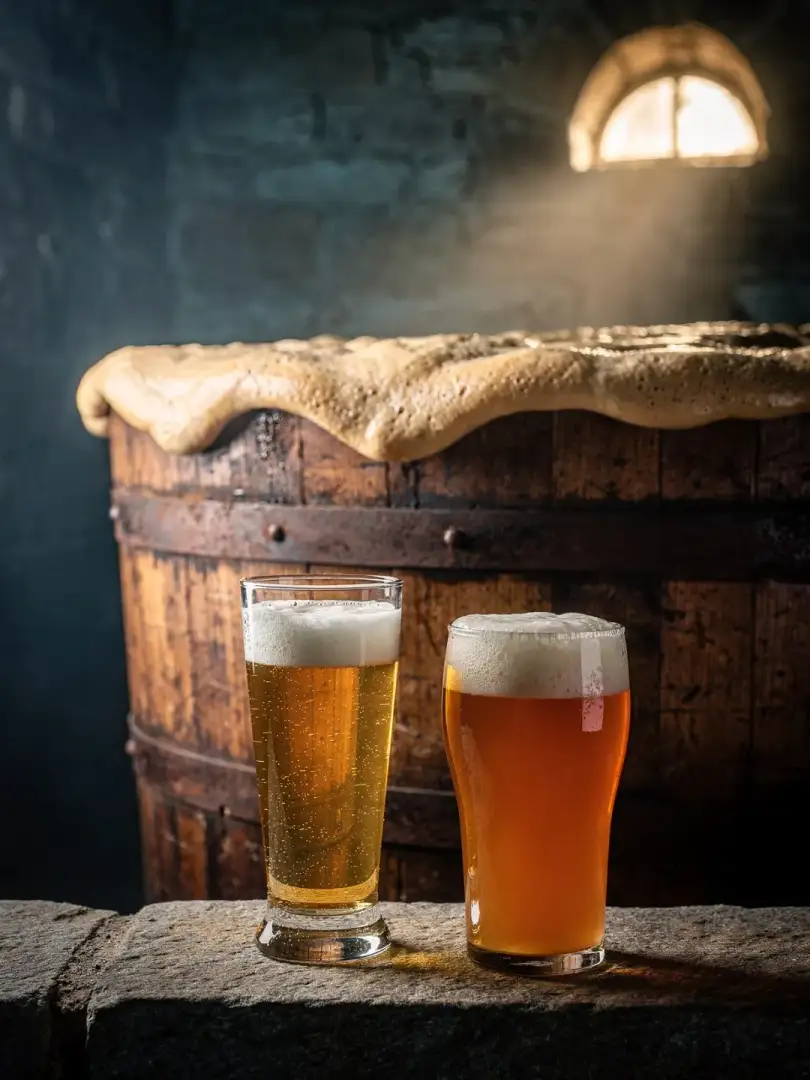
The terms date from when fermentation happened in open vats. Top-fermenting yeast attached itself to carbon dioxide bubbles and rose to the top in a thick layer. Brewers skimmed it off there and added it to the next brew. Bottom-fermenting yeast clumped into flakes toward the end of fermentation and sank to the bottom, where it was harvested after the green beer was drained off.
In modern cylindroconical tanks, that is, tall fermentation tanks with a cone-shaped bottom, both yeasts end up settling at the bottom. The old names have stuck anyway, because they denote two yeast types with quite different characters. In English, one speaks of ale yeast and lager yeast, meaning the same distinction.
Why Does Top-Fermented Beer Taste Fruitier Than Bottom-Fermented?
Top-fermenting yeast of the species Saccharomyces cerevisiae works best between about 15 and 25 °C. In this warmth, its metabolism is lively, primary fermentation often takes only three to five days, and considerably more esters are produced. An English pale ale therefore often smells of pear or red fruit, even though no fruit is in it. Belgian yeasts go further, contributing notes of spice, pepper, or clove.
Bottom-fermenting yeast, Saccharomyces pastorianus, copes better with cold. Classically it ferments at about 8 to 10 °C, with some breweries going even lower. Fermentation takes longer, usually a week or more. The result is a clean beer in which malt and hops come through clearly. A good Pils tastes of grain and hops, not of yeast. That's exactly the intention.
In the lab, the two families can also be distinguished by a sugar. Lager yeast can metabolize melibiose, while most ale yeasts cannot. This is irrelevant to flavor but useful for identifying a strain.
Kölsch, Altbier, Pils, Helles: Which Beer Belongs Where?
Many mix-ups resolve themselves as soon as you ask about the yeast. Pils, Helles, Export, Märzen, Dunkel, Schwarzbier, and most bock beers are bottom-fermented. Wheat beer, Kölsch, Altbier, British ales, porter, stout, and Belgian monastery beers are top-fermented. Color says nothing about this, since there are pale and dark beers in both families.
Kölsch and Altbier are the most instructive cases here. Both are fermented with top-fermenting yeast, but then cold-conditioned for weeks like a lager. Kölsch is pale, lean, and only lightly fruity. Altbier is copper-brown, maltier, and usually more strongly hopped. Anyone who mistakes a Kölsch for a Pils is confusing color with yeast.
For beginners, a simple test helps. If a pale beer smells distinctly of pear or apple, it most likely has top-fermenting yeast behind it. If it smells mainly of bread, grain, and hops, it's very probably a lager. The test isn't foolproof, since Kölsch in particular is deliberately fermented restrainedly and cold-conditioned.
There are surprises the other way too. Baltic porter, a strong dark porter from the Baltic region, is nowadays usually brewed with lager yeast. California Common, formerly called steam beer, ferments lager yeast at temperatures more typical of ales. Such borderline cases show: yeast determines the family, temperature helps shape the character.
Top- and Bottom-Fermented in German Beer Law
In Germany, this distinction has concrete consequences. The Provisional Beer Law was repealed in 2005, but its beer rule in § 9 still applies. Under it, bottom-fermented beer may consist only of barley malt, hops, yeast, and water. For top-fermented beer, other malt is additionally permitted, such as wheat or rye malt, as well as technically pure cane, beet, or invert sugar, starch sugar, and coloring agents made from these.
Bavaria makes an exception. There, the strict rule also applies to top-fermented beer, and sugar remains off-limits. A Bavarian wheat beer may contain wheat malt, since it's top-fermented, but no sugar. A Pils made with wheat malt, by contrast, couldn't legally be sold as beer anywhere in Germany without a special exemption. Yeast thus also decides what's allowed in the brew kettle.