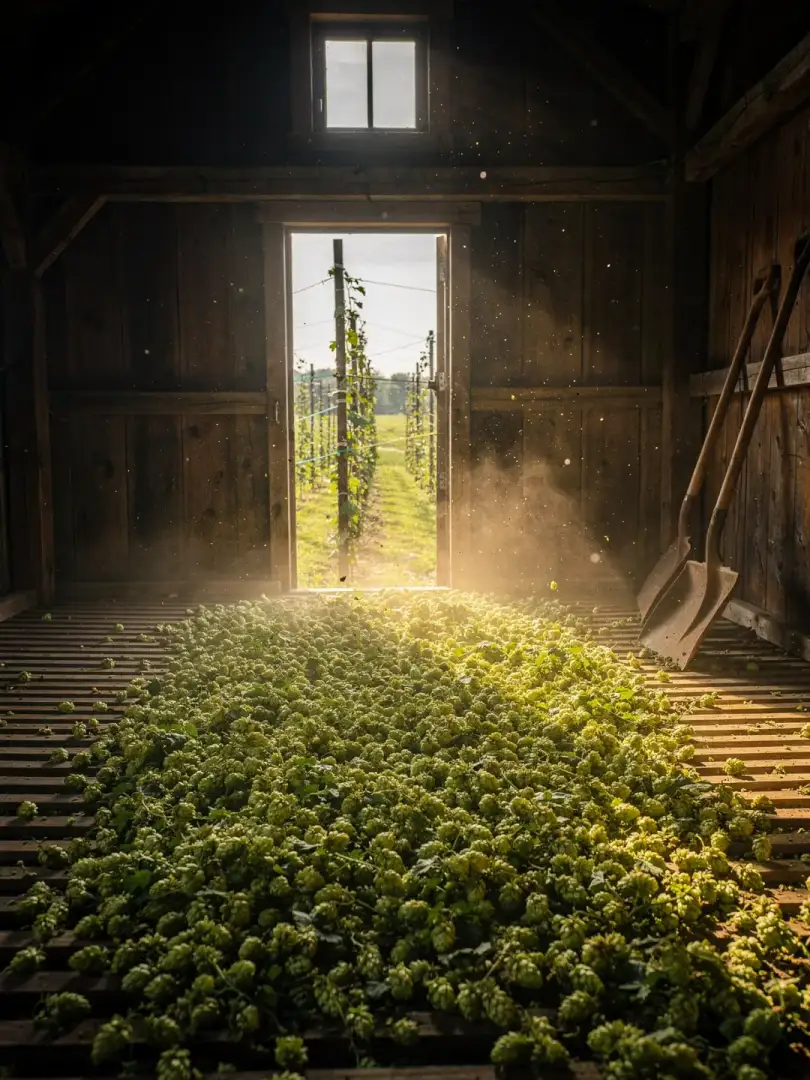
From the garden to the kiln
Hop growing: trellis systems, harvest, drying
Hops grow in hop gardens on trellis systems of poles and wires about seven meters high. In Central Europe, harvest takes place from late August to mid-September, after which the cones dry within a few hours on the hop kiln.
Hop garden and trellis: how hops grow
A hop garden looks from a distance like a forest of telegraph poles. Wires are strung between wooden or concrete poles at a height of about seven meters. In spring, growers attach climbing strings to each rootstock, up which the vines climb. Training the plants, that is, winding the first shoots clockwise, remains manual work to this day.
In May and June, hops can grow more than a hand's width on good days. By the end of June, they have reached trellis height, in July they flower, and in August the cones ripen. The plant needs deep soils, enough rain and long summer days. This is why the major growing regions lie in temperate latitudes, both in the Northern and Southern Hemispheres.
Diseases, pests and climate change in hop growing
Downy and powdery mildew, as well as hop wilt, a disease caused by soil fungi, can damage entire gardens. Add to that aphids and spider mites. Many old landrace varieties are particularly susceptible, which is why breeders have been searching for decades for more resistant varieties with similar aroma.
Heat and drought take a toll on hops, especially their alpha acids. In dry summers, the harvest is smaller, and the values fluctuate more strongly. Many farms now irrigate using drip hoses. At the same time, demand is falling: for the 2025 harvest, German farms took around 1,300 hectares out of production, because less beer is being drunk worldwide and prices have fallen.
Hop harvest: a few weeks in late summer
Growers check the right time by the cone itself. It feels dry and papery, the lupulin is golden-yellow, the aroma is strong. Harvested too early, aroma is lacking; too late, the oils oxidize, the cones discolor and fall apart. For each variety there's a window of just a few days, and farms stagger the harvest by variety.
The entire vine is harvested. A machine tears it, along with the climbing string, off the trellis; back at the farm, a stationary picking machine strips off the cones, with blowers and belts separating leaves and stems. Until the postwar period, seasonal workers picked the cones by hand, and in the growing regions, hop picking was an event that drew helpers from both town and countryside.
Drying on the hop kiln
Fresh cones contain about three-quarters water and would spoil within hours. On the hop kiln, a multi-story drying oven, warm air flows up from below through the layers of hops. Drying is done gently at moderate temperature until only about ten percent moisture remains. Too much heat would drive off the oils, too little would let the hops grow moldy.
In Kent and Sussex, you'll find the round oast houses with their pointed white caps, old hop kilns that today often serve as homes. After kilning, the hops are cooled, pressed into bales, and sold as raw hops to processors. They test alpha acid content and origin, certify the batch, and mostly turn it into pellets.
Green hop beer: beer from freshly picked cones
Once a year, some breweries skip the kiln entirely. They bring the cones straight from the field and add them to the brew the same day. Such green hop or harvest beers, called wet hop beer in English, smell grassy, juicy and very fresh. They exist only in late summer and fall, and almost only close to the growing region, because moist hops can't travel.
Green hops are hard to dose. Since they still contain their water, you need many times the quantity, and alpha acid and oil content can barely be measured beforehand. Every harvest beer therefore turns out a little different, which is exactly what many enthusiasts appreciate.