Hops in form
Hop pellets, cones, extract and cryo hops
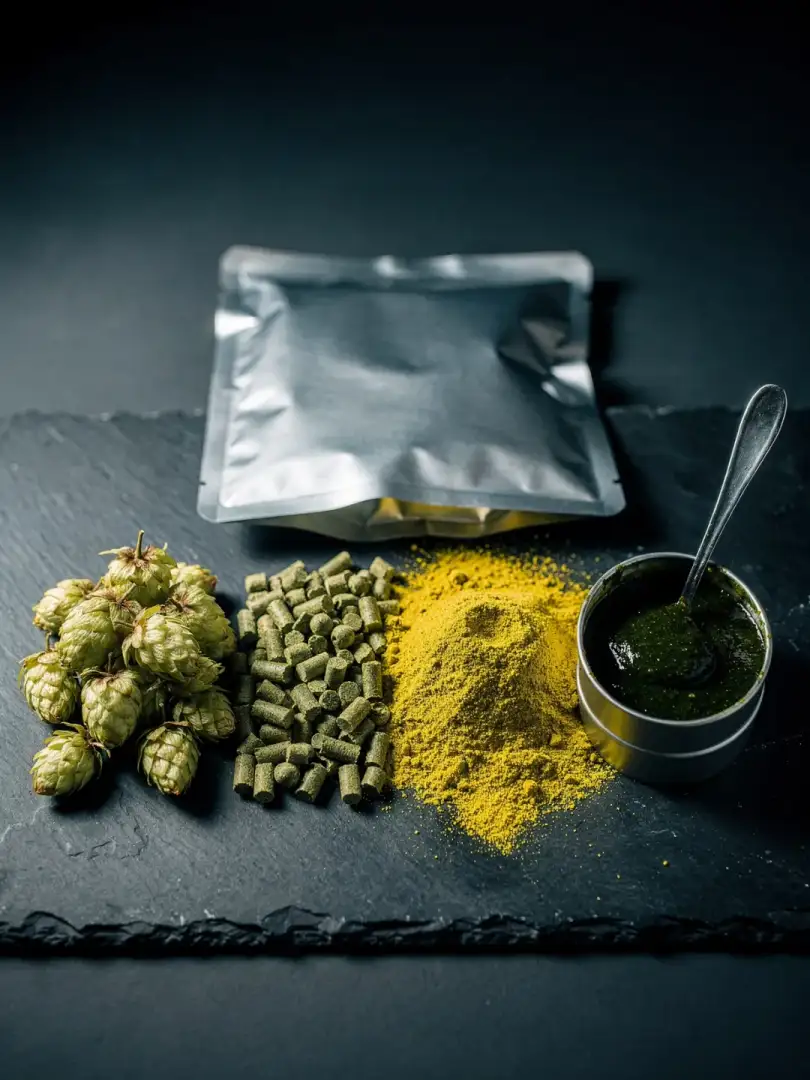
Hop pellets are ground hops pressed into small cylinders, the most common form in the brewhouse. There are also whole cones, hop extract, and lupulin powder such as cryo hops. All come from the same cone, but they behave differently in the kettle.
Whole cones: natural hops in bales
Dried whole cones, pressed into bales, are the most original form. Some breweries swear by them and advertise cone hopping. Whole cones give a fresh, green aroma and form a loose filter bed in the hop strainer, through which the wort drains. Their drawback: they take up a lot of space, oxidize faster than pressed forms, and soak up wort, which is lost to the brewer.
In the British tradition of cask ale, which matures unfiltered in the cask and is tapped straight from the cellar in the pub, a handful of cones often go into the cask as well. There they steep until serving and give the beer its aroma.
Hop pellets: Type 90 and Type 45
For pellets, dried hops are ground and pressed through a die, similar to animal feed. The small green cylinders are dense, can be vacuum-packed and stored cold, and dosed precisely. Type 90 means: from 100 kilograms of raw hops, about 90 kilograms of pellets result, keeping practically everything. With Type 45, some of the leaf material is sifted out beforehand, concentrating the lupulin.
In the hot wort, pellets break down into a green slurry. It settles in the whirlpool, a vessel in which the wort circulates after boiling and collects its sediment in the center. The yield of bittering compounds is slightly higher with pellets than with cones, because the crushed glands lie more exposed.
Hop extract: bittering compounds from the can
Hop extract is made by dissolving resins and oils out of the hops using liquid carbon dioxide or alcohol. What remains is a sticky, green-brown mass, delivered in cans. It provides a clean, well-calculated bitterness, few tannins, and saves storage space. Large breweries use extract mainly for base bitterness and add aroma later with pellets.
Under German beer law, hop powder, pellets and extract made solely from hops count as hops and are permitted even for beers under German regulations. Chemically modified hop products, such as reduced iso-extracts, are another matter. Breweries abroad use them so that beer in clear glass bottles doesn't develop a lightstruck flavor. In Germany, these are widely considered not permitted.
Cryo hops and lupulin powder: aroma concentrated
A more recent development breaks the cone down into its parts. At very low temperatures, the lupulin becomes brittle and can be sifted away from the leaflets. The result is a yellow, concentrated powder sold under names like cryo hops or lupulin powder. According to manufacturers, it provides roughly double the aroma strength with significantly less plant mass.
For Hazy IPAs with large cold hop additions, this is an advantage. Less leaf material means fewer grassy and astringent, that is, puckering, notes, and less beer loss in the hop trub at the bottom of the tank. There are also liquid aroma extracts and individual oil fractions, which brewers use to dose specific aroma components precisely.
Fresh hops: oxygen is the enemy
Whatever the form: hops age. Alpha acids oxidize, oils dissipate, and very old hops smell like cheese, because isovaleric acid and related fatty acids form from the bittering compounds. This is why dealers and breweries store hops cold, dark and under protective gas. The Hop Storage Index, or HSI, shows in the lab how much a batch has aged.
For lager beers like Pils or Helles, pellets and extract are entirely sufficient if they're fresh. For beers whose strength is their aroma, however, freshness matters more than the form. An IPA made from fresh pellets smells better than one made from old whole-cone hops, no matter how romantic the label sounds.