Grain becomes sugar
What is malt? Why beer needs malt
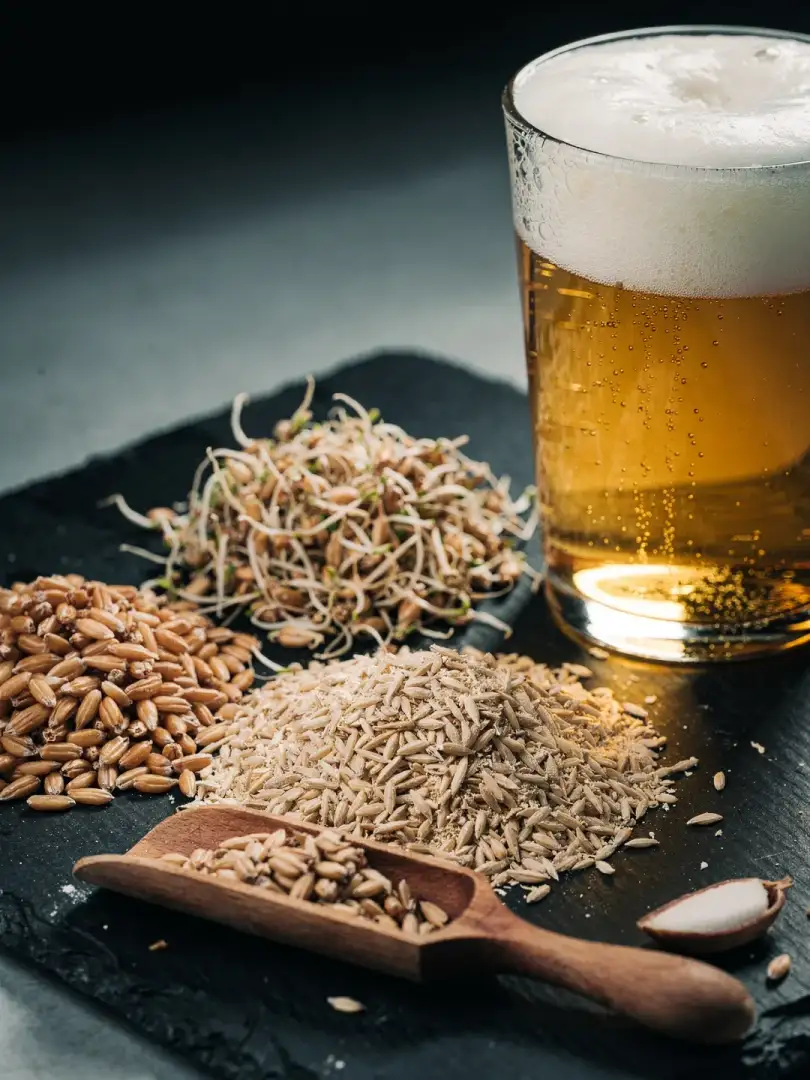
Malt is grain that has been allowed to germinate and is then dried. During germination, the kernel forms enzymes that later convert its starch into sugar in the brewhouse. Only this sugar can be fermented by yeast into alcohol and carbon dioxide. Without malt, there would be no beer as we know it.
Why does beer need malt and not just grain?
A barley kernel is a storage package. Inside it, in the endosperm, starch is stored: long chains of sugar building blocks that the seedling is meant to live on until it has leaves of its own. Yeast can't do anything with these long chains. It needs small sugars like maltose, in other words malt sugar, or glucose. Anyone who stirs raw, crushed barley into water and adds yeast will get hardly any alcohol, just a cloudy, bland mash.
Nature has long since solved this problem. As soon as a kernel becomes moist and begins to germinate, it forms enzymes, proteins that act as tools to speed up chemical reactions. Some break down starch, others loosen the cell walls or split proteins. The maltster uses precisely this moment. He lets the kernel germinate until the tools are in place, then stops the growth with warm air. What remains is malt: a stable, storable kernel full of starch and full of enzymes waiting to be put to work.
What malt does in the finished beer
In the brewhouse, the malt is crushed and mixed with warm water. This step is called mashing. Now the enzymes get to work, converting the starch into fermentable and unfermentable sugars. The sweet liquid that results is what brewers call wort. How much dissolved matter it contains is indicated by the original gravity, measured in percent or degrees Plato. A pilsner usually sits around 11 to 12 percent. In Germany, a beer may only be called a bock or strong beer once it reaches 16 percent original gravity.
Malt delivers far more than sugar. It's the source of colour and flavours like bread crust, honey, caramel, coffee, or chocolate. It gives beer body, that sense of fullness on the tongue, because part of the sugar remains unfermented. And it brings protein, which together with substances from the hops supports the foam. Hops, in turn, contribute bitterness and aroma, while yeast shapes alcohol and fruity notes. Malt is the framework everything else hangs on.
Why almost always barley? Malt from other grains
Almost any grain can be malted, from wheat to rye, oats, or even millet. Barley has nonetheless become the dominant grain, and for solid reasons. Its kernel is wrapped in a tough husk, a sheath of tough bracts. Later, in the lauter tun, these husks form a filter bed through which the wort runs clear. Barley also produces plenty of enzymes during germination, enough to help convert the starch of grains that have few enzymes of their own.
Wheat has no husk and more protein. It makes a beer cloudier and the foam firmer, but is harder to lauter, that is, harder to separate from the solid residue. That's why even a wheat beer always contains a portion of barley malt. Germany's beer law regulates which malts a beer brewed there may contain: bottom-fermented beers like pilsner or helles may only contain barley malt, while top-fermented beers like wheat beer or Kölsch may also contain other malts.
Malt, malt beer, whisky: where the paths diverge
The words are often misleading. Malt beer, also called Malztrunk in Germany, is indeed brewed from malt and water, but it's usually barely fermented or not fermented at all, then sweetened. It's a refreshing drink related to beer, not a fermented beer. Malt extract, meanwhile, is concentrated wort, a thick syrup prized by bakers and home brewers.
The road to malt whisky starts the same way: barley malt is mashed, the wort fermented. Distilleries, however, skip the hops and then distil the fermented liquid. Beer remains a fermented, undistilled drink. Wine, on the other hand, needs no malt at all, because grape juice already brings its sugar ready-made. The detour through germination is what sets beer apart from both.
Anyone who chews on malt by itself quickly understands a great deal. Pale pilsner malt tastes of grain and fresh bread, Munich malt of bread crust, roasted malt of espresso. Many breweries pass around a handful during tours. Every beer builds on this flavour, whatever style ends up on the label.