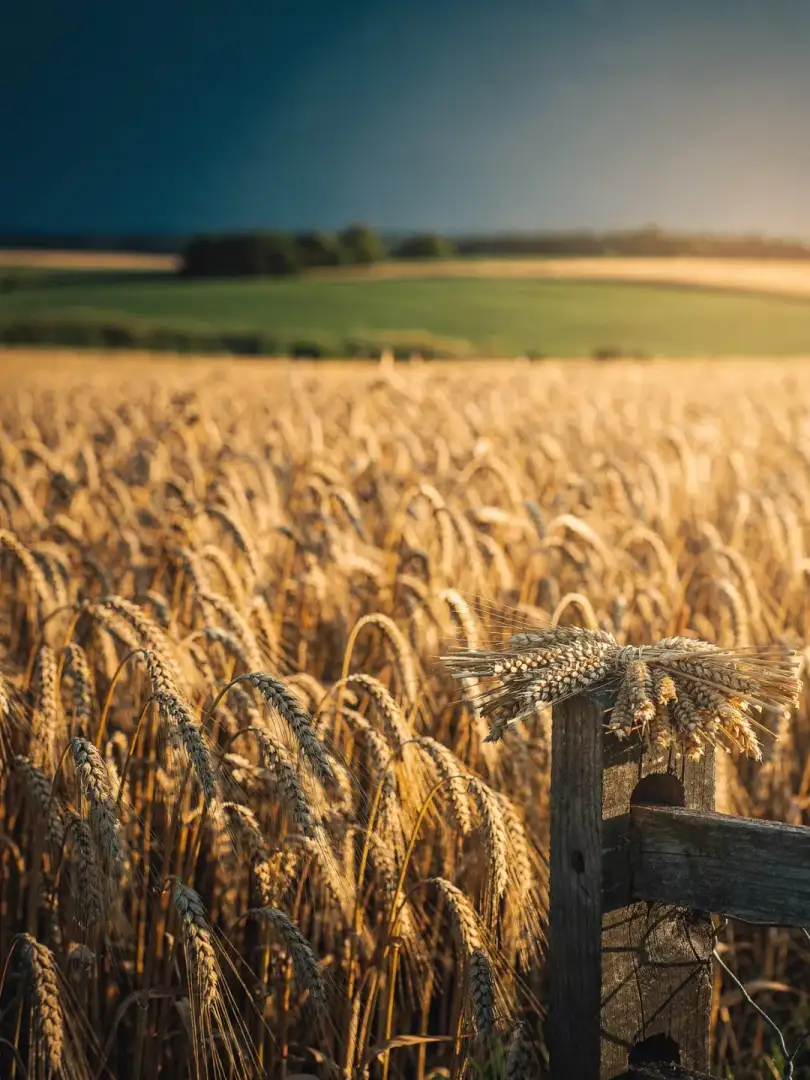
From field to malt
Malting barley: what makes good malting barley
Malting barley is barley suited to malting: usually two-row spring barley with low protein, large, uniform kernels, and strong germination capacity. Only part of the harvested barley clears this bar; the rest becomes feed. The variety also determines how the malt will later behave in the brewhouse.
Two-row or six-row barley: a look at the ear
Looking down at a barley ear from above, you'll see either two or six rows of kernels. At each node of the ear's spine sit three small flower clusters. In two-row barley, only the middle one forms a kernel, but a large, plump, even one. In multi-row barley, usually six-row, all three bear kernels. These kernels stay smaller and less uniform, with more husk and more protein.
For the maltster, uniformity is what counts. Kernels of equal size absorb water at the same rate and germinate in step, giving an even malt. That's why Europe brews almost exclusively with two-row barley. In North America, six-row barley was long the norm. It has one advantage: its enzyme reserves are large enough to help convert corn or rice in the mash as well. The chapter on raw grain returns to this point.
Why should malting barley have low protein?
For German malting barley, a crude protein content of roughly 9.5 to 11.5 percent is the target range. Above that, brewing quality suffers. Every extra percent of protein means less starch in the kernel and therefore less extract, that is, less dissolved material for the wort. Protein-rich barley also malts less evenly, and surplus protein in the finished beer binds with tannins to form haze, especially noticeable when the beer is chilled.
That said, it can't go entirely without protein either. Yeast needs amino acids as food, and the foam depends on certain proteins. Farmers therefore deliberately apply nitrogen sparingly to malting barley. The weather has its say too: drought during grain filling often pushes the protein level up. If a batch falls outside the range, the maltings will either dock the price or refuse it altogether, and the barley ends up in the feed trough.
Spring barley, winter barley, and celebrated varieties
Spring barley is sown in spring and harvested in summer. Its short growing season keeps protein levels low, which is why it's considered the classic malting barley in Germany. Winter barley is sown in autumn and yields more, but long had a reputation for being too protein-rich for malting. Two-row winter barleys now exist, however, that maltsters are happy to accept.
Malting barley thrives best in a temperate climate with cool nights and sufficient rain during grain filling. Major growing regions lie in France, Germany, the UK, Denmark, Canada, and Australia. Many countries with a huge thirst for beer cannot meet their own demand and buy in barley or finished malt. So a lager from Asia or Africa may well contain European or Australian barley, without the label ever revealing it.
Some varieties are nearly legendary among brewers. Maris Otter, a two-row winter barley, was introduced in 1966 by the British Plant Breeding Institute near Cambridge and still shapes many English ales with a full, nutty malt profile. Golden Promise, a spring barley, was grown in Scotland from 1967. It was created when breeders irradiated an older variety to produce shorter, sturdier stalks. Most modern varieties, by contrast, disappear again after a few years, replaced by new ones offering higher yields or better specifications.
How a variety becomes malting barley: the Berlin Programme
In Germany, a new barley variety must pass several years of testing before maltsters buy it on a large scale. In the so-called Berlin Programme, it's grown, trial-malted, and brewed. Only afterwards does the malting barley association issue a processing recommendation. Farmers generally only grow varieties with this recommendation, since otherwise they'd find few buyers.
At harvest, the maltings tests every batch. What matters is germination capacity, moisture, protein, the share of plump kernels, and possible fungal contamination. Mixed batches are unpopular, since different varieties germinate at different speeds. Some craft breweries now market barley from a particular region or even a specific farm. Differences between varieties and origins are detectable on the palate, but they tend to remain subtler than the difference between pale and dark malt.