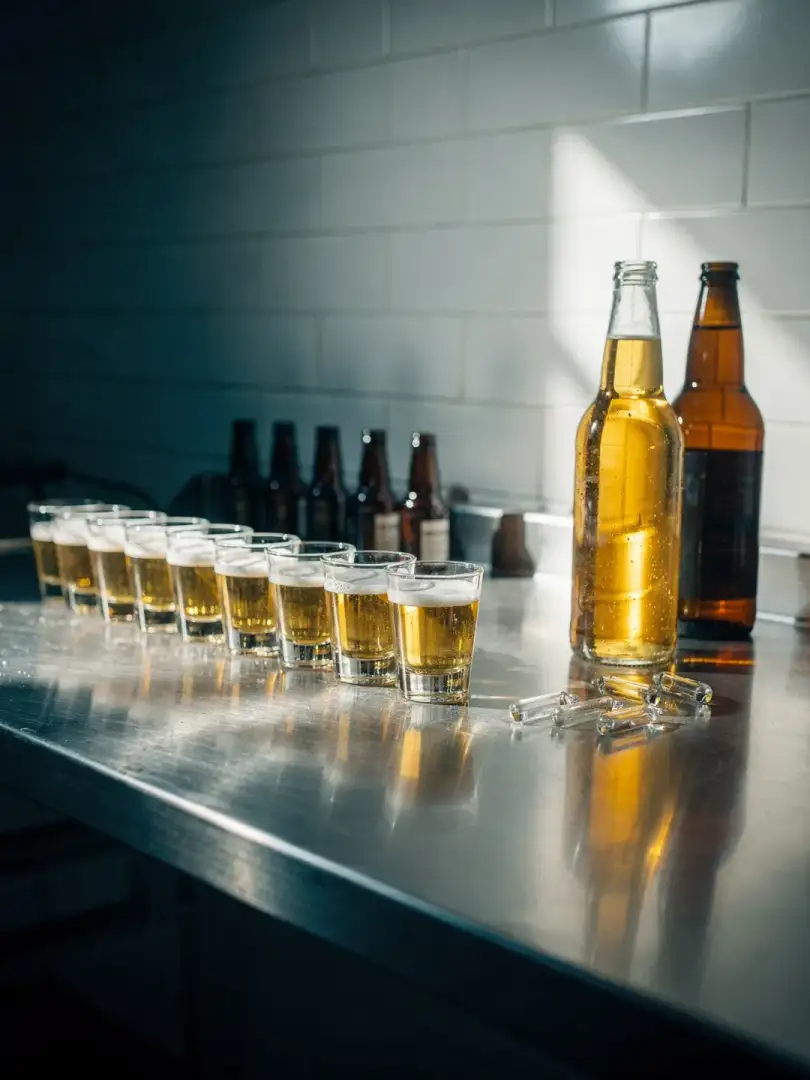
Spotting Off-Flavors
Beer faults: lightstruck flavor, diacetyl, DMS, oxidation
Beer faults are aromas and flavors that don't belong in a given style. The most common are lightstruck character, buttery diacetyl, cooked-vegetable DMS, and cardboard-like oxidation. Some originate at the brewery, others develop later at the shop or at home.
What Is a Beer Fault? Always a Question of Style
An off-flavor isn't a verdict on taste itself, but on whether it fits. Acidity in a Lambic is intentional; in a Pils, it signals bacterial infection. Barnyard notes from Brettanomyces belong in an Orval, not in a Helles. That's why every fault analysis starts with the same question: What does this style call for?
Many fault compounds are detectable even in tiny amounts. Scientists determine perception thresholds for this purpose—the concentration at which roughly half of trained tasters notice a compound. The figures below are reference values from the technical literature. They vary considerably depending on the beer and the taster.
Lightstruck Flavor: Why Does Beer Smell Like Skunk?
Light changes beer faster than any other fault. Blue and ultraviolet light, with the help of riboflavin—a vitamin from the malt—breaks down the hop's bittering compounds. This produces 3-methyl-2-butene-1-thiol, or MBT for short. It smells like skunk, burnt rubber, or cat spray.
The nose is extremely sensitive to it. A study by the American Society of Brewing Chemists (ASBC) found a perception threshold of about 7 nanograms per liter—billionths of a gram. Brown glass largely filters out the harmful light, while green and clear glass barely do. Beers in clear glass can often be identified by smell after only a short time on the cooler shelf.
Diacetyl and DMS: Butter and Canned Corn in Beer
Diacetyl smells like butter or buttered popcorn and feels oily on the palate. Yeast forms a precursor to it during fermentation and breaks it back down during a rest period. If the beer is chilled or bottled too early, the buttery flavor remains. Bacteria in the tap system can also produce it. The ASBC lists a threshold of 0.10 to 0.30 milligrams per liter, depending on the beer.
Diacetyl isn't taboo everywhere. BJCP guidelines tolerate a light touch of it in certain Czech lagers and English ales. In a German Pils or Helles, it counts as a clear fault.
DMS, dimethyl sulfide, smells like canned corn, cabbage, or tomato sauce. Its precursor is found mainly in very pale Pilsner malt. A vigorous, open boil of the wort drives it off, while slow cooling leaves it behind. The reference threshold is around 30 to 50 micrograms per liter. In some pale lagers, a hint of it is considered typical.
Spotting Oxidation and Other Off-Flavors
Beer ages with oxygen. First the hop aroma fades, then notes of wet cardboard or paper appear. Trans-2-nonenal, among other compounds, is responsible, with a threshold around 0.12 micrograms per liter. Later come honey, sherry, and dried fruit. In a Barley Wine or Imperial Stout, such aged notes can be appealing; in a Pils, they are not.
Other classics include acetaldehyde, which smells of green apple and signals an overly young beer, and metallic notes that taste like coins. Sour, vinegary notes in a clear lager point to infection. Once you've consciously smelled such notes—say, using lab-prepared sensory kits—you'll recognize them reliably afterward.
Not every fault originates at the brewery. Lightstruck character often develops only at the shop or out on the balcony, oxidation through long, warm storage. A dirty tap faucet can bring diacetyl and sourness into the glass even though the beer in the keg was flawless. So if you notice an off-flavor, feel free to ask about it at the bar. A good establishment takes the feedback seriously and checks the lines or opens a fresh container.