Twelve Degrees, Pale
Beer Styles
What does '12 degrees' mean for Czech beer? It refers to the original gravity, the proportion of dissolved solids in the wort before fermentation, measured in degrees Plato. Twelve degrees does not mean twelve percent alcohol, even though the number on the tap might suggest it. Such a beer typically has around five percent alcohol.
In the Czech Republic, beers are commonly classified by original gravity: draft beer (výčepní) at around ten degrees, lager (ležák) at eleven to twelve degrees, and special beer (speciál) above that. The Budweis breweries produce all these categories. Samson bottles a ten-degree beer, two lagers at eleven and twelve degrees, and a dark beer.
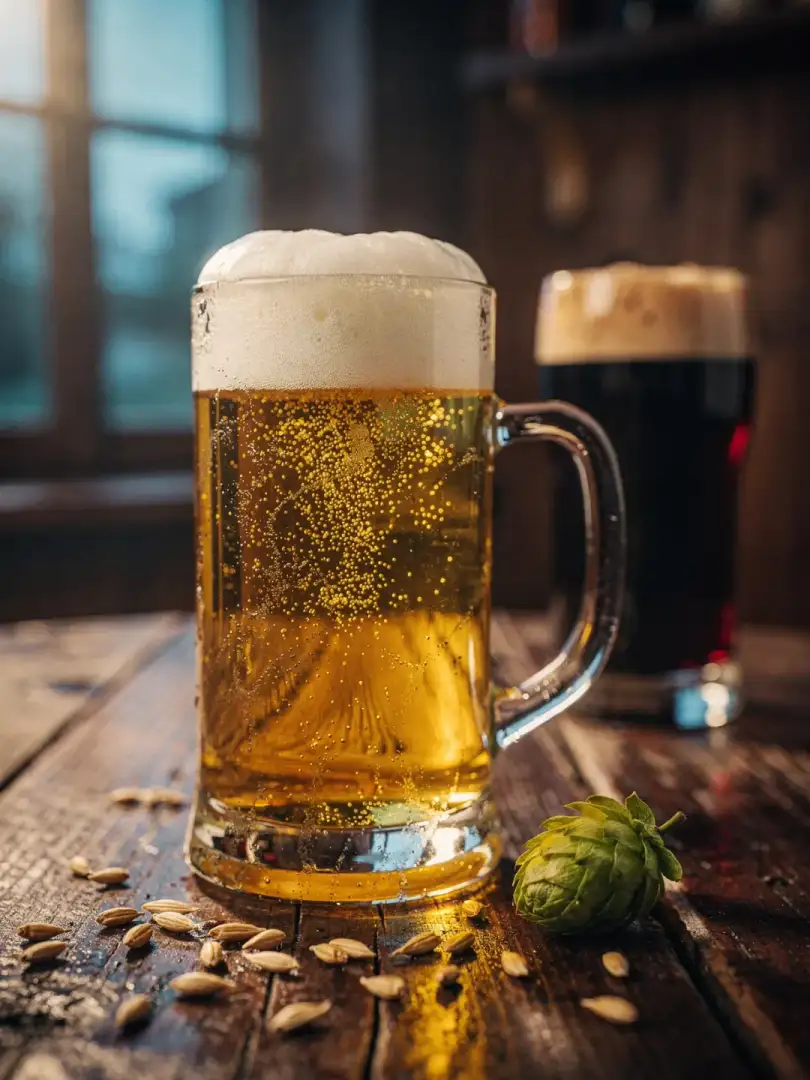
The flagship beer of the region is the Světlý ležák, the pale lager. Is Budweiser Budvar a Pilsner? In German usage, people often say yes, since Pils is used there as a style designation. In Czech, it's referred to simply as pale lager, or in competition as Czech Premium Pale Lager.
Compared to Pilsner, Budweiser lager is often considered rounder and maltier, with a finer bitterness. These are flavour differences within a shared style, not a strict rule. Its counterpart is the Tmavý ležák, the dark lager, with roasted notes and little hop sharpness.
Both are brewed bottom-fermented, with lager yeast and long cold maturation. The style guideline for pale lager ranges from 11 to 14.7 degrees Plato and 4.2 to 5.8 percent alcohol. Individual beers can fall outside these competition limits. Anyone comparing a specific label should always check the brewery's own figures.
Světlý ležák (Czech Premium Pale Lager)bottom-fermented
- Original gravity
- 11–14.7 °P
- Alcohol
- 4.2–5.8 % vol
- Bitterness
- 30–45 IBU
- Colour
- 7–12 EBC
Golden, with bread and honey in the malt, spicy Saaz hops, fine bitterness.