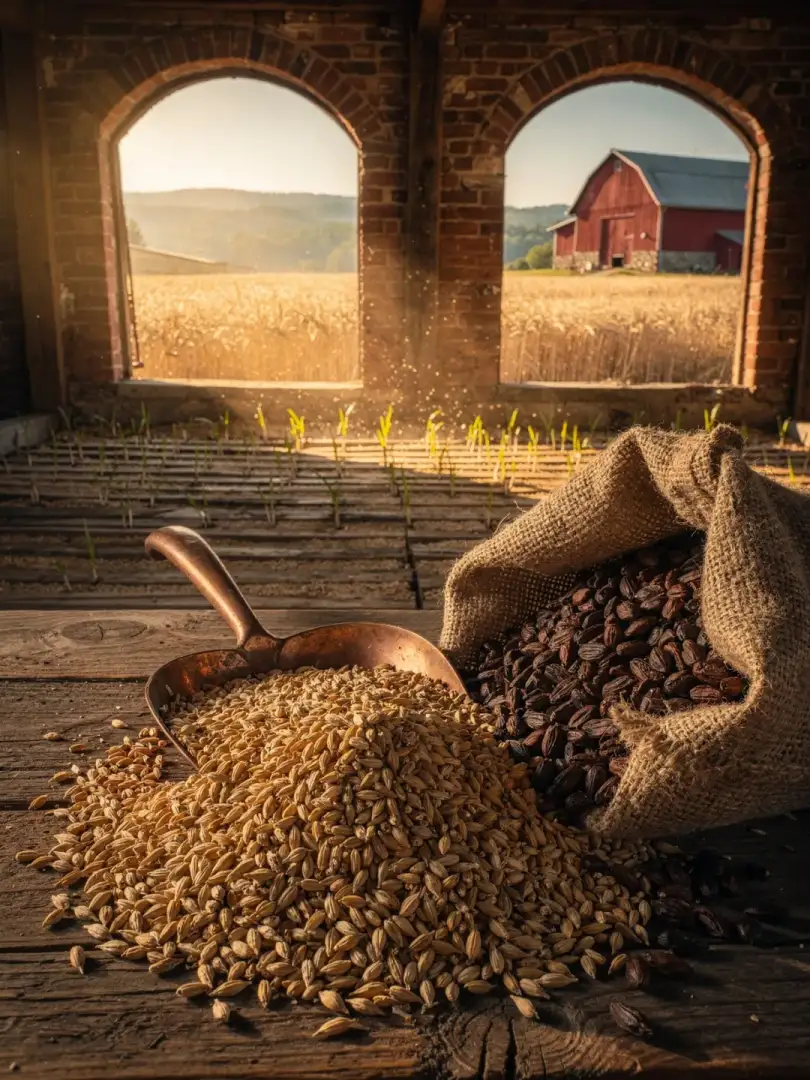
Barley, Corn, Roasted Malt
Malt & Grain
What grain goes into an American lager? The core is barley malt, but many US lagers replace part of it with corn or rice. This makes the beer lighter, crisper, and drier. Anyone in Pennsylvania trying a lager from the coal region, however, will often taste more malt than an industrial lager would suggest.
First, barley must become malt. At the maltings, the grains are soaked and allowed to germinate, during which the kernel develops enzymes that will later convert starch into sugar. Then the kiln—a heated drying chamber—dries and roasts the germinated grain. Kilned briefly and gently, it becomes pale malt; kilned longer and hotter, it becomes caramel and roasted malts.
The darker the malt, the stronger the flavors. Caramel malt lends sweetness and a copper color, as found in Vienna lagers and many American amber lagers. Chocolate and roasted malts provide coffee and cocoa flavors and turn porter nearly black. The porter Hare brewed in Philadelphia thrived on exactly these dark notes.
American brewing barley grows in two types: two-row, with large, starch-rich kernels, and six-row, with more protein and enzymes. It was precisely the enzyme-rich six-row barley that once tolerated a portion of corn, and this blend still defines American lagers today. In Pottsville and Philadelphia, this recipe was followed just as it was in Milwaukee.
During brewing, malt also provides body. The sugars that yeast cannot ferment remain in the beer and make it fuller. A Pennsylvania lager in the glass is therefore no thin drink: the color ranges from gold to copper, the flavor from bread crust to a light caramel sweetness.