Cascade and Willamette
Hops
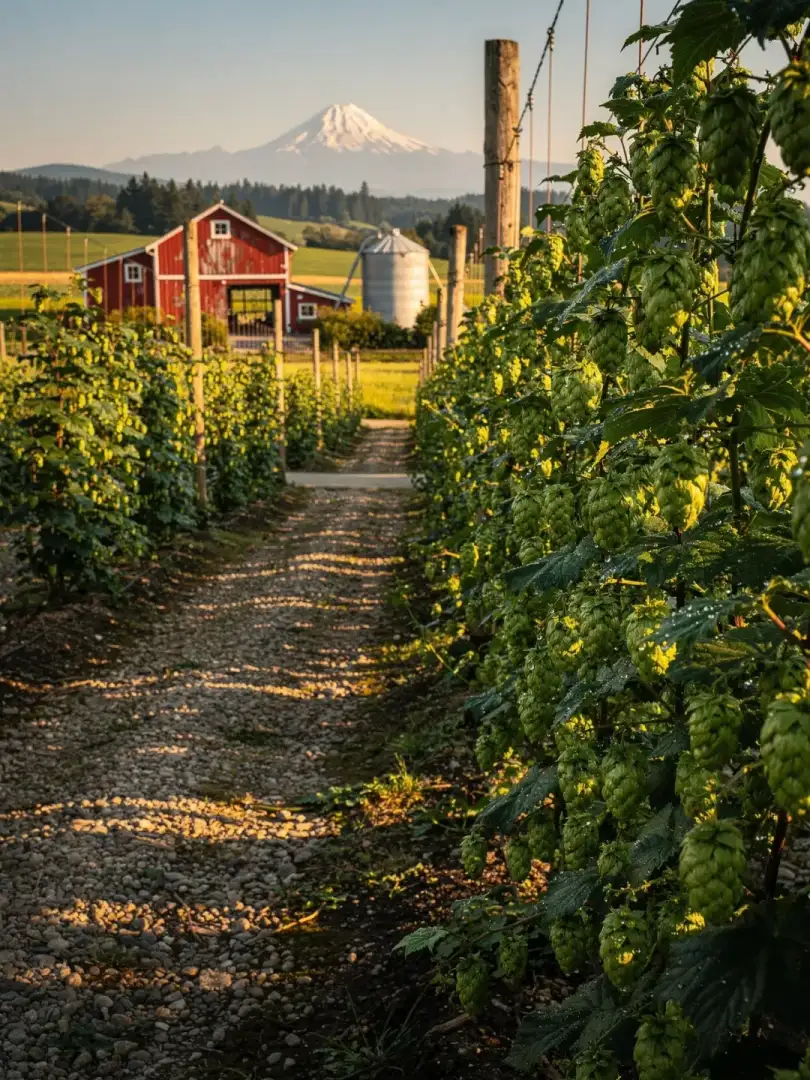
Hops grow right on the doorstep here. The Willamette Valley is Oregon's main growing region; according to the state's Department of Agriculture, farms there cultivate 5,000 to 6,000 acres on average, roughly 2,000 to 2,400 hectares, and harvest 8 to 11 million pounds, or roughly 3,600 to 5,000 metric tons. That's about 5 percent of the world's crop. Only Washington's Yakima Valley grows more in the US.
The most famous variety comes from right here in Oregon. The US Department of Agriculture bred Cascade at Oregon State University, and it was released in 1972. Its parents are the English Fuggle and the Russian Serebrianka. The Willamette variety followed in 1976. Cascade delivers high yields, resists downy mildew, and carries aromas of grapefruit and blossoms.
Widmer Brothers brewed their Hefeweizen with Cascade hops in 1986, an unusual choice for a wheat beer. That's what makes it more citrusy and fresh than a Bavarian Weissbier, and why the style today is called American Hefeweizen.
Hops do two jobs. Boiled for a long time in the wort, the malt solution before fermentation, they release alpha acids and make the beer bitter. Added late to the wort or cold into the fermenter, a technique called dry hopping, they leave their essential oils behind and the beer becomes aromatic. Bitterness is measured in IBU: a Pale Ale falls between 30 and 50 according to style guidelines, while an American IPA runs between 40 and 70.
The plants climb up wires in summer and are harvested in late summer. Some brewers take the cones straight from the field to the kettle while still fresh, while they still smell of resin and fruit.