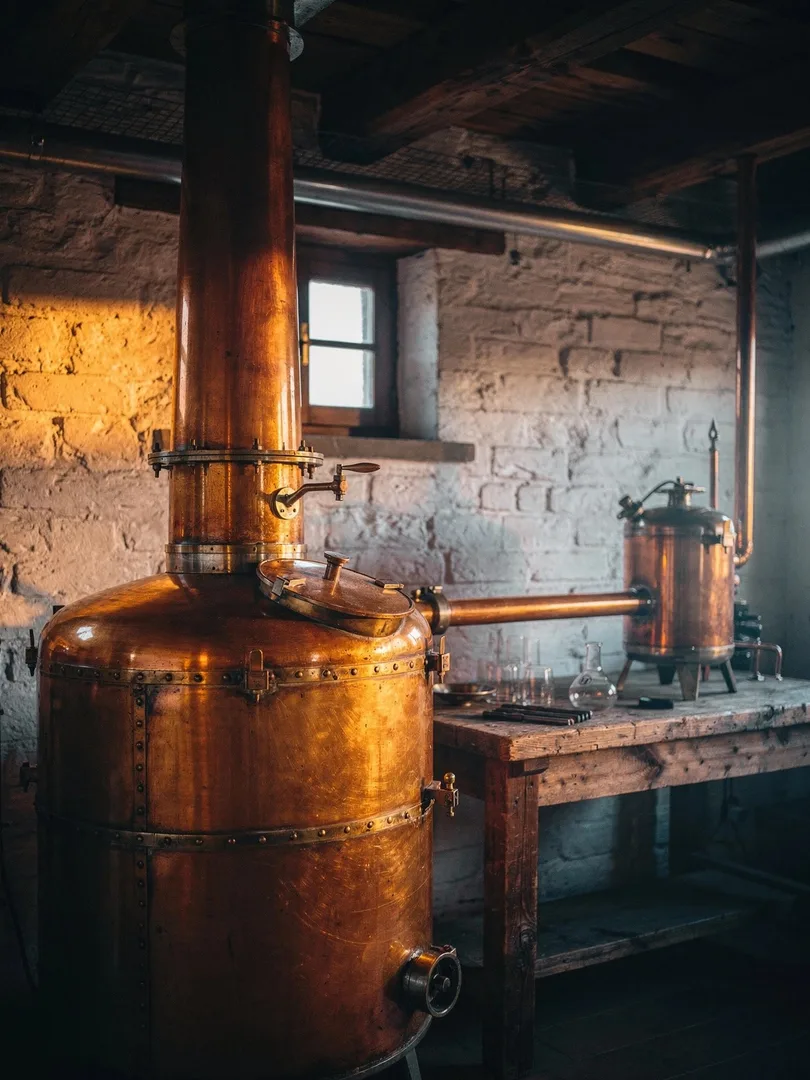
Copper in the Distilling House
Distillation
Why distill a mash that already contains alcohol? Because alcohol evaporates before water does. In a copper still, the mash is heated, the vapor rises, cools in a coiled pipe, and drips out as distillate into a vessel. A mash with just a few percent alcohol thus becomes a spirit with significantly higher alcohol content and concentrated aroma.
Classically, this happens in two steps. First comes the raw distillate, a cloudy, weaker spirit, followed by the fine distillate, which concentrates the aromas. Some producers fit a column onto the still that strengthens the spirit in a single pass. What matters is that the distillation doesn't exceed the 86% ABV limit — otherwise nothing of the original raw material would remain.
The crucial work happens during the cut. The heads contain volatile compounds like acetaldehyde and ethyl acetate, which smell like solvent, and these are separated out. The heart, the main run, is what's collected. The tails, heavy and fusel-laden, are set aside. The idea that cutting the heads removes methanol from the spirit is a myth — methanol is distributed throughout the entire run.
For farms with an allowance distillery, every distillation run must be registered in advance, and the alcohol yield is calculated from the quantity of raw material using official rates, not measured at the still itself. The farm distiller therefore works by experience and a practiced eye for proportion and quantity, not by manual or recipe.
With Rossler, the process is the same as with fruit — only the raw material differs. The distillate tastes of whatever is in the mash. Anyone wanting to spot the difference should compare them later in the glass, not at the still.