Stillness in the Cellar
Maturation & Storage
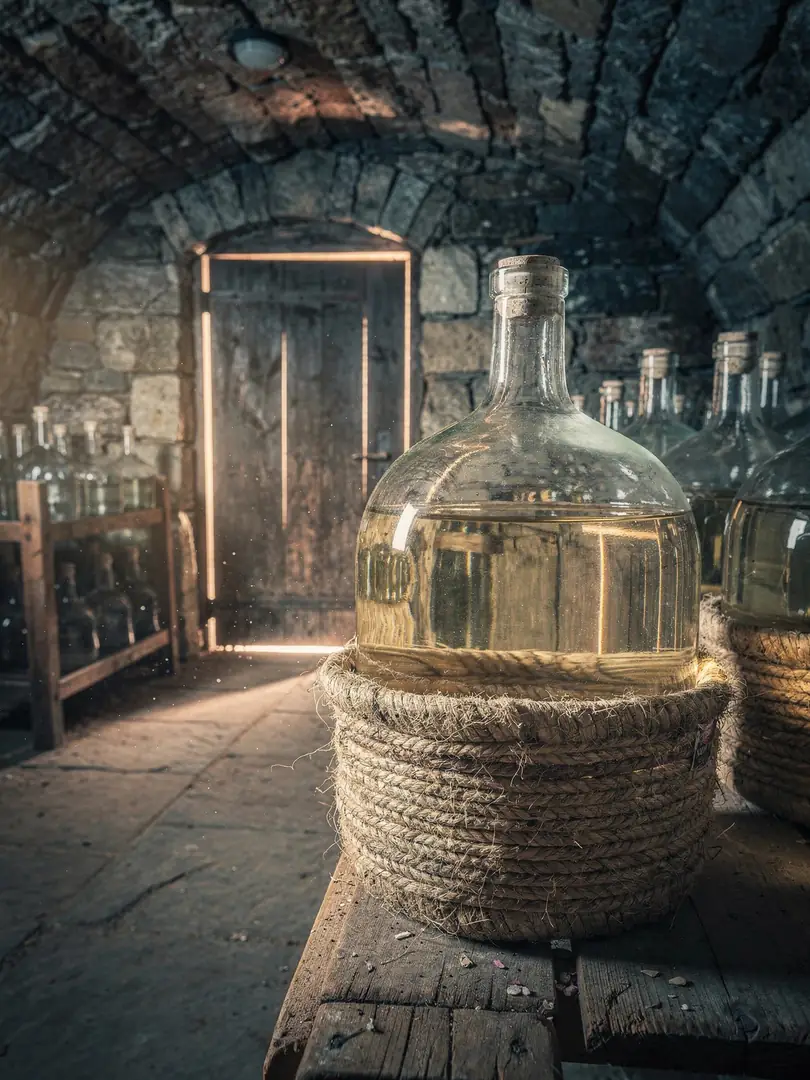
A freshly distilled fruit brandy often tastes sharp and unsettled. That's why it rests in the cool farm cellar, usually in glass demijohns, stainless steel, or, in earlier times, stoneware. These vessels are neutral — they impart nothing, and the fruit aroma stays exactly as it is. The spirit is also kept in the dark, since light promotes the formation of ethyl carbamate from hydrocyanic acid.
No law dictates how long a fruit brandy must rest. The EU sets no age categories for fruit brandies — there's no minimum maturation period. If an age statement appears on the label, it must refer to the youngest component, and storage must have taken place under tax supervision. Farms therefore prefer to state a bottling year rather than an age figure that wouldn't really reflect the contents.
Wood aging is nonetheless permitted: oak, ash, or acacia. A spirit that has rested in wood for a year or more may be adjusted with caramel coloring to standardize its hue. What's prohibited, however, is coloring a fruit brandy that hasn't undergone this minimum aging period. On the farm, the spirit usually stays colorless and still; in wood, it turns pale gold and softer.
Before bottling, the spirit is diluted down to drinking strength, usually with demineralized water. Rossler often rests for a shorter time than plum brandy, since its earthy character isn't refined by time so much as it needs to be cleanly distilled from the start. A dry, consistently cool cellar with little light is all it requires.
On the farms of the Kinzig Valley, the stock usually sits beneath the farmhouse, where it stays cool even in summer. An Obstler or plum brandy from the Brennhäusle may rest for a few months before bottling, and a good glass can also handle years of aging, as long as it's kept tightly sealed and in the dark.