Riesling on Slate
Fruit & Raw Material
In October, when the presses run along the Mosel, every batch leaves behind a solid cake of skins, seeds and stems. That's the pomace, and on the Mosel it's predominantly Riesling. More than half the vineyard area carries this variety; from 2015 to 2022 that amounted to a good 5,300 hectares out of nearly 9,000 hectares across the whole growing region, which also includes the Saar and Ruwer.
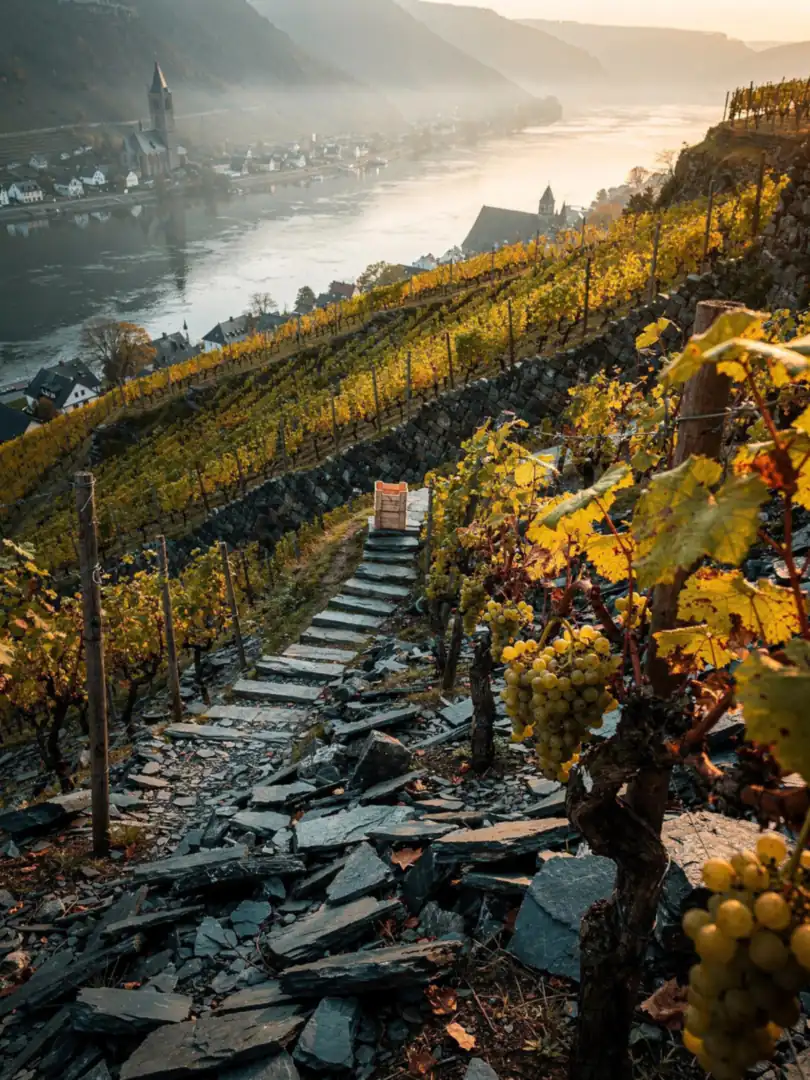
Here, Riesling grows on Devonian slate formed around 400 million years ago. Many vineyard names end in "-lay," from the Celtic word "ley" for slate. The dark stone stores the day's warmth and releases it to the vines at night, giving the wine its freshness and tension.
Then there's the steep terrain. Slopes with a gradient over 30 percent count as steep sites, and these generally can't be worked with machinery. The labor involved is estimated at 2.5 to 3.8 times that of flatter sites. The Mosel is considered the largest contiguous steep-slope wine region in the world, and the Calmont between Bremm and Ediger-Eller, with inclines of up to 68 degrees, ranks among the steepest vineyards anywhere.
This has practical consequences for the pomace. Anyone wanting to distill it needs grapes that were picked in healthy condition, since rot in the harvested fruit carries through into the brandy. On the steep slopes, every grape is picked by hand into a bucket anyway, and sorting on the slope is the first quality check, long before the press.
Alongside Riesling, the Upper Mosel grows Elbling, an old, crisp variety whose pomace is also collected. What goes into the still therefore depends on the vine growing on a particular slope, which makes pomace brandy from the Mosel a product of both vintage and site.