Root in the Mountain
Fruit & Raw Material
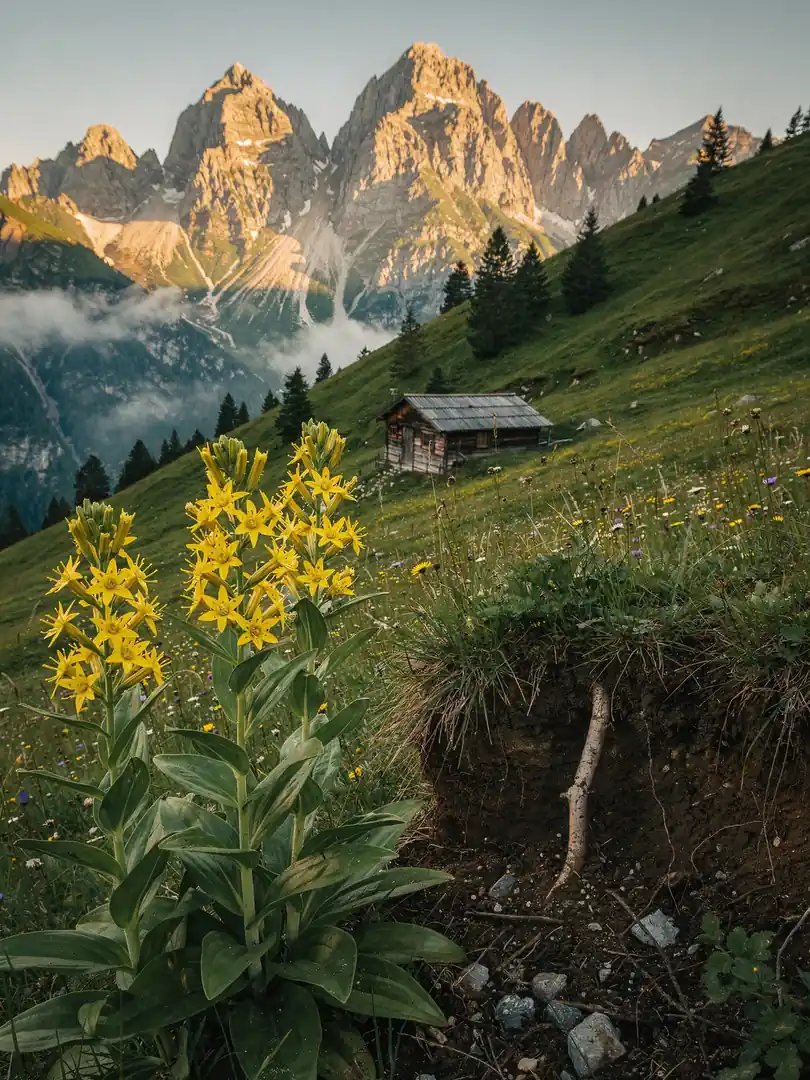
The Yellow Gentian, botanically Gentiana lutea, grows on alpine meadows and sends up tall stems with yellow flowers in summer. What ends up in the brandy stays underground, though. The root can grow up to one meter long and weigh two kilos, and it takes time: about eight years pass before the first bloom, and a plant needs at least six years before it is fit for digging.
The root diggers of the Grassl gentian distillery travel to remote, high-alpine locations to find it. According to the house, the digging area stretches from the Roßfeld across the entire Berchtesgaden National Park to the Kallbrunnalm in the Salzburg Pinzgau region. Harvesting takes place from late summer into autumn. Only the upper rootstock is taken, after which the diggers carefully close the turf again.
Since gentian has been protected in many parts of the Alps since the 1960s, no one may simply start digging. A permit from the relevant authority is required. Plant knowledge is also essential: Yellow Gentian is easily confused with the poisonous White Hellebore, whose leaves resemble it, and anyone digging must be able to tell the two apart with certainty.
Besides gentian, the diggers reportedly also search for masterwort, a second root with a strongly spicy aroma. Both grow where the mountain is steep and no machine can reach.
The raw material for the region's other spirit, Obstler, looks very different. It comes from apples and pears grown in the orchard meadows of the foothills. EU regulation requires that at least 85% of the mash consist of apples or pears, or both, and different varieties may be blended. The remainder may come from other fruit.