Bananenapfel and Pear
Fruit & Raw Material
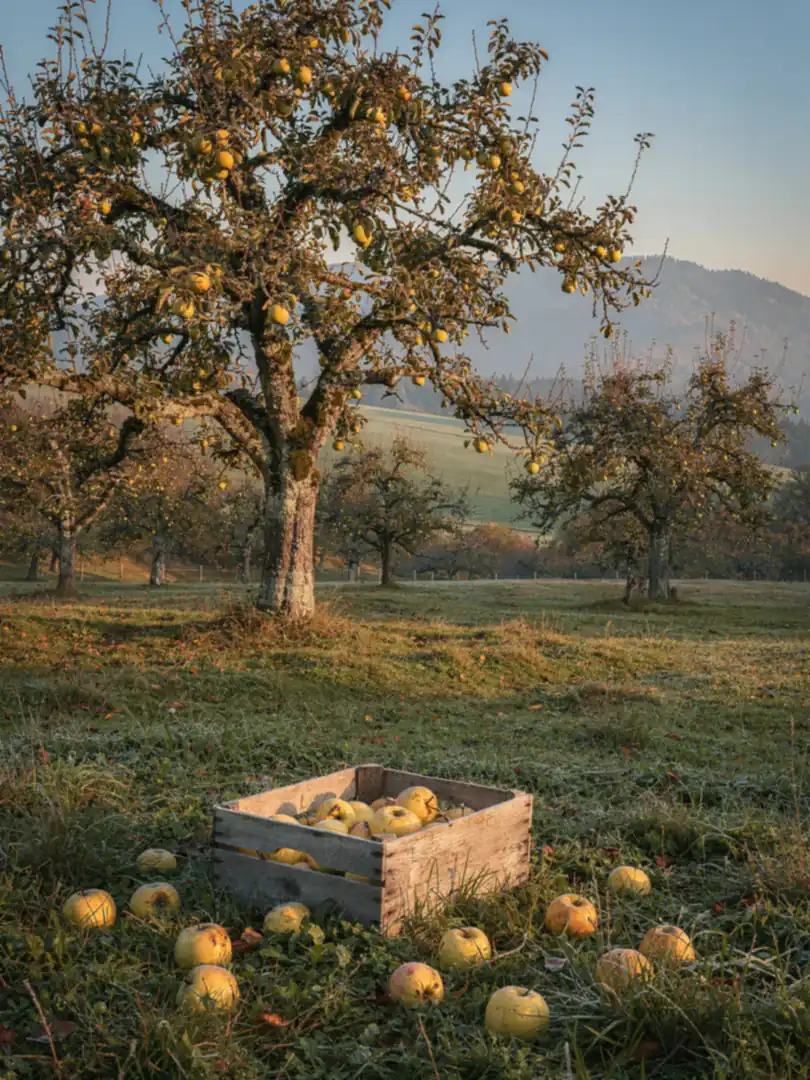
The Bananenapfel didn't originate in Carinthia. It was likely brought to the Lavanttal around 1882 by the Birkershauser family from Massachusetts. First described in Boston in 1844, the variety was known there as American Mother. In the valley it took on the name Lavanttaler Bananenapfel, and today it grows on traditional orchard meadows, where tall trees stand scattered rather than in tight plantation rows.
The name comes from its aroma. The apple tastes sweet, only mildly tart, very aromatic, with a note reminiscent of banana. It's a late-ripening variety, reaching peak eating quality between November and January. Because it doesn't keep long, timing the harvest correctly is crucial. According to the Ministry, the trees are heavy bearers and resistant to scab.
For the brandy, the fruit is hand-picked, as described in the register of Traditional Foods. There's a practical reason for this: a bruised apple quickly begins to rot, and rot shows up later in the distillate. Anyone gathering windfall apples from the ground has to sort carefully and process the fruit quickly.
Pears also grow in these meadows. The Achatzlbirne, a perry pear, was rediscovered during a variety survey in the Lavanttal in autumn 1996 and has since been preserved by the Carinthian Chamber of Agriculture. Perry pears are varieties that taste poor raw but contribute plenty of aroma to perry and brandy.
At Pfau in Klagenfurt, Williams pears are added to the mix. The house states that it processes only fresh, aromatic, fully ripe fruit. Under EU spirits regulation, a pear brandy may only be labeled "Williams" if it's made exclusively from this variety.