Distilled twice
Distillation
The Original Pielachtaler Dirndlbrand is distilled twice, as specified in the register of traditional foods. The first pass crudely separates alcohol and aroma from the mash; the second refines the distillate.
From one hectoliter of mash comes only four to five liters of ready-to-drink brandy, at 39 to 45 percent alcohol. That's why Dirndlbrand stays rare — and Elsbeerenbrand, too, needs around 25,000 berries per liter, according to the region.
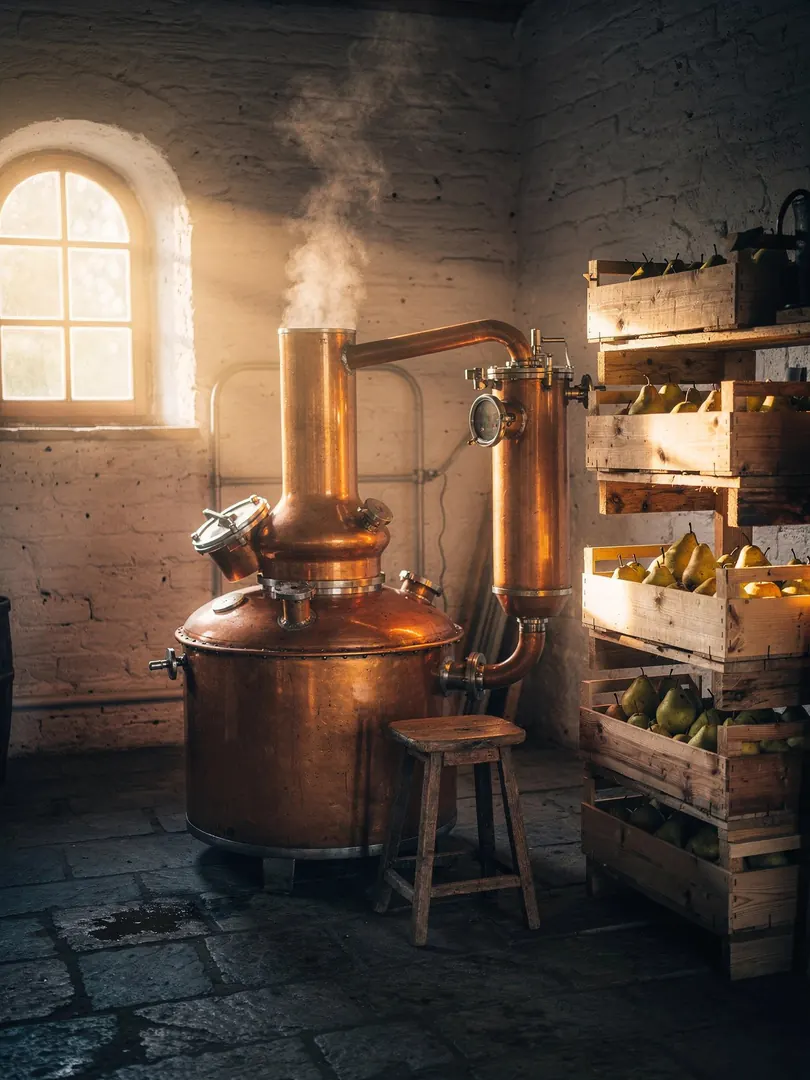
Distillation takes place in copper stills, often fitted with a rectifying column on top. This re-purifies the rising vapor before it condenses back to liquid in the cooling coil. For fruit brandy, every distillation run must stay below 86 percent alcohol, or the fruit's flavor would be lost.
The cut is what matters most. The first spirit to emerge from the still is the heads (Vorlauf): volatile, harsh, and not meant for the bottle. Next comes the heart (Mittellauf), followed by the tails (Nachlauf) at the end, carrying heavy, often bitter compounds. Where the distiller makes the cut is a judgment call based on smell and taste. Cutting the heads only partly reduces methanol, though, since it's already present in the mash.
Smaller stills generally allow for more precise cuts, and that takes real experience. With only four to five liters of brandy from a hectoliter of mash, this isn't a side detail — it's the heart of the craft.
How far distilling methods can diverge is clear from France: Cognac is double-distilled in a Charentais pot still, while Armagnac is usually distilled once in a column. Unlicensed distilling is banned in Austria too — the Abfindungsbrenner of the Mostviertel work under permit from the customs office.