Copper and Column
Distillation
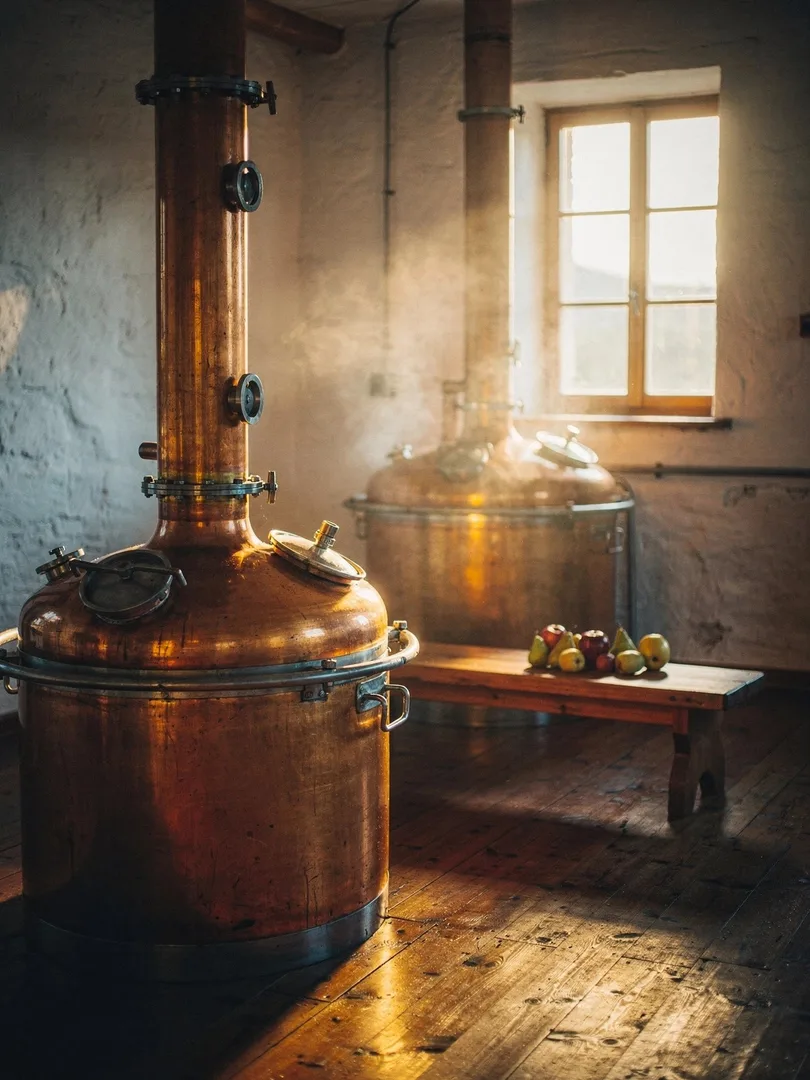
Wherever a fruit brandy like Styrian Hirschbirne Brandy is made, you'll usually find a copper pot still. The mash is heated inside it, and since alcohol evaporates before water, it rises into the still's neck. There it cools and is collected as distillate. Copper conducts heat well and binds unwanted sulfur compounds, which is why distillers have relied on it for centuries.
In German-speaking countries, a rectifying column often sits atop the still, concentrating the alcohol in a single pass, whereas the classic method is double distillation. Which path a house chooses depends on the fruit and on its own style. According to the house, Gölles distills in copper pot stills and adds no sugar, flavorings, or colorings.
The distillate doesn't flow evenly. First comes the foreshots, with sharp, highly volatile compounds; at the end comes the feints, carrying heavy, bitter components. In between lies the heart, or middle cut, which becomes the brandy. The distiller separates these fractions by smell and taste. This cut only partially reduces methanol, since it originates from the fruit itself.
The register shows just how little survives the process: roughly 100 kilograms of Hirschbirne pears yield about three liters of Hirschbirne brandy, which must have at least 38 percent alcohol. The autumn harvest of the Hirschbirne sets the pace, since only ripe fruit delivers a clean pear bouquet. The distillate comes off the still at a higher strength and is later diluted down to drinking strength.
Is it legal to distill your own schnapps? In Austria, only with registration at the customs office and within set quantity limits. In Germany and Switzerland too, distilling without a permit is prohibited.