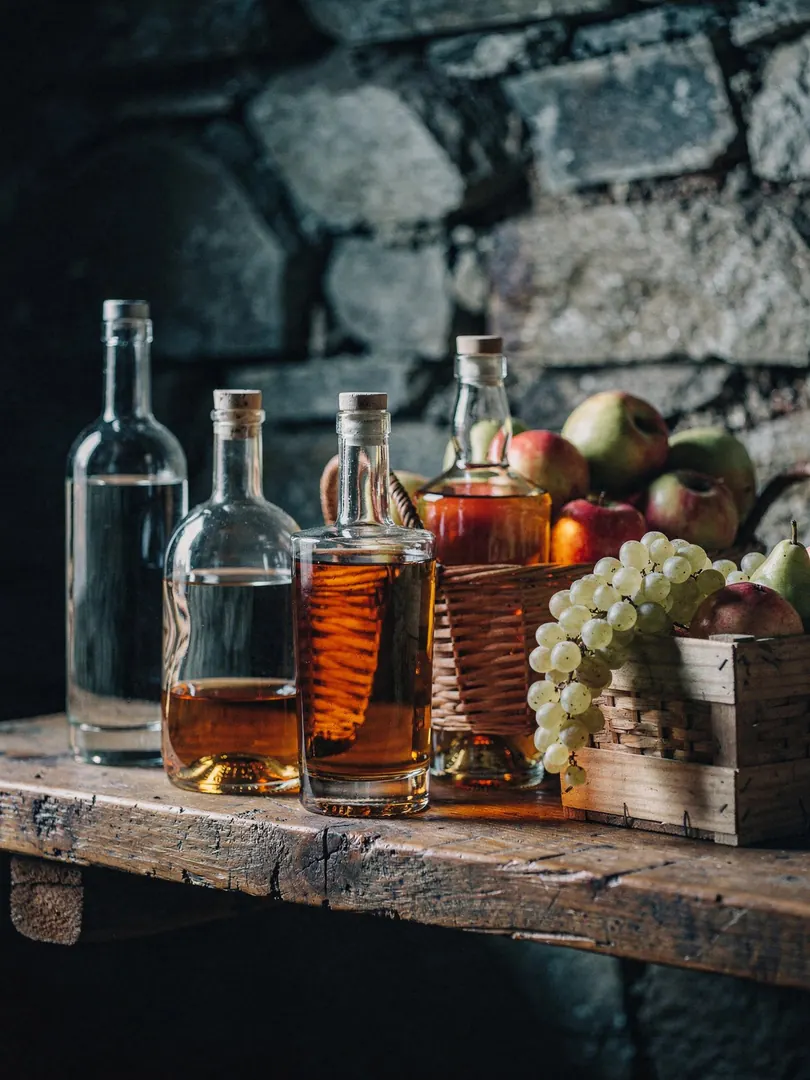
The Basic Terms
What Is a Brandy? Schnapps, Spirit, and Brandy Explained
A brandy is a spirit made by fermenting and distilling a specific raw material, such as fruit, wine, or pomace, and it retains that material's aroma. "Schnapps," on the other hand, is colloquial language for almost anything clear and strong, and it's not a legal term.
Schnapps: An Everyday Word Without Legal Meaning
At the pub, you might ask for a schnapps, and what lands on the table could be a kirsch, a corn spirit, or a herbal bitter. In Germany, Austria, and Switzerland, the word covers pretty much any spirit that's clear and packs a punch. It has nothing to do with a production rule. In the European Spirit Drinks Regulation, Regulation (EU) 2019/787, schnapps doesn't appear as a category at all.
This is more than splitting hairs. Every label carries a legal designation, the name the law prescribes for that exact drink. If it says "fruit brandy," "brandy," or "raspberry spirit," the path from raw material to glass is clearly defined. If it just says "spirit drink," the beverage doesn't meet any of the more specific regulated categories. The everyday word schnapps reveals nothing about either.
What Is a Spirit Drink in the Legal Sense?
Spirit drink is the umbrella term. The regulation defines it as an alcoholic beverage for human consumption with at least 15 percent alcohol, produced according to its rules. Underneath this umbrella sit 44 categories, from rum and whisky to vodka, gin, and liqueur. Each category has its own requirements for raw materials, production, minimum alcohol content, and permitted additives.
Several of these categories apply to brandies. What they share is that the alcohol comes from the raw material named in the title, or its aroma survives the distilling process. The law expresses this technically: every distillation must stay below 86 percent alcohol. A higher-proof distillate would be nearly pure alcohol and would barely smell of cherry or grape anymore. Added flavoring or coloring is prohibited for most brandies.
What Types of Brandy Does EU Law Distinguish?
The main brandy categories can be organized by raw material. Fermented fruit, berries, or vegetables produce fruit brandy (Category 9), which may also be called "...wasser," as in kirschwasser. Fermented apple or pear wine, meaning cider or perry, produces brandy from apple or pear wine (Category 10), which includes Calvados. Wine yields wine spirit (Category 4), and if it matures long enough in oak, it may be called brandy or Weinbrand (Category 5).
Then there are the leftovers from winemaking. Pomace brandy (Category 6) comes from the fermented skins and seeds of grapes; in Italy it's called grappa. Lees brandy (Category 12) is distilled from the sediment left after fermentation. Jerusalem artichoke (Category 14) and gentian (Category 18) each have their own categories, made from tubers and roots respectively.
Two processes hold a special position, both involving fruit steeped in alcohol. Fruit spirit (Category 17) is made from unfermented fruit steeped in neutral alcohol and then distilled. Brandy "obtained by maceration and distillation" (Category 16) sits somewhere between fruit spirit and fruit brandy. Both get their own chapters later in this journey.
Brandy, Branntwein, Edelbrand: Where Everyday Usage Gets Muddled
The older German word Branntwein, literally "burnt wine," long stood for all spirits. This lives on in the Branntweinmonopol, Germany's state alcohol monopoly that ran from 1919 until the end of 2017 and covered alcohol from potatoes, grain, and fruit alike. In today's EU law, however, Branntwein means only a distillate made from wine. Calling a fruit brandy a Branntwein is colloquially fine but legally off the mark.
Marketing terms are similarly shaky. Edelbrand, Feinbrand, or Hausbrand sound like quality tiers, but they're not categories under the regulation. What they actually mean depends on the country and the producer. What you can rely on is the legal designation on the bottle. It tells you whether the fruit itself fermented, whether outside alcohol was involved, and how much sweetening is allowed.
For the chapters that follow, a simple reading rule applies. First comes the raw material, then whether it was fermented or merely steeped, then the distilling, and finally the aging. Almost every point of confusion among brandies can be resolved with these questions, from raspberry spirit to brandy.