Proofing Down
To Drinking Strength: Water, Alcohol Content, Minimum Proof
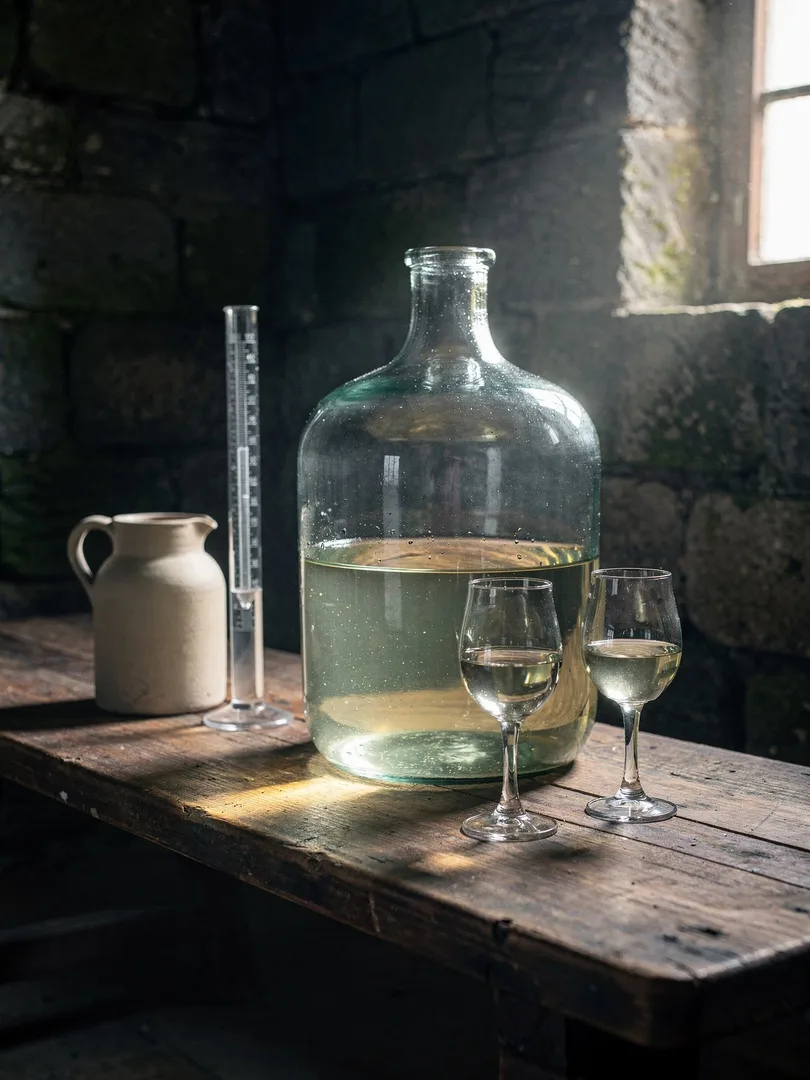
A freshly distilled spirit is too strong to drink and is proofed down with soft, often demineralized water. Fruit brandy then needs at least 37.5% ABV, wine brandy 36%, while Cognac and Calvados on the market need 40%. Peruvian Pisco is the exception: it gets no water added at all.
Why is a brandy diluted with water?
No ready-to-drink brandy comes straight out of the still. The heart cut of a Zuger Kirsch, for instance, must average at least 68% ABV. At that strength, alcohol numbs the nose and tongue, and the fruit gets lost. Only with water does the aroma open up. Distillers call this step proofing down or reduction, and it's one of the most underrated jobs in a distillery.
The water used for this must be soft and clean. The specification for Zuger Kirsch / Rigi Kirsch PDO requires softened or demineralized water. The reason is simple: limescale and other minerals can react with compounds in the distillate, form sediment, or alter the flavor. A spirit meant to look clear and taste fruity can't tolerate hard tap water.
Many distilleries don't proof down their spirits in a single step, but gradually, letting them rest in between. Some aromatic oils dissolve well only in strong alcohol. As the strength drops, they can appear as a fine haze. These compounds are then either filtered out to keep the brandy clear, or they recombine over time. This, too, is a matter of style: overly aggressive filtering strips a brandy of aroma.
What does % vol mean on the label?
The term % vol stands for percent by volume. It indicates how many milliliters of pure alcohol are contained in 100 milliliters of the drink, measured at 20 degrees Celsius. A brandy at 40% ABV therefore contains 280 milliliters of pure alcohol in a 0.7-liter bottle. Incidentally, this exact figure is also what alcohol tax is calculated on.
Something surprising happens when mixing alcohol and water. One liter of alcohol and one liter of water together yield less than two liters, because the molecules pack more closely together. Experts call this volume contraction. That's why distilleries don't simply calculate with a pocket calculator, but use official alcohol tables, and measure again after proofing down.
Minimum Alcohol: How Strong Must a Brandy Be?
The Spirit Drinks Regulation (EU) 2019/787 sets a minimum alcohol content for every category. Fruit brandy, fruit spirit, pomace brandy, eau-de-vie, and brandy made from apple or pear wine all require at least 37.5% ABV. Wine brandy, also called Brandy, gets by with 36% ABV. Jerusalem artichoke spirit and yeast brandy, on the other hand, require at least 38% ABV.
Origin regulations often set stricter requirements. Wachauer Marillenbrand must have at least 38% ABV. Cognac, Armagnac, and all three Calvados geographical indications may only be sold from 40% ABV upward, as must Zuger Kirsch. Hungarian Pálinka stays at 37.5% ABV but may neither be sweetened nor flavored. Traditional specialties go even higher: Fraxner Kirsch is bottled at 40 to 45% ABV, and Krautinger at 39 to 49% ABV.
So anyone who finds a fruit brandy at 35% ABV on the shelf isn't legally holding a fruit brandy. Such drinks are sold under other designations, such as spirit drink or liqueur. A glance at the percentage, then, helps distinguish between categories.
Pisco from Peru: Distilled Directly to Drinking Strength
One exception shows just how different things can be done. Under its appellation rules, Pisco from Peru may receive no water at all. It's distilled in a single distillation run directly to drinking strength, between 38 and 48% ABV, and then rests for at least three months in neutral containers made of glass, stainless steel, or clay. Wood is not permitted.
For the distiller, this is a demanding task. The cut must be made so that the collected heart naturally reaches the desired strength. Chilean Pisco follows a different standard and allows both water addition and wood aging. Both countries lay claim to the name, and both paths are tradition in their respective homelands.
At the other end of the spectrum are cask-strength brandies, bottled undiluted at full barrel proof. They reveal how a distillate tastes before proofing down. Whether a brandy with a higher percentage is better isn't something the number alone can answer. It only reveals how much water the master distiller added and how powerfully the brandy comes across in the glass.