Pits and Light
Hydrogen Cyanide and Ethyl Carbamate: The Stone Fruit Problem
Kirsch, plum and apricot brandies can contain hydrogen cyanide, because the pits of stone fruits contain amygdalin. Under light, hydrogen cyanide turns into ethyl carbamate in the finished spirit, a substance suspected of being carcinogenic. Intact pits, copper in the still, and dark storage keep both in check.
Where Does Hydrogen Cyanide in Kirsch Come From?
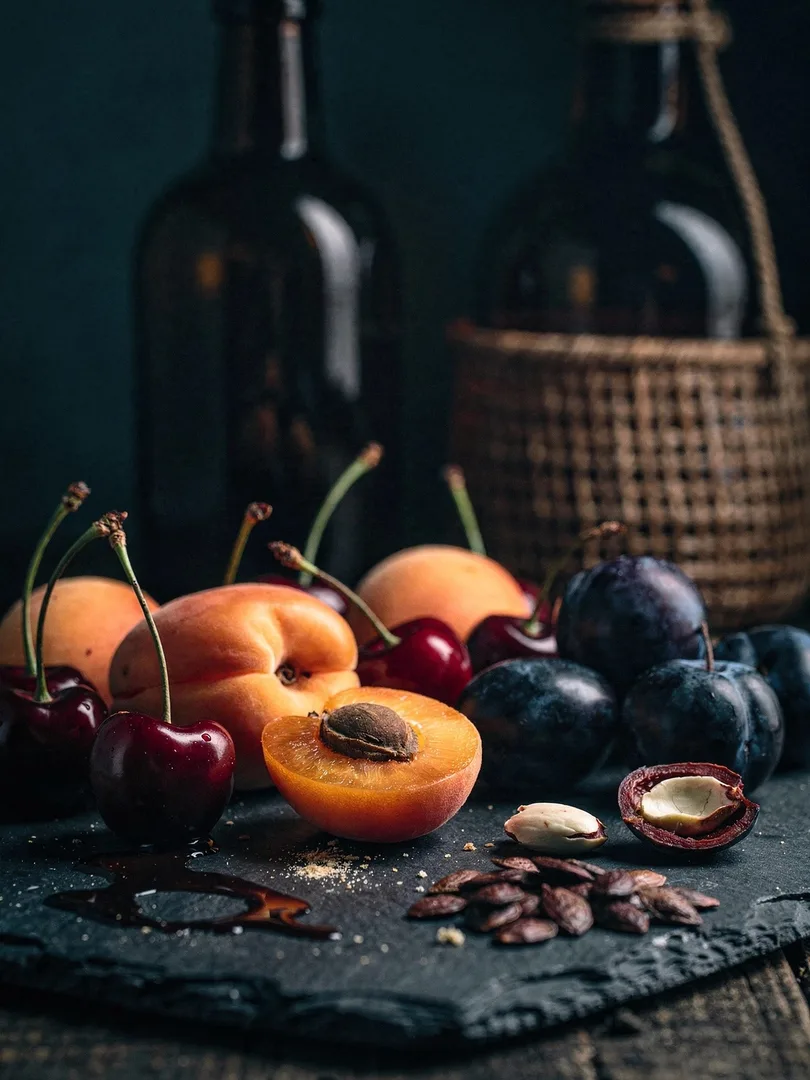
Crack open a cherry pit and you'll find a small, soft kernel inside. It smells of marzipan. This scent comes from amygdalin, a compound that many stone fruits produce in their seeds, including cherry, plum, apricot, mirabelle and peach. When amygdalin is broken down by enzymes, it forms benzaldehyde, the characteristic bitter-almond aroma, and hydrogen cyanide.
This is exactly what happens in the mash when pits are damaged. That's why distilleries take care to keep the stones intact during mashing. A few damaged pits are hardly avoidable, and a light stone-fruit note is part of a good kirsch's character. It gives the spirit depth and sets it apart from a purely fruity distillate. Too much of it, however, is a flaw—both in flavor and in health terms.
Apple and pear seeds also contain some amygdalin. But the EU's hydrogen cyanide limit specifically targets stone fruit, since large pits sit in the mash there for weeks. The stone fruit problem is named for good reason: it mainly concerns cherry, plum, apricot and their relatives.
Hydrogen cyanide limit: 7 grams per hectoliter of pure alcohol
The Spirit Drinks Regulation (EU) 2019/787 limits hydrogen cyanide in stone fruit brandies to 7 g/hl pure alcohol (p.a.), meaning per hectoliter of pure alcohol. The same limit applies to brandies made from stone fruit pomace. The value is set low because hydrogen cyanide is a potent poison, and because it's the main precursor for a second problem: ethyl carbamate.
For distilleries, this means the stone-fruit note must be dosed, not maximized. Old recipes that deliberately crush the pits to gain more almond aroma don't fit within this limit. Among master distillers, the rule of thumb is that a Kirschwasser should smell of cherry, with only a subtle hint of stone.
What is ethyl carbamate and how does it form?
Ethyl carbamate, also known as urethane, occurs in trace amounts in many fermented foods. In stone fruit brandies, however, the level can be considerably higher. The German Federal Institute for Risk Assessment describes the substance as genotoxic and carcinogenic and recommends avoiding it as far as possible. As a guideline value for stone fruit brandies, it cites 0.4 milligrams per liter.
Here's the tricky part: ethyl carbamate largely forms only after distillation. In the finished distillate, hydrogen cyanide and its salts, the cyanides, react with the alcohol. Light strongly accelerates this reaction. So a brandy that leaves the distillery with low ethyl carbamate levels can end up with more of it later if stored in bright conditions.
This can't be detected by eye or by nose. A Kirschwasser with high ethyl carbamate levels looks just as clear as one with low levels. Only laboratory analysis provides certainty. That's why distilleries and authorities don't rely solely on end-point control, but on prevention along the entire path from fruit to bottle. The less hydrogen cyanide that ends up in the distillate, the less ethyl carbamate can form later on.
What distilleries do about hydrogen cyanide and ethyl carbamate
The most important measures start with the fruit. Pits are kept as intact as possible, and the mash is processed promptly without unnecessary prolonged storage. During distillation, copper surfaces or dedicated copper catalysts in the still help bind hydrogen cyanide before it reaches the distillate. The Federal Institute for Risk Assessment explicitly names these catalysts as a means of reducing ethyl carbamate.
The cut also matters. A further measure is a clean and timely separation of the tails, which lets fewer precursors into the heart cut. After that, darkness is key. Stone fruit brandies should be protected from light from distillation all the way to the glass, both at the distillery and in retail. For guidance on properly storing brandies at home, see the feature on maturation and age.
Testing authorities such as the Bavarian State Office for Health and Food Safety specifically test stone fruit brandies for ethyl carbamate. For the enjoyer, the message is simple: a well-made Kirschwasser smells clearly of fruit, with a subtle almond note in the background, and isn't kept in sunlight.