Distilling in a continuous flow
Column and rectifier: continuous distilling
A column still distills continuously: wine or cider flows in steadily at the top, vapor rises from below through multiple plates, and distillate runs off without interruption. This is how Armagnac and Calvados Domfrontais are made. A rectifying column mounted on a pot still is something of a hybrid in between.
What is a column still? Many small distillations stacked on top of each other
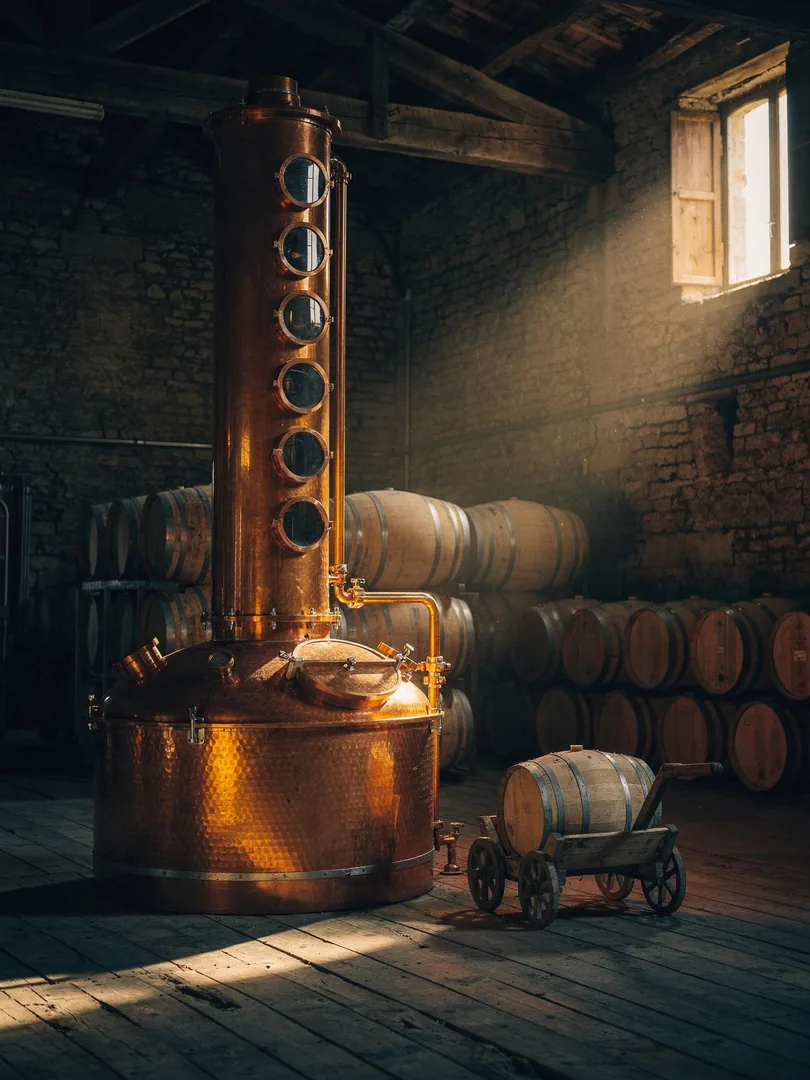
Instead of a bulbous vessel, here stands a tall column. Inside, horizontal plates are stacked one above another, often fitted with small bubble caps or perforations. Hot vapor rises from below, while liquid trickles down from above. On each plate, the two meet. The vapor releases water and picks up alcohol, then rises to the next plate.
Each plate thus acts like its own small distillation. The more plates a column has, and the taller it is, the stronger and purer the distillate becomes. At the very top, it can arrive extremely strong; at the bottom, the spent liquid, the stillage, drains away. The big difference from the pot still lies in the rhythm: the column doesn't need refilling, it simply runs as long as raw material keeps flowing in.
For large operations, this is an advantage. A column processes large volumes evenly and with little energy per liter. Modern brandy distilleries therefore often work with columns. Neutral alcohol, meaning alcohol of agricultural origin with little flavor, is brought to at least 96% ABV in especially tall columns. For an aromatic spirit, that would be far too highly purified.
Armagnac: the alambic armagnacais as the primary method
The best-known example of a column-distilled spirit is Armagnac. Its primary method is a single, continuous distillation in the alambic armagnacais, a plated column whose kettle is heated over an open flame. The distillate must come off between 52 and 72.4% ABV. In 2012, according to the appellation rules, 95% of the base wine was distilled using such equipment.
Double distillation in the pot still is also permitted for Armagnac, but it is considered a secondary method. Every distillery must operate at least one device of the main type. Many winegrowers don't own their own equipment, instead calling in mobile distilleries that travel from farm to farm with their column. A continuous still was already patented in Gascony in 1814, by Tuilière of Auch.
The result tastes different from a double-distilled Cognac. Because the Armagnac distillate comes off the still at a comparatively low strength, more congeners from the wine remain in it. Young Armagnacs therefore often seem robust and earthy, needing time in the barrel. This isn't a judgment of quality, but a question of style that's already set in the column.
Calvados: column permitted, mandatory in Domfrontais
Calvados shows how appellation rules determine the method. The Calvados appellation allows, alongside the pot still, a continuous, multi-stage column made of copper. Calvados Pays d'Auge excludes it. Calvados Domfrontais, on the other hand, requires the column exclusively, along with at least 30% perry pears and at least three years of aging in oak.
All three are subject to an upper limit: the distillate may have a maximum of 72% ABV, and rectification is forbidden for Calvados. Rectifying means strengthening alcohol through many stages until almost no aroma remains. The limit thus protects the apple and the pear in the glass.
Enrichment column: the hybrid form found in fruit distilleries
Many fruit distilleries in German-speaking countries use a hybrid design. At the bottom sits a classic pot still, which works in batches. Mounted on top is a short column with a few bubble plates, the enrichment column. It strengthens the vapor before it reaches the condenser. Depending on the setup and the number of active plates, a single pass can produce a spirit that would otherwise require two passes in a simple pot still.
Important for understanding: a pot still with an enrichment column remains a discontinuous process. It's filled, distilled, and emptied like any other pot still. The distiller can switch individual plates on or off, controlling how robust or lean the distillate becomes. Where appellation rules only prohibit continuous distillation, this distinction is more than splitting hairs.
That leaves the question of the upper limit. Spirit Drinks Regulation (EU) 2019/787 requires that for fruit spirit, every distillation stay below 86% ABV. The same limit applies to spirit distilled from wine. This way, the distillate retains the smell and taste of its raw material, whether it comes from a pot still, an enrichment column, or a continuous column.