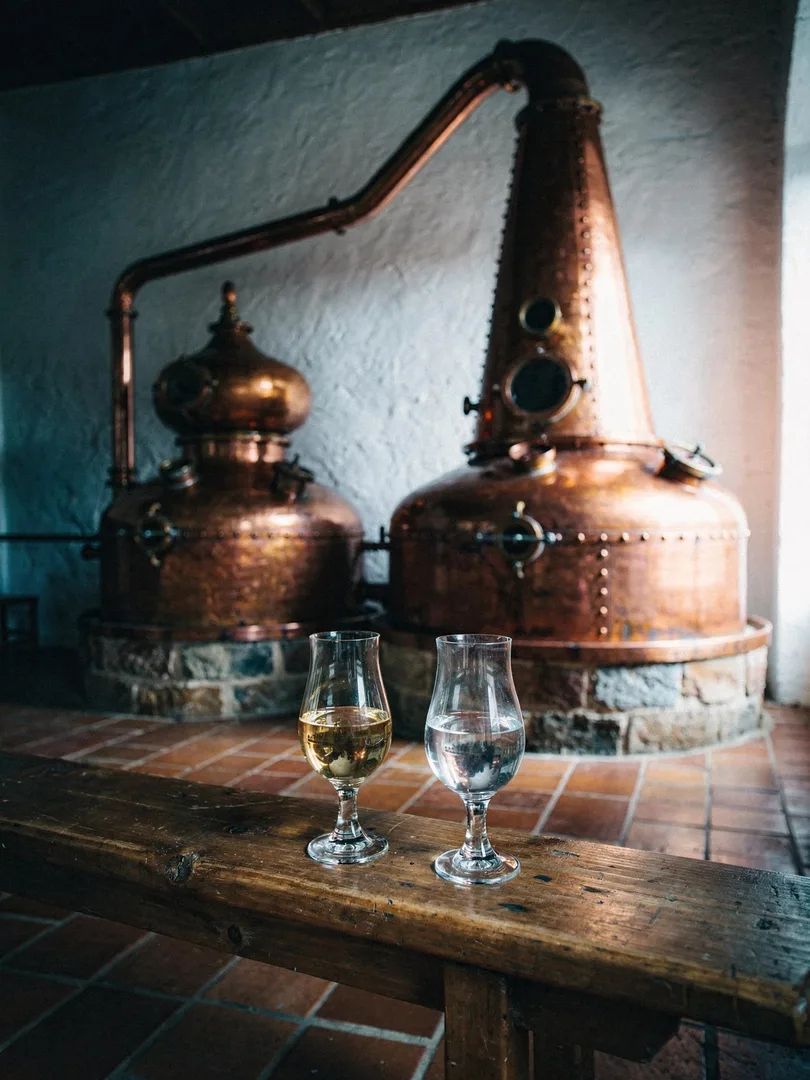
Low wines and spirit run
Single or double distilled – which is better?
Neither single nor double distillation is automatically better. Double means: a first pass yields the weak low wines, a second pass yields the spirit run. Single means: a column or enrichment column achieves this in one run. What matters is how cleanly it's distilled and how the cuts are made.
Low wines and spirit run: what double distillation means
In a simple pot still without an enrichment column, one pass isn't enough. What comes out of the first distillation of the mash is cloudy, fairly weak, and full of substances that don't belong in the glass yet. Distillers call this intermediate product the low wines, or brouillis in France. It simply collects the alcohol from the mash, nothing more.
Why isn't one pass enough? A simple pot still only strengthens the alcohol in a single stage. From a mash with just a few percent alcohol, this produces low wines that are noticeably stronger but still far below drinking strength and still carrying along many unwanted substances. Only the second stage raises the alcohol further and allows for a precise cut. It's the same with wine destined for Cognac, except here there's no solid fruit matter in the still.
In the second pass, the low wines are distilled again. Only now does the distiller carefully separate the heads, the heart, and the tails. The heart is called the spirit run, or bonne chauffe in Cognac. It's clearer, stronger, and more aromatically focused than the low wines. The fact that the term 'spirit run' appears on some labels has no legal meaning, by the way: Spirit Drinks Regulation (EU) 2019/787 doesn't recognize a category called 'spirit run.'
Which spirits are double distilled?
For some appellation spirits, double distillation is mandatory. Cognac must be distilled twice in the Charentais still, as must Calvados Pays d'Auge in the pot still. Fraxner Kirsch from Vorarlberg is traditionally double distilled, as is Wildschönauer Krautinger from Tyrol. For these spirits, the second pass is part of their identity.
Other appellation rules leave the choice open. The basic Calvados appellation allows double distillation in the pot still as well as the column. Two Calvados from the same area may therefore have been made by completely different routes. Some producers state the method on the label, which is worth checking.
Sometimes there's even a third pass. The Cognac specification recognizes Esprit de Cognac, a triple-distilled spirit at 80 to 85% ABV. It's not sold on its own, but is used exclusively to make sparkling wine. So if you read that Cognac is triple distilled, that's confusing it with this special case.
Single distilled: column, enrichment column, and Pisco
Single distillation is no shortcut. Armagnac is made in its main method through a single, continuous distillation. In the column, the plates do the work that a second pass does in the pot still. Many fruit distilleries likewise reach the desired strength in a single pass using their enrichment column, depending on the setup and the mash.
A special case is Pisco from Peru. Its appellation standard requires a single distillation in the pot still, taken directly to drinking strength between 38 and 48% ABV. Water may not be added afterward. The distiller must therefore make the cut exactly where the Pisco should land once it's in the bottle. Chilean Pisco follows different rules and allows the addition of water.
Is double distillation better than single?
The short answer is: no, not inherently. The number of passes tells you which technique was used, not how good a spirit is. A carefully distilled Kirsch made in a single pass with an enrichment column can be clearer and fruitier than one that's hastily double distilled. Conversely, double distillation can make a spirit rounder, if the cuts are right.
What changes is the style. Each additional pass and each extra plate makes a distillate stronger and leaner. In the process, congeners are also lost that give a spirit body and character. A distillate that comes off at a lower strength retains more of these and often seems more robust, sometimes more rustic. Which direction tastes better is a matter of preference and depends on the raw material.
Labels stating 'double' or 'triple distilled' are therefore producer statements about the method, not a protected mark of quality. What matters more for quality remains healthy fruit, a clean fermentation, and a bold cut during distillation. Anyone wanting to compare spirits is best off tasting them side by side, rather than counting the passes.