Distilling in batches
Pot still, hafenbrand, Charentais still: batch distilling
A pot still works in batches, what experts call discontinuous distillation: it's filled with a batch of mash or wine, heated, emptied, and refilled. Examples include the Charentais still used for Cognac and the hafenbrand apparatus used for Zuger Kirsch. The process is slow but allows for precise cuts.
What is a pot still?
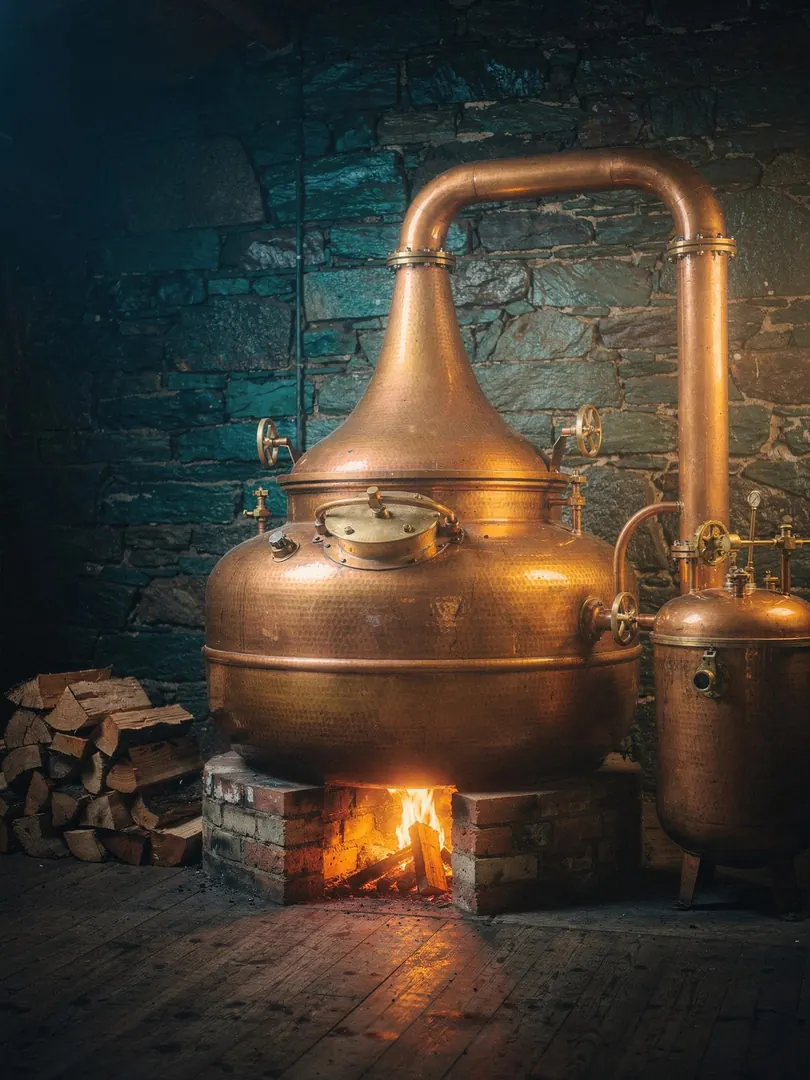
Walk into a distillery and the first thing you notice is the gleaming copper vessel. Above it sits a head, from which a pipe leads to the condenser. This unit is called a pot still. It works in batches, what experts call discontinuous operation. A run begins with filling and ends once little alcohol continues to pass over. The remainder is then drained and the still refilled.
During a run, the vapor keeps changing. At the start it's rich in alcohol and highly volatile compounds, later it becomes more watery and heavy. This very shift is what makes the pot still a tool for precise cutting. The master distiller can decide minute by minute what goes into the heart. In a continuously operating column, this simply isn't possible.
The shape of the still also shapes the spirit. A tall, bulbous head and a long, rising neck cause more vapor to condense against the cooler walls and run back down, a process experts call reflux. Only the lightest fractions make it through to the condenser, giving a finer, leaner distillate. A flatter head lets more heavy compounds through, producing bolder, oilier spirits. No shape is right or wrong, each suits a different style.
Why copper? The metal plays an active role
Copper is no accident, and no mere nostalgia. It conducts heat well, is easy to shape, and reacts with unwanted sulfur compounds that would otherwise smell of rotten eggs or rubber. With stone fruit, copper also binds some of the hydrocyanic acid. Germany's Federal Institute for Risk Assessment specifically names copper catalysts as a measure against ethyl carbamate in stone fruit spirits.
With fruit mash, there's a practical problem too. The solid fruit particles can scorch on the bottom, giving the spirit a burnt note. Many fruit distilleries therefore heat indirectly, using a water bath or steam, and keep the mash moving with an agitator. This is less of an issue for brandy, since wine is liquid. Cognac, classically, is distilled over an open flame.
Charentais still: the pot still of Cognac
The best-known example is the Charentais still, French alambic charentais. The appellation rules for Cognac require it: copper construction, open flame heating, and a maximum capacity of 30 hectoliters. Distillation happens twice. The first pass yields the raw spirit, French brouillis. In the second pass, this becomes the bonne chauffe, the actual Cognac distillate. Distillation must be completed by March 31 following the harvest.
Calvados Pays d'Auge, too, may only be double distilled in a pot still. The broader Calvados appellation, by contrast, also permits the column still. Such rules aren't verdicts on which technique tastes better. They simply fix how a spirit from a particular region is traditionally made, so that its name means something specific.
Hafenbrand: how fruit spirit is made in Switzerland and the Alps
Hafen is an old word in the southern German-speaking world for pot. A hafenbrand apparatus is simply a pot still, a pot with a head and condenser. The appellation rules for Zuger Kirsch / Rigi Kirsch AOP permit only such equipment, approved by the Swiss Federal Office for Customs and Border Security. The Wachau Marillenbrand apricot spirit is similarly strict: its rules require simple stills and forbid continuous distillation.
In Vorarlberg, Fraxner Kirsch is traditionally double distilled in December, and in Tyrol's Wildschönau valley, Krautinger made from stubble turnips is likewise distilled twice. Both examples show how closely a process can be bound to a particular region. Everywhere, though, the pot still remains the same idea: heat, vaporize, cool, and then cut.
For flavor, the pot still above all means one thing: control over the fractions. Because the vapor changes gradually over the course of a run, heads, heart, and tails can be separated cleanly. This often makes pot-distilled spirits more complex and full-bodied. The price is time and labor, since every batch must be filled, distilled, and emptied individually.