Mashing and Fermenting
Mash and fermentation: why fruit must first become wine
Fruit must ferment before distillation because the still doesn't create alcohol, it only separates it. For this, the fruit is crushed into mash, often acidified, and fermented under airtight conditions. Whatever goes wrong here, no master distiller can fix later.
What is mash? Crushed fruit with everything that belongs to it
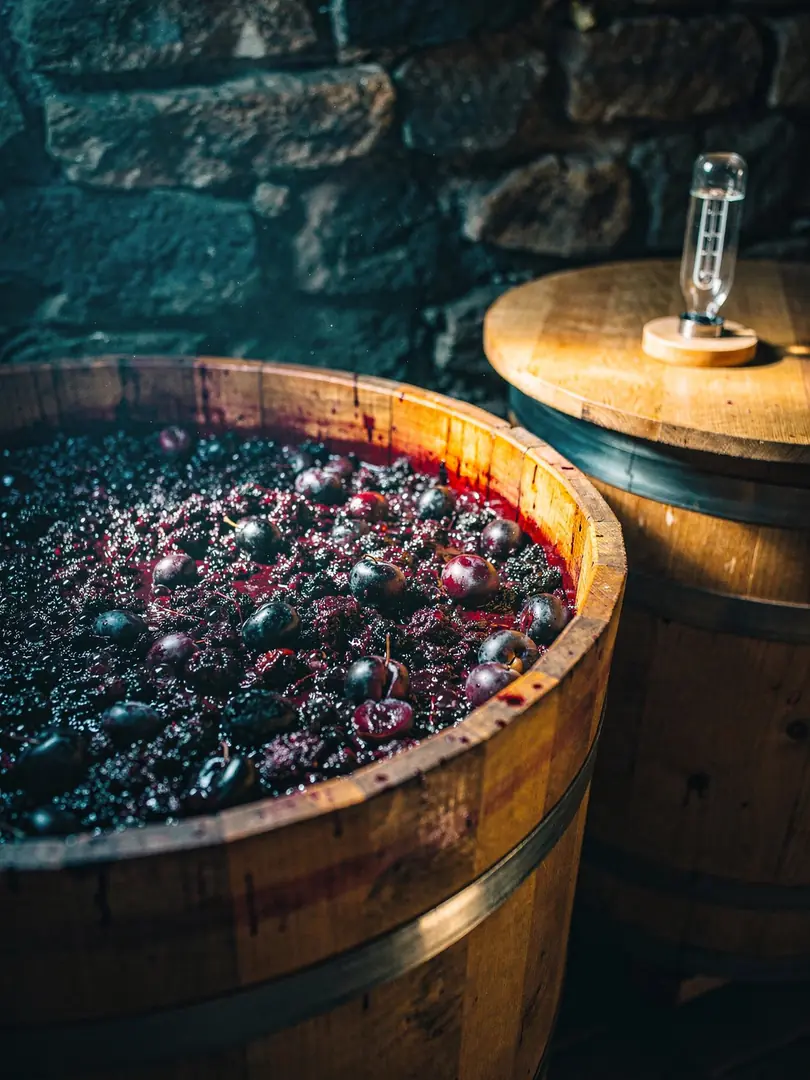
In late summer and autumn, distilleries fill vats and tubs with fruit pulp. This mass is called mash. It refers to crushed fruit together with juice, skin, and flesh, and with stone fruit, the pits as well. Unlike with wine, the juice is not pressed off. The solid parts remain until distillation because they hold many of the aroma compounds.
When crushing cherries, plums, or apricots, distillers take care to keep the pits as intact as possible. Crushed pits release hydrocyanic acid and give the spirit a strong bitter almond note. A hint of this is desired in kirsch, but too much is a flaw and a health concern. Pome fruit like apples and pears, by contrast, is ground finely so the yeast has good access to the sugar.
The fruit itself is just as crucial. Fruit for distilling must be fully ripe, healthy, and clean. Rotten or moldy fruit introduces off-flavors that any distillation will concentrate. For Zuger Kirsch, table cherries are explicitly excluded; only approved distilling cherry varieties from traditional standard trees may be used.
Why must fruit ferment before distilling?
Fresh fruit contains sugar but no alcohol. Only yeast converts the fruit sugar into alcohol and carbon dioxide. This process is called alcoholic fermentation and works just as it does in a wine cellar. The result is a kind of fruit wine, much weaker than the eventual spirit, but carrying all the aroma compounds that distillation is meant to concentrate.
This is also the legal core of fruit spirit. Under Spirit Drinks Regulation (EU) 2019/787, it must be produced exclusively through alcoholic fermentation and distillation of the fruit. Added alcohol is prohibited. This is precisely where it differs from fruit geist: there, the fruit isn't fermented but steeped in neutral alcohol. With Calvados, in turn, it's not the mash that ferments but the pressed juice, which becomes cider before being distilled.
Acidifying and sealing out air: keeping the mash clean
A mash is a feast for microbes, and not all of them are welcome. Acetic acid bacteria turn alcohol into acetic acid and ethyl acetate, which smells like nail polish remover. Other bacteria produce butyric acid or lactic notes. Good distillers keep these unwanted guests away, mainly through two means: acidity and excluding air.
Many distilleries acidify the mash slightly. Yeast tolerates an acidic environment well, most spoilage bacteria do not. At the same time, fermentation takes place in closed vessels fitted with an airlock, a valve that releases carbon dioxide but keeps oxygen out. This keeps the mash fresh until it reaches the still.
The Swiss appellation rules for Zuger Kirsch / Rigi Kirsch AOP show exactly how this works. The cherries must be mashed no later than 48 hours after harvest. Acidification is only allowed with phosphoric or lactic acid, within a defined acid range. GMO-free cultured yeast and enzymes are permitted, and a limited fermentation temperature plus airtight vessels are required. The mash must be distilled by May 31 of the following year.
Yeast, time, and the end of fermentation: what the mash means for the spirit
Some distillers rely on the wild yeasts naturally present on the fruit skin. Others add cultured yeast, a selected and propagated strain that ferments reliably and cleanly. Both approaches have their supporters. Cultured yeast reduces the risk of off-flavors; wild fermentation is considered by some to produce more complexity. There is no general law prescribing either method for fruit spirit.
Once the sugar is used up, the bubbling in the airlock stops. After that, the mash shouldn't sit indefinitely, since every additional week gives bacteria another chance. A master distiller therefore checks smell and taste before distilling. If a mash smells sharply of vinegar or has a musty, cellar-like note, the distillate will carry that trace too.
With brandies, the raw material is a finished wine. For Cognac and Armagnac, white wine is fermented without added sulfur, since sulfur would produce unpleasant notes during distillation. Here too the rule holds: whatever is in the wine will reappear, concentrated, in the spirit. A spirit's quality is largely decided already in the fermentation vessel.