The full journey
How is schnapps distilled? The journey from fruit to spirit
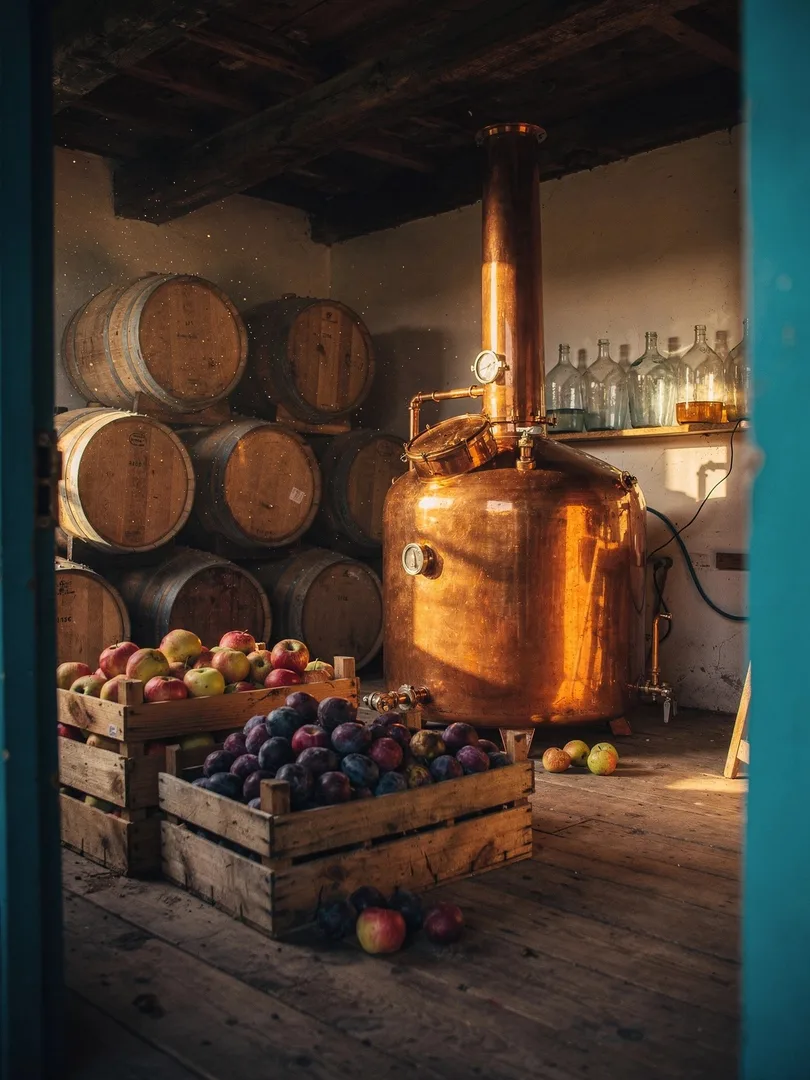
Schnapps is distilled by crushing fruit, letting the mash ferment, and separating the resulting alcohol through heating. The vapor is cooled, the master distiller separates the heads and tails, and the heart rests before being brought to drinking strength with water.
How is schnapps distilled? The short version
It begins with ripe fruit and ends with a clear liquid at 40% ABV or more. In between lie weeks to months and four major steps: mashing, fermenting, distilling, and bringing to drinking strength. For cask-aged spirits, maturation in wood follows. Each of these steps leaves its mark in the glass, and many flaws in a spirit can be traced back to one of them.
The word schnapps is colloquial. European Spirit Drinks Regulation (EU) 2019/787 doesn't use it; instead it speaks of fruit spirit, pomace spirit, brandy, or geist. Anyone asking how schnapps is distilled almost always means the classic fruit spirit made from cherries, plums, pears, or apples. This journey focuses mainly on that, with wine and pomace brought in for comparison.
Important note up front: this journey explains what happens in a distillery and why. It is not a how-to guide. In Germany, alcohol may only be produced with authorization, whether as a bonded distillery, a compensation distillery, or as a raw material owner who has their own fruit distilled at a licensed distillery. Private distilling without authorization is prohibited under § 4 para. 2 of the German Alcohol Tax Act, even for personal use.
From fruit to mash: alcohol forms in the vessel, not the still
A common misconception holds that alcohol is created in the pot still. That's not true. The still only separates what's already there. Alcohol is formed beforehand by yeast, as it ferments the fruit sugar in the mash, the crushed fruit pulp. This produces alcohol and carbon dioxide, along with hundreds of aroma compounds that later reappear in the spirit.
That's why fruit must first become a kind of wine before it can be distilled. How much alcohol results depends mainly on the fruit's sugar content. Ripe, sweet fruits yield a lot, sour or dry ones yield little. For low-sugar berries like raspberries, many distillers take a different route, the geist: the unfermented fruit is steeped in neutral alcohol and then distilled.
Distilling: why alcohol evaporates first
Distillation relies on a simple physical fact. Alcohol boils at around 78°C (172°F), water not until 100°C (212°F). When the fermented mash is heated, a vapor rises that contains more alcohol and more aromatic compounds than the liquid below. This vapor is condensed back to liquid in a cooler. What runs out is called the distillate.
Distillation happens either in batches in a pot still or continuously in a column, a tower with multiple plates. Many fruit distilleries in German-speaking regions combine both: a pot still topped with a rectifying column. Whether distillation happens once or twice is often regulated by the rules governing specific appellations. Cognac must be double distilled in a pot still, while Armagnac typically passes once through a column.
From distillate to bottle: the cut, resting, drinking strength
Not everything that flows from the cooler becomes spirit. The first fraction, the heads, smells of solvent and is cut away. At the end comes the tails, with heavy, fusel-laden compounds. In between lies the heart, the hearts cut. Exactly where the cut is made is decided by the master distiller using nose, palate, and instruments, and few decisions shape a house's style more profoundly.
After that, the distillate needs time. Clear fruit spirits usually rest in glass demijohns or stainless steel tanks so the fruit character stays in the foreground. Brandy, Cognac, and Calvados, on the other hand, mature in oak casks. Finally, the spirit is reduced to drinking strength with soft water, to at least 37.5% ABV for fruit spirit, and then bottled.
Anyone who understands this chain also understands the differences between spirits. Brandy is made from wine rather than fruit mash. Pomace spirit is distilled from the solid pressed remains of grapes, with the pomace present during distillation. Calvados is distilled from cider, meaning from fermented juice rather than mash. The raw material determines what goes into the still; the process determines what comes out.