Single-variety brandies from mash
Apple brandy from Germany, Austria and South Tyrol
Apple brandy from Germany and Austria is usually a fruit brandy made from fermented apple mash, often from a single variety and without cask aging. Protected designations of origin are rare: South Tyrolean Golden Delicious and Gravensteiner, East Tyrolean Pregler and Franconian Obstler are among them.
How is apple brandy made in Germany?
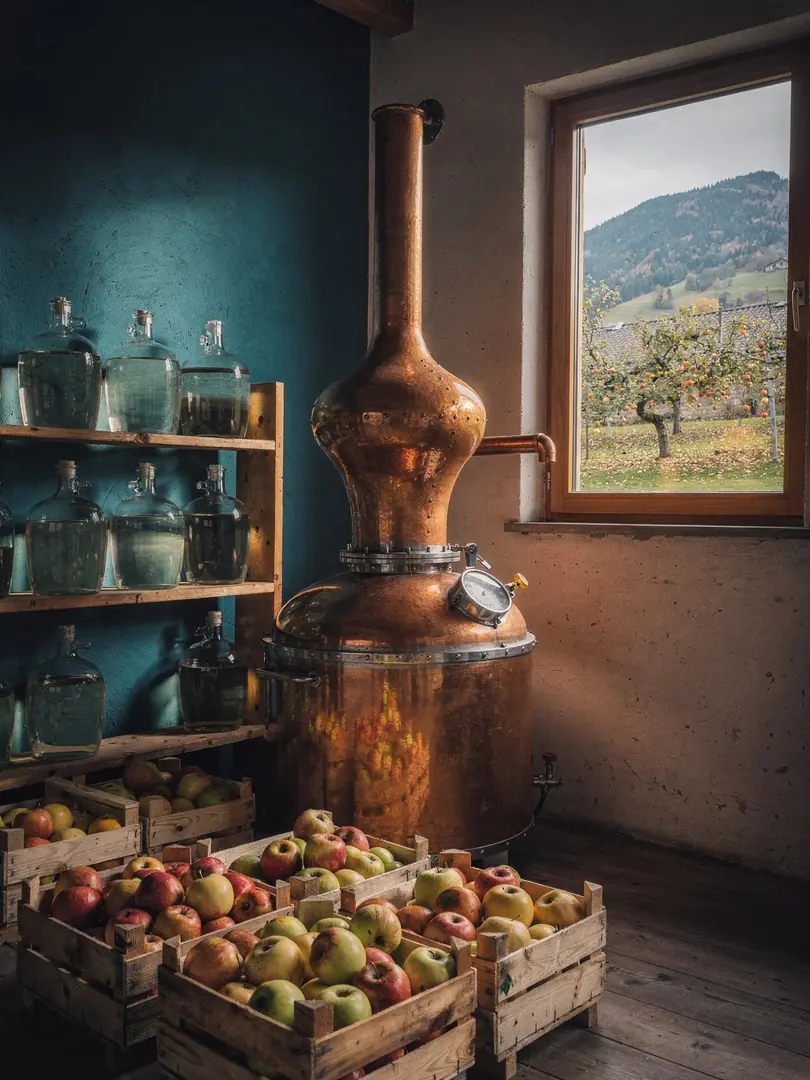
Unlike in Normandy, apple wine is rarely distilled here. The apples are washed, crushed and fermented as mash, meaning skin and core included. Distillation usually takes place in copper pot stills, often fitted with a rectifying column that enriches the distillate in a single pass. The brandy then rests in glass demijohns or stainless steel tanks, remains colorless and is reduced to drinking strength, at least 37.5% ABV, though many distillers go well above that.
Many apple brandies come from small Abfindungsbrennereien, agricultural operations licensed to distill a limited annual quantity. There are also Stoffbesitzer, fruit owners who have their own fruit distilled at such a distillery. In Germany, distilling fruit is not permitted even for personal use without a license. The reduced alcohol tax for these small operations is justified by lawmakers as a way to preserve traditional orchard meadows. So some old apple varieties survive today partly because their fruit finds a buyer at the distillery.
Single-variety apple brandy: Boskoop, Gravensteiner, Golden Delicious
Where Calvados relies on blending, German and Austrian distillers love the single variety. A Boskoop brings bold acidity and a spicy, slightly smoky note. Gravensteiner has an intensely floral aroma, Cox Orange smells of nut and spice, Topaz and Elstar come across fresh and juicy. The variety name may appear on the label, such as "Apfelbrand Gravensteiner." For Golden Delicious, EU regulation even allows a short designation without the word Brand.
Large growing regions such as the Altes Land near Hamburg or Lake Constance supply plenty of fruit, but there is no protected origin for apple brandy there. The applications "Bodensee Obstler" and "Bodensee Birnenbrand" are listed as withdrawn in the EU register. In Germany, only Fränkischer Obstler is protected for apple, a brandy in which at least 85% of the mash comes from apples and pears. Those seeking origin with these brandies are more likely to find it in the name of the farm.
Apple brandy from Austria: Maschanzker, Kronprinz Rudolf, Pregler
Austria cultivates its old apple varieties with particular visibility. The register of traditional foods lists Steirischer Maschanzker Apfelbrand and Steirischer Kronprinz Rudolf Apfelbrand, both made from varieties rarely found in supermarkets. In Carinthia there is also Lavanttaler Bananenapfelbrand, named after an apple variety with a faint banana aroma. Such brandies show how differently apples can taste when distilled individually, ranging from nutty to exotic.
A genuine EU designation of origin belongs to Pregler from East Tyrol, a protected geographical indication. It is a fruit brandy made from apples and pears from the district of Lienz, sourced from plantations, traditional orchard meadows and individual trees. The fruit, distillation and production must all take place within the district. In Austria, the word Edelbrand also comes up often. According to the food code, it denotes a brandy made entirely from fermented mash; if up to a third agricultural alcohol is added, the product is called Obstschnaps instead.
South Tyrol, Trentino and Hungary: protected apple brandies
South Tyrol, one of Europe's major apple-growing regions, protects two apple brandies by variety: South Tyrolean Golden Delicious and South Tyrolean Gravensteiner, both listed in the EU register since 1989. There is also South Tyrolean Obstler, made from apples and pears. In neighboring Trentino, "Distillato di mele trentino" is protected, an apple brandy from the province of Trento. All of these are fruit brandies made from mash, and thus relatives rather than copies of Calvados.
Further east, Hungary protects Szabolcsi Almapálinka, an apple brandy from the northeast of the country. Like any Pálinka, it must be made 100% from fruit grown in Hungary, with no sugar, flavoring or foreign alcohol added. The list reveals a pattern: wherever apple brandy is protected, it's almost always about mash and variety, whereas in France, England and Spain it's about cidre and cask. Two paths, one raw material.