Age on the label
Calvados age statements: Fine, VSOP, XO, and Hors d'âge
The age statement on Calvados indicates the minimum age of the youngest brandy in the bottle. According to common industry practice, Fine denotes at least two years in cask, Vieux or Réserve at least three, VSOP at least four, and XO and Hors d'âge at least six years.
What the age statement on Calvados means
Almost every Calvados is a blend of brandies from different years. For the label, what counts is neither the average age nor the oldest component, but the youngest. This is mandated by the EU Spirit Drinks Regulation for all spirits: an age or maturity statement may only describe the youngest alcoholic component, and the aging must have taken place under excise supervision or comparable control. So a Calvados labeled "6 ans" contains no brandy younger than six years.
What's counted is time spent in the oak cask, not time in the bottle. A brandy that sat in a collector's cellar for twenty years doesn't become older as a result, since it barely matures further once in the bottle. Because the appellation requires at least two years in oak, three in the Domfrontais, there's no younger Calvados on the market. A label with no age statement at all therefore usually implies exactly this minimum maturation, and not a day less.
Fine, VSOP, XO, Hors d'âge: the usual tiers
Calvados age tiers resemble those of Cognac but follow their own figures. According to figures consistently cited by the trade, the following applies: Fine, also called "Trois étoiles" or "Trois pommes," at least two years. Vieux or Réserve at least three years. VO, VSOP, or Vieille Réserve at least four years. XO, Hors d'âge, Très Vieille Réserve, Extra, or Napoléon at least six years. We have not verified the exact legal basis for these tiers in the original source; the figures should be taken as guidelines.
An important difference emerges when comparing the two. Since April 1, 2018, a Cognac XO must be at least ten years old, while a Calvados XO, under common industry rules, needs only six. The same letters, then, don't mean the same age. Napoléon also denotes six years for Cognac, while for Calvados the term is usually assigned to the highest tier. Anyone comparing brandies from different origins is better off reading the number than the abbreviation.
Vintage Calvados and age statements in years
Beyond the tiers, there are two more precise forms. Often a number appears on the bottle, such as 12, 15, or 20 ans. Here too, the youngest component counts, though older brandies may be included. Rarer is vintage Calvados, called Millésime in French. It comes entirely from a single distillation year, which appears on the label, often alongside the bottling year. From this you can work out exactly how long the brandy spent in cask.
Vintages appeal to connoisseurs because they reveal the character of a particular harvest: a hot summer with ripe, sugar-rich apples, or a cool year with more acidity. A blend of several years evens out such differences and keeps a house's style consistent over decades. Both approaches have their merit. For beginners, a blend is often the more reliable choice, while vintages are best enjoyed side by side for comparison.
Is older Calvados better?
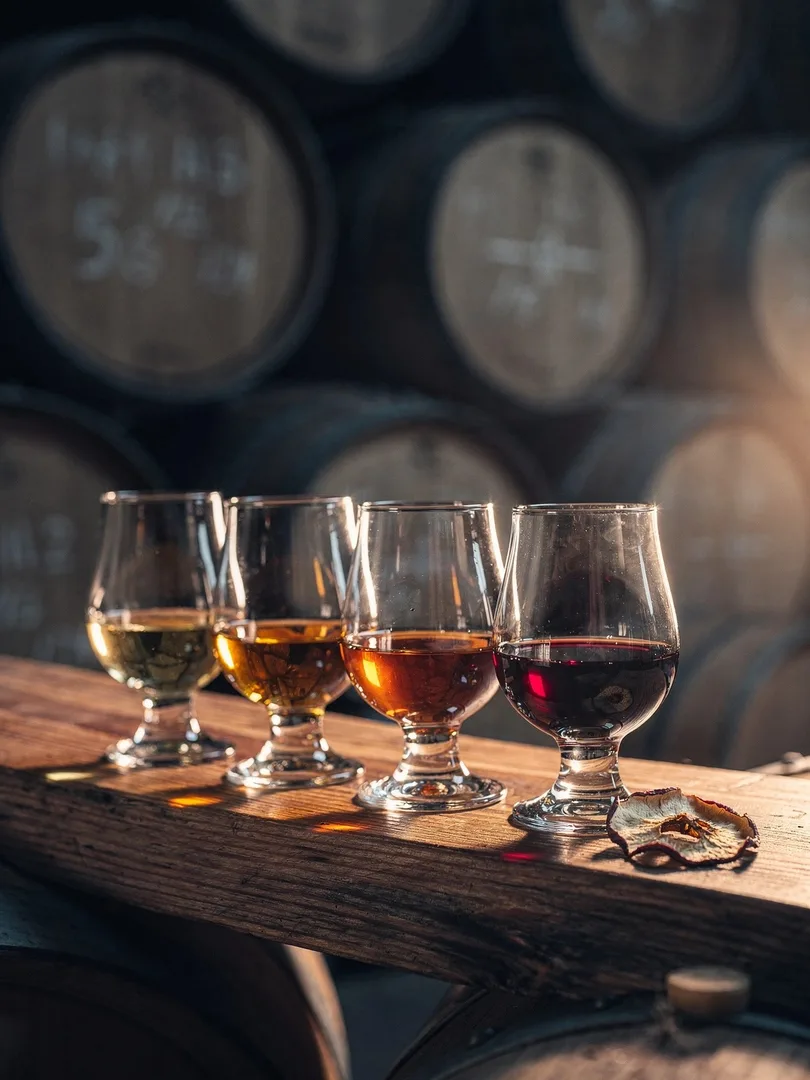
Older means different, not automatically better. Young Calvados shows off fresh apple most clearly, comes across as lively, and works well in cooking and mixed drinks. At four to six years, baked apple, vanilla, and spice notes emerge, and the alcohol feels better integrated. Very old brandies develop notes of leather, tobacco, dried fruit, and walnut, with fresh fruit receding into the background. Anyone specifically seeking apple character may sometimes be disappointed by very old bottles.
A look at the origin helps with placing a bottle. A six-year-old Domfrontais often comes across as brighter than a Pays d'Auge of the same age, thanks to the pear. And a brandy from large old casks stays fruitier than one from small, new ones. The age statement is therefore a reference point, not a promise of flavor. The most instructive approach is a direct comparison of two age tiers from the same house, since the fruit, distillery, and cellar style all remain constant.