Apple, Fermentation, Distillate
From Cider to Calvados: How Calvados Is Made
Calvados is made in three steps: cider apples and perry pears are fermented into cider, the cider is distilled, and the distillate matures in oak casks. The character is shaped by tart, tannin-rich cider apples, a long and slow fermentation, and the choice between pot still and column still.
Which Apples Go into Calvados?
Table apples from the supermarket would be a poor choice for Calvados. Normandy works with cider apples, small fruits that are often bitter or fuzzy-tasting when eaten raw. Distillers broadly sort them into four groups: sweet apples for sugar, and thus alcohol; bittersweet and bitter apples for tannins, which give the spirit structure; and tart apples for freshness. A good cider comes from a blend, much as a winemaker blends different grape varieties. Depending on the region, perry pears are also added.
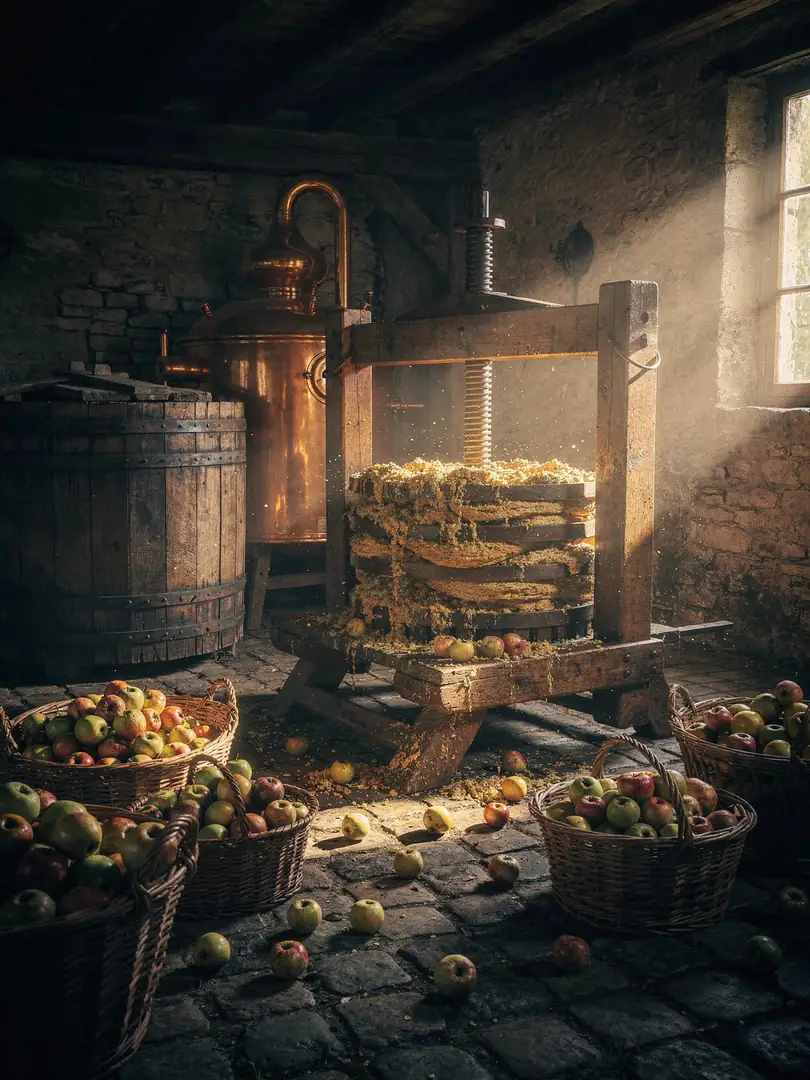
Many of the fruits still come from traditional orchard meadows, where the trees stand far apart with cattle grazing beneath them. There are also low-growing orchards, which are easier to harvest. Picking by hand is rare: ripe apples fall into the grass in autumn and are gathered up, often over several passes. They're then left to rest for a while so that starch converts to sugar and the flavour develops. Only then do they go to the mill and the press, where the juice is separated from the pomace.
How Long Does the Cider for Calvados Ferment?
The fresh juice ferments in large tanks or wooden casks, usually with the yeasts that naturally live on the fruit and in the cellar. During the cool winter months this happens slowly, and that's exactly the point: a calm fermentation produces more delicate aromatic compounds than a fast, warm one. The specifications prescribe a minimum duration—several weeks for simple Calvados, and at least 42 days for Pays d'Auge under the current specifications.
The result is a dry cider in which the sugar has largely fermented into alcohol. It must reach at least 4.5% ABV for distillation. A sweet bottled cider, the kind known as a beverage, would be unsuitable for the distillery, since unfermented sugar yields no alcohol during distillation. Some producers let the cider rest on its lees for several months after fermentation. This adds extra depth that later carries through into the brandy.
Pot still or column still: two paths to the distillate
In the pot still, a copper kettle with a swan neck, the cider is heated. Alcohol and aromatic compounds evaporate before water, rise up, and condense back into liquid in a cooling coil. The first pass yields a weak "raw spirit" (brouillis). Only the second pass, the fine distillation, produces the actual distillate. Here the distiller separates the heads, containing light, undesirable compounds, and the heavy tails, keeping only the heart. In Pays d'Auge, this method is mandatory.
In the column still, by contrast, cider flows in continuously from the top while steam rises from below. Across several plates the alcohol concentrates, and the distillate flows out continuously. A single pass is enough. Column-distilled Calvados is considered fruitier and lighter in its youth, while pot-still Calvados is seen as denser and longer-lived, though the lines blur with the distiller's skill. Both methods must finish under 72% ABV. This rules out nearly neutral alcohol and preserves the apple character.
Why Calvados must go into oak
Fresh from the still, the brandy is crystal clear, sharp, and very fruity. In the oak cask it changes slowly. Wood imparts color, tannins, and aromas such as vanilla; a little oxygen seeps in through the pores, and some of the alcohol evaporates. Calvados houses often use large old casks, known as foudres, which impart little wood character, alongside smaller casks that leave a stronger mark. This keeps the apple at the center, rather than letting it vanish under oak.
The appellation requires a minimum of two years, three in the Domfrontais. After that, the cellar master decides which casks to blend. The brandy is gradually brought down to drinking strength with water, at least 40% ABV for sale. Small amounts of caramel coloring or oak extract may be used to adjust color and roundness, as long as the effect doesn't exceed 4% ABV on the measured value. What these years in cask mean for the age statement is covered in the following chapter.